

Sometimes spiritual change begins quietly. A familiar ambition loses its shine, a conversation stays with you, or a few minutes of stillness make you wonder what you have been overlooking. You may call that an awakening: a growing wish to live with more awareness, meaning and connection.
The stages of spiritual awakening below offer one reflective framework, not a universal timetable. Different traditions describe awakening differently, and people may revisit several themes at once. There is no reliable stage test, no deadline and no requirement to become a different person overnight.
You can value intuition, prayer or psychic readings while staying open to uncertainty. Awakening does not guarantee psychic abilities, endless happiness, freedom from suffering or special access to all knowledge. The useful question is less “How advanced am I?” and more “How am I living what matters to me?”
How to use this five-stage framework
Read the stages as lenses rather than a ladder. You might feel clear about your friendships but uncertain about work. You might enjoy meditation one month and need a break the next. Ordinary responsibilities, professional care and supportive relationships do not make a spiritual path less genuine.
The five themes are noticing inherited roles, questioning, looking inward, integrating insights and choosing purposeful action. Take what helps you reflect; leave what does not. You are allowed to slow down, change your interpretation or stop a practice that feels unhelpful.
Stage one: Noticing the roles you have inherited
This theme is sometimes described as the “false self”: the identity built around approval, expectations and familiar roles. That language can be useful, but it should not make your everyday self seem fake or worthless. Being a parent, worker, partner or community member may express real values, not merely an ego to overcome.
The invitation is to notice where a role fits and where it has become too tight. Perhaps you are always the reliable one and rarely ask for help. Perhaps success means something different to you now than it did when you first chose your career. A small awareness of “something more” can be a question about how you want to live, not proof that everyone around you is asleep.
External pleasures are not the enemy. A warm home, friendship and a satisfying job can matter deeply. The reflection is whether your worth depends entirely on receiving approval or controlling what happens next.
A useful question
“Which parts of my identity feel chosen, and which parts do I keep mainly because I fear disappointing someone?”
Try noticing one moment when you automatically agree. You do not need to start a confrontation; you might simply say, “Let me think about that.” Recognizing an automatic habit gives you a chance to choose a response.
Stage two: Questioning what no longer fits
Questioning can begin when a belief, routine or ambition no longer feels satisfying. You might revisit the values you grew up with, explore a spiritual tradition or ask whether a relationship allows you to be yourself. Curiosity can coexist with loyalty: examining an inherited belief does not require rejecting your family, culture or religion.
This period may feel uncertain. It can be tempting to replace one rigid explanation with another, especially when a teacher or reader offers a complete answer. Give yourself permission to say, “I am interested, but I am not convinced yet.” A spiritual interpretation can remain a possibility rather than becoming a rule for every experience.
Taking responsibility for your choices does not mean taking blame for harm done to you. Nor does dissatisfaction mean that your life is failing. Some questions call for an inner conversation; others call for a practical change, a fairer arrangement or outside support.
A useful question
“What do I know, what do I believe, and what am I still trying to understand?”
Make three short lists with those headings. For example, you may know that you feel exhausted after a weekly commitment, believe that solitude would help and still be unsure whether you want to end the commitment. Keeping those distinctions visible can prevent a powerful feeling from becoming a rushed conclusion.
Anxiety, depression or trauma are not proof that spiritual programming is breaking down, and suffering is not an initiation you must endure. If distress is persistent or interfering with daily life, seek qualified support alongside any spiritual reflection.
Stage three: Looking inward without withdrawing from life
Introspection is the practice of paying attention to your own motives, feelings and patterns. Journaling, prayer, gentle meditation or time outdoors may give you a setting for it. You may discover grief for opportunities you missed, relief at naming a need or affection for parts of yourself you once dismissed.
Looking inward does not mean that every answer is hidden inside you. Other people can offer perspective, and facts still matter. A journal can help you explore why a job feels wrong; it cannot tell you whether a new employer will offer the salary or conditions you need. Reflection and information work well together.
Letting go is another theme here. Sometimes it means loosening a demand for certainty, not leaving a relationship or resigning from work. Before a major decision, consider finances, responsibilities, safety and the people affected. A sense of urgency from a reading, dream or meditation is not a reason to skip those checks.
A useful question
“What am I ready to change in a small, responsible way?”
Choose an experiment rather than a dramatic reinvention: reserve an evening for rest, ask a direct question, explore a class or spend a week noticing when you ignore your own limits. Review what actually happens.
You may also notice a wish to convince other people to awaken. Try replacing that impulse with curiosity about their perspective. Disagreement is not evidence that they are less conscious. You do not need to hide every spiritual interest, but you can choose respectful conversations with people who welcome them.
Keep practices gentle
Meditation is optional, and more intensity is not automatically better. The National Center for Complementary and Integrative Health notes that some people report negative experiences with meditation and advises against using it to replace conventional care. If a practice increases distress, pause it and discuss what is happening with an appropriate professional.
Loneliness may be a sign that you need companionship, not proof that awakening must cost you everyone. Keep room for ordinary connection: a meal with a friend, a conversation about something other than spirituality or a shared activity you enjoy.
Stage four: Integrating insight into everyday choices
Integration means trying to live an insight rather than continually searching for the next revelation. If you have recognized a need for healthier boundaries, the next step might be a clear conversation. If gratitude matters to you, it might become a habit of thanking someone specifically rather than a demand to feel grateful for everything.
Some people describe this period as a closer relationship with their higher self or a greater trust in their spiritual path. You can use that language while remembering that confidence does not make an impression infallible. Intuition can invite a question; it does not establish another person’s motives or give unlimited information.
Integration can include peace, but also doubt, frustration and grief. You have not failed because an old reaction returns. Neither complete forgiveness nor permanent surrender is required. You can acknowledge harm, keep a boundary and continue learning.
A useful question
“What would this insight look like in an ordinary Tuesday?”
“I want to be more compassionate” might mean listening before replying and still being honest about your limits. “I trust myself” might mean making a decision after checking the facts, not refusing all advice. “I feel connected” might mean giving attention to a friendship you have neglected.
If you feel drawn to support others, be clear about the limits of your role. Sharing personal reflections is different from offering professional mental-health care or claiming spiritual authority. You do not need to become a mentor to make your own insights worthwhile.
Stage five: Choosing purpose through grounded action
The phrase “conscious creation” can describe making deliberate choices about how you spend your time and contribute to life. It need not mean that thoughts create every circumstance or that inspiration removes obligations. Work, caregiving and practical duties may still require effort even when they serve something meaningful.
Purpose can be chosen, discovered, revised or expressed in several ways. You do not have to decide that life has no inherent purpose, nor do you need one grand mission. Creating art, caring for someone, building a welcoming community or doing useful work can each carry meaning.
Intention is a starting point, not a guarantee of attraction or success. Relationships require mutual interest and consent. Communities take cooperation. A project may need skills, resources and revisions. Spiritual inspiration can sit beside those realities rather than replace them.
A useful question
“What matters enough to me that I am willing to take one realistic step?”
For example, if you feel called to create a discussion group, begin by asking a few people whether they are interested. Agree on respectful conversation and costs before making promises. If you want a new direction at work, investigate options before treating a sign as an instruction to quit.
This theme is not a finish line. A purposeful life can still include uncertainty, rest and ordinary disappointments. You can return to questioning or introspection whenever your circumstances change.
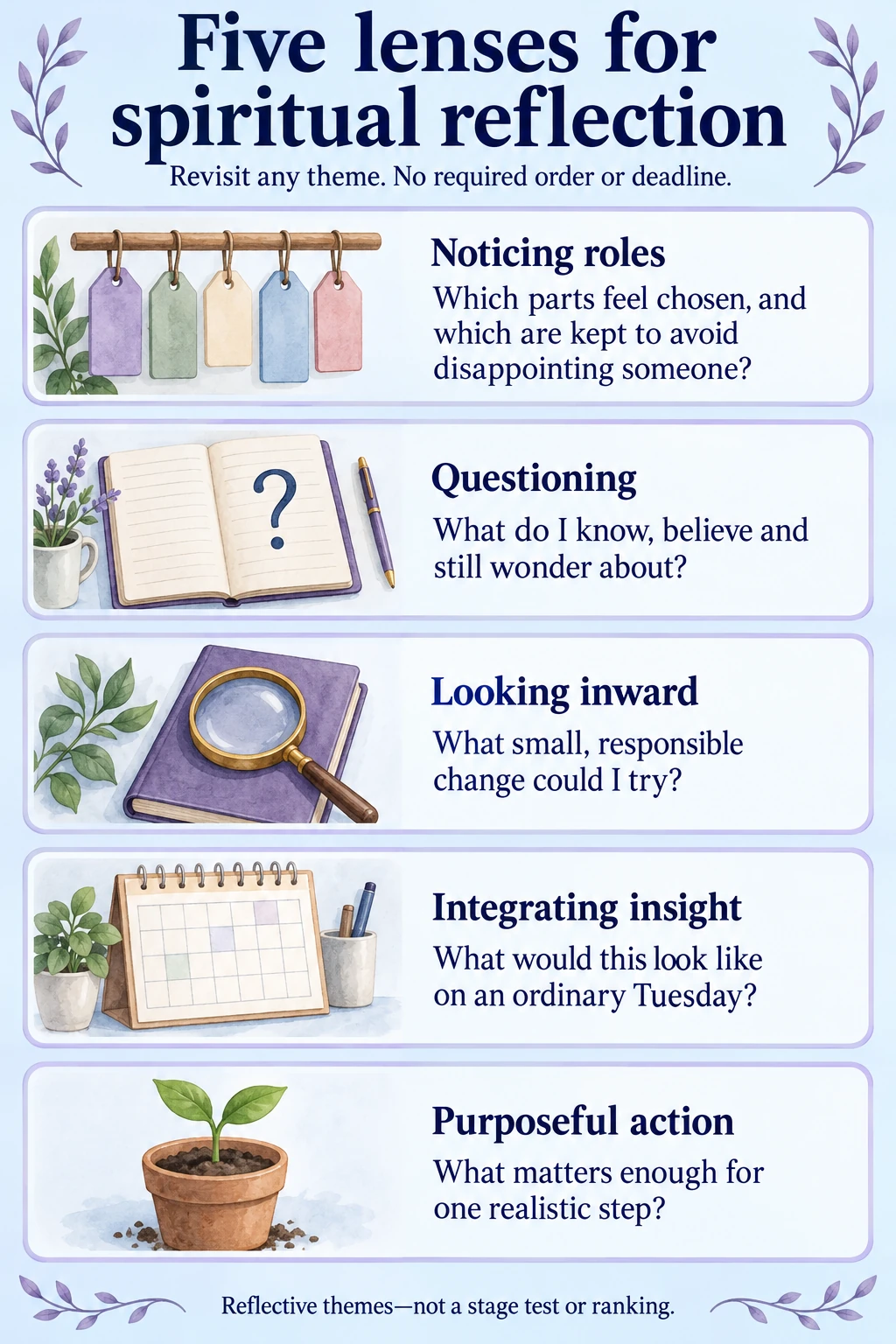
Read the five reflection lenses as text
Revisit any theme. No required order or deadline.
- Noticing roles: Which parts feel chosen, and which are kept to avoid disappointing someone?
- Questioning: What do I know, believe and still wonder about?
- Looking inward: What small, responsible change could I try?
- Integrating insight: What would this look like on an ordinary Tuesday?
- Purposeful action: What matters enough for one realistic step?
Reflective themes—not a stage test or ranking.
A short awakening journal you can return to
- Notice: What experience or question has my attention?
- Separate: What happened, and what meaning am I giving it?
- Reflect: Which value, need or boundary might this reveal?
- Check: What facts or outside perspective would help?
- Act: What small step is realistic and respectful?
- Review: Did that step help me live more thoughtfully?
A few sentences are enough. You do not have to assign yourself a stage or keep a record of every coincidence. Let the journal support your life, not become a constant search for proof that you are progressing.
Where a psychic reading can fit
If readings are part of your spiritual life, ask about reflection rather than ranking: “What pattern could I look at differently?” or “What might help me put this insight into practice?” Treat an interpretation as a perspective you can consider, not a diagnosis or a command.
Be cautious if someone claims that only they can complete your awakening, that disagreement proves you are blocked or that urgent paid sessions are necessary to avoid danger. You can decline, pause or seek another perspective. No reader needs to approve your decisions about healthcare, money or relationships.
When to seek support rather than a stage explanation
Spiritual meaning and professional care can coexist. Seek prompt professional help if you are experiencing severe confusion, difficulty telling what is real, frightening voices or visions, or major disruption to sleep and everyday functioning. The National Institute of Mental Health’s guide to psychosis explains why changes in perception and thinking deserve assessment. A stage label is not a diagnosis, and these experiences should not be assumed to be psychic gifts.
You do not need to give up your beliefs to ask for help. The aim is to understand what is happening and support your safety and well-being. If there is immediate danger, contact emergency services.
Frequently asked questions
Does everyone go through five stages of awakening?
No. These five themes are a reflective framework, not an established universal sequence. Other traditions use different language, and your experience may not fit a stage model at all.
How long does spiritual awakening take?
There is no fixed schedule. Reflection and change may unfold gradually, and you can revisit questions over many years. A deadline or promise of permanent enlightenment is not something this guide can offer.
Do anxiety and loneliness mean I am awakening?
Not necessarily. Those experiences can have many explanations and deserve care in their own right. Do not assume they are required signs of spiritual growth or postpone support because of that interpretation.
Can I slow down or stop a spiritual practice?
Yes. Rest, ordinary routines and supportive company can remain part of a meaningful spiritual life. You are not trapped on an irreversible path, and pausing does not make you less worthy.
Whatever language you choose, let awareness lead toward greater care, curiosity and responsibility. You do not have to become extraordinary to live more thoughtfully.
It’s intriguing how the stages are laid out. The transition from questioning to introspection appears to be a significant turning point where one begins to look within for answers.
Stage one, being mostly unconscious, is relatable. Many people might not even realize they are in this stage. The journey to awareness seems essential for understanding deeper truths.
I agree. Recognizing that one is in the false-self stage might be the hardest part. It’s like breaking through a veil of societal conditioning.
Indeed, the transition from false-self to questioning marks the beginning of a significant change in one’s perspective on life.
The stages presented seem to align with a logical progression from unconscious living to a conscious, awakened state. It’s an interesting framework to understand personal transformation.
The introspection stage seems particularly challenging. Releasing old beliefs and facing internal conflicts can be a tough but rewarding process.
True. It’s during these challenging introspective moments that we often make the most significant breakthroughs in our understanding of ourselves.
Absolutely. The internal conflict during introspection can lead to profound insights, though it can be a lonely and confusing time.
The concept of moving from false-self to introspection suggests a deep transformation. It implies that self-awareness and questioning are crucial for personal growth.
The journey to awakening described in this article resonates with many spiritual teachings. The emphasis on inner peace and freedom from suffering is a common goal across various philosophies.
The five stages of awakening seem to reflect a psychological journey as well. It would be interesting to see how these stages align with theories in developmental psychology or cognitive behavior.
The path to awakening as described is quite profound. It encompasses stages that many might identify with, even if subconsciously. The notion of moving from societal norms to personal introspection is particularly compelling.