

The idea of exploring beyond the physical body can be compelling. In psychic and spiritual conversations, astral projection is often described as a journey of consciousness or a subtle body into another realm.
You can be curious about that idea without treating it as established travel. An experience may feel vivid and meaningful while leaving its explanation uncertain. This guide separates spiritual vocabulary from sleep experiences, practical care and claims that a reader or teacher cannot verify.
What is astral projection?
Astral projection is a spiritual interpretation in which consciousness or an “astral body” is believed to leave the physical body. An out-of-body experience, by contrast, describes the felt experience of being located outside your body. Describing that sensation does not by itself establish that a soul traveled elsewhere.
There is no verified technique here that removes a soul from the body, reaches another plane or observes a distant location. A sense of floating, a vivid scene or seeing yourself from another perspective is not a reliable test of external travel.
Astral bodies, chakras and planes: spiritual vocabulary
Some accounts connect astral bodies with emotions, chakras or different planes of existence. Others use “etheric projection” to describe another kind of subtle-body experience. These terms are interpreted differently across spiritual teachings; they are not established anatomical structures or measured destinations.
Chakras should not be described as parts of the central nervous system that manage your physical and mental health. Nor does a person’s mood establish a measurable spiritual frequency or a rank in an afterlife. Feeling sad does not place you in a lower realm.
Historical and religious stories also need their own context. A broad spiritual analogy is not evidence that ancient cultures shared one modern astral-projection technique. You do not need an origin story or a claim of scientific status to decide what personal meaning an experience has.
Astral projection, lucid dreaming and sleep paralysis
Lucid dreaming
Lucid dreaming involves recognizing that you are dreaming while the dream continues. The Max Planck account of its dream research describes working with lucid dreamers who signaled their awareness during sleep. That research concerns dreaming and brain activity, not verified travel to an astral plane.
A dream’s vividness or your awareness within it does not establish that it happened outside sleep. Being a hero, seeing an unfamiliar scene or changing shape is not a test that distinguishes imagination from soul travel.
Sleep paralysis
The NHS explains sleep paralysis as being unable to move or speak while waking or falling asleep. You may feel awake, sense someone in the room or feel pressure. Those sensations do not establish a demon, possession or an astral visitor.
If episodes are frequent and make you anxious about sleep, or you feel tired because of poor sleep, seek medical advice. Do not rely on a spiritual explanation to assess a recurring sleep problem.
Out-of-body and near-death accounts
People may describe out-of-body sensations or interpret an experience near a medical crisis spiritually. Their personal meaning does not establish a universal explanation, prove an afterlife or show that practice determines what happens during an emergency.
Never attempt to create a near-death experience. A medical emergency needs emergency care, not a projection exercise.
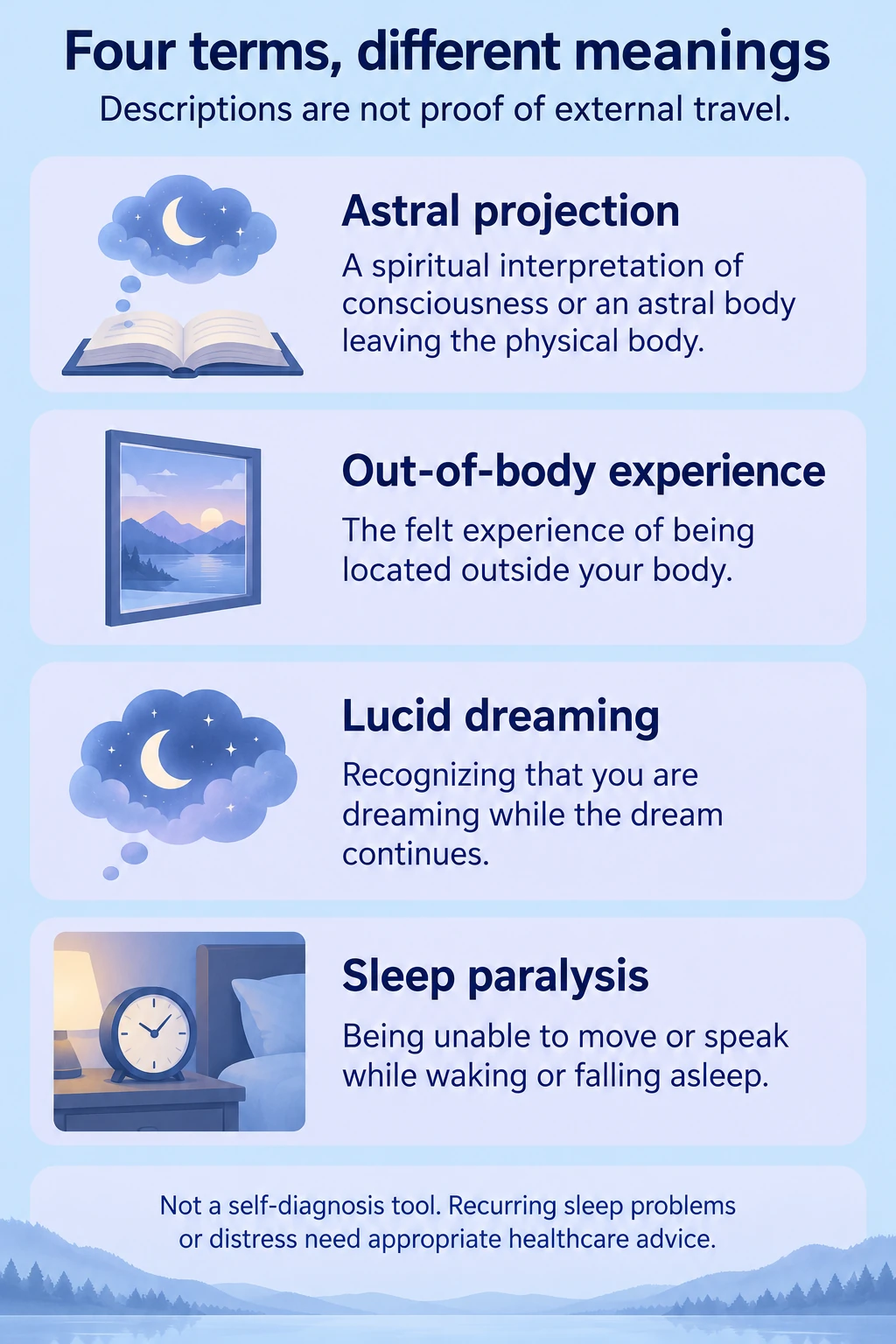
Read the four-term comparison as text
Four terms, different meanings. Descriptions are not proof of external travel.
- Astral projection: A spiritual interpretation of consciousness or an astral body leaving the physical body.
- Out-of-body experience: The felt experience of being located outside your body.
- Lucid dreaming: Recognizing that you are dreaming while the dream continues.
- Sleep paralysis: Being unable to move or speak while waking or falling asleep.
Not a self-diagnosis tool. Recurring sleep problems or distress need appropriate healthcare advice.
How is remote viewing different?
Remote viewing is generally used for a claim of perceiving a distant or hidden target, rather than a felt journey of leaving the body. That distinction is about the claim being made; it does not verify either ability.
Do not treat an imagined view as factual information about a location or another person. It is not permission to invade privacy, make an accusation or decide that someone is safe or unsafe.
A gentle alternative: imagination and reflection
If the theme interests you, you can explore it as an optional waking visualization without trying to induce paralysis, force unusual sensations or disrupt sleep.
- Keep an ordinary setting: Choose a comfortable place where you do not need to drive, supervise a hazard or remain alert for another task.
- Set a modest intention: “I want to reflect on what freedom means to me” is enough. No travel needs to happen.
- Imagine briefly if comfortable: Picture a peaceful place or an imagined view. Keep it labeled as imagination rather than a verified location.
- Stop freely: Open your eyes, orient to the room and return attention to an ordinary activity if you want to finish or feel uncomfortable.
- Record meaning, not proof: Note a feeling or question without claiming the scene revealed facts about the world.
For example, imagining a wide landscape might prompt a question about space in your daily life. You could decide to leave one evening unscheduled. That choice does not depend on having visited the landscape.
If quiet practice increases distress or feels disorienting, stop. NCCIH’s meditation guidance notes that unwanted experiences can occur and that meditation should not replace conventional care. Seek qualified support when needed.
Ropes, sounds and crystals are not guarantees
Some techniques use imagined ropes, audio marketed as binaural beats, or crystals such as calcite, tourmaline and labradorite. A rope can be an image in a visualization, and an object can carry personal symbolism. Neither establishes that a soul left the body.
There is no guarantee here that a sound track produces astral travel or that a stone protects you from spiritual harm. You do not need to buy anything. Avoid methods involving sleep deprivation, substances, forceful breathing or overriding discomfort to obtain a result.
Can you get lost, possessed or attacked?
Stories about demons, attachments and souls becoming trapped are spiritual claims, not verified consequences of an experience. Tiredness is not proof that an entity attached to you. A ritual or a guide’s reassurance cannot certify your safety either.
Focus on what you can check: sleep, distress, your surroundings and whether an experience is affecting everyday functioning. Seek appropriate healthcare advice for concerning symptoms rather than paying someone to remove a supposed threat.
You do not need to imagine re-entering your body to end an ordinary visualization. You can stop the exercise. If you are experiencing a recurring inability to move around sleep, use medical guidance on sleep paralysis rather than assuming you must complete a spiritual procedure.
Choosing a discussion or class
Ask what the teacher means by projection, what the activity involves and how you can opt out. Be cautious about guaranteed travel, mandatory daily practice, fear-based protection sales or claims that an experience qualifies you to heal others.
A teacher or psychic cannot verify a journey, diagnose a sleep condition or grant healthcare qualifications. You may disagree, decline exercises, keep details private or leave. No spiritual milestone is required for your worth or growth.
Frequently asked questions
Does a floating sensation prove astral projection?
No. A sensation can be vivid without establishing that consciousness traveled outside the body.
Is lucid dreaming the same as astral projection?
No. Lucid dreaming describes awareness within a dream. Astral projection is a spiritual interpretation of travel beyond the body.
Does seeing a frightening figure mean a demon is present?
No. A perceived figure or presence does not establish a supernatural source. Experiences around sleep may need sleep-health guidance, especially when recurring or distressing.
How long does it take to learn astral projection?
There is no verified timetable or guarantee of travel. You do not need to increase practice or purchases until something happens.
Explore meaning without forcing an experience
You can find wonder in dreams, imagination and spiritual questions while protecting ordinary sleep and wellbeing. Leave room for uncertainty, stop when you need to, and let curiosity remain compatible with practical care.
The article provides a comprehensive overview of astral projection, but it lacks scientific evidence. More empirical research could help validate these experiences.
The connection between chakras and the central nervous system is interesting. I wonder if there are any modern studies that explore this potential link further?
The idea of vibrations influencing our state of being is compelling. It would be interesting to see if there’s any correlation between this concept and quantum physics.
Practicing astral projection daily, as suggested, implies dedication. For those interested, it would be useful to have specific techniques or methods to ensure safety and effectiveness.
The historical references to astral projection are fascinating, particularly the mentions of Ancient Egypt and Greece. It seems like a concept that has intrigued humanity for a long time.
While the article mentions dangers associated with astral projection, it would be helpful to have more information on what these dangers entail and how to mitigate them.
Astral projection as described here seems experiential and subjective. How can these experiences be distinguished from vivid dreams or subconscious imaginations?
The term ‘projectology’ is new to me. It’s intriguing to learn that there’s a branch of study dedicated to this phenomenon. Are there any notable findings from this field?