

If you hope for lasting love, it can be tempting to look for the hidden reason a relationship feels difficult. You may wonder about soulmates, past lives or an Akashic records reading. Those ideas can offer a language for spiritual reflection, but a relationship still unfolds through the choices and behavior of the people in it.
No reading can guarantee that love will last forever. A more useful goal is a relationship both people freely want to continue—one with respect, room for honest conversation and care that is visible in everyday life.
What does relationship “energy” mean to you?
In spiritual conversation, energy may describe warmth, distance, tension or a feeling of connection. Give that feeling a concrete example: “We have not had time to talk this week” or “I feel heard when you ask before making plans.” A chakra or aura interpretation cannot establish another person’s intentions.
Self-love without a test you must pass first
You do not need perfect self-esteem, complete healing or a life without loneliness to deserve care. Self-love can mean noticing what you need and treating yourself with consideration while you continue learning. Another person’s mistreatment is not caused by your vibration or a failure to love yourself enough.
When you are single
Clarify what you want from dating and what pace fits your life. You can enjoy being single, seek a partner or feel unsure without treating any of those states as a spiritual failure.
When you want to meet someone
Choose social activities or dating options that suit you. Move at your own pace and keep ordinary privacy and meeting precautions. Openness does not require overriding discomfort or consent.
When a couple feels disconnected
Describe the pattern rather than deciding whose energy is wrong. Ask about changed needs, goals and responsibilities. A connection needs participation from both people.
When a relationship may end
Allow grief and uncertainty without assuming you must reunite. Forgiveness, contact and reconciliation are separate choices. Support can help you make room for an ending.
Keep friendships, interests and your own voice. Love is respect’s healthy-relationship guidance includes individuality, equal say and respected boundaries. Partnership does not mean you stop being your own person.
If you want extra support, consider qualified therapy or another appropriate resource without forcing yourself to uncover hidden wounds. A quiet walk, rest or a class may be enjoyable forms of care, but no single activity guarantees confidence or the right partner.
What supports a relationship you both want to keep?
Love, communication and trust matter, but they are not a formula that guarantees permanence. The National Domestic Violence Hotline’s healthy-relationship guide emphasizes mutual respect, honesty, equality, boundaries and consent alongside communication and trust.
Notice how those qualities appear in practice. Can you express a need without being mocked? Can you decline intimacy or a plan? Do decisions leave room for both people? A spiritual label does not answer those questions for you.
Communication: ask rather than assume
Try describing a specific situation and a request: “When plans change without a message, I feel uncertain. Can we agree on how to let each other know?” That gives you something concrete to discuss instead of asking your partner to prove the connection is destined.
Listen to their answer, including a different need or preference. A conversation is not a guarantee of agreement, and one person cannot do all the communicating for both.
Trust: look at conduct over time
Trust is not a requirement to ignore concerns. Notice whether agreements are followed, mistakes are acknowledged and changes are sustained. Privacy does not automatically mean dishonesty, and demanding passwords is not proof of love.
If trust has been hurt, ask what repair would involve in real life. A reading that says the bond is strong does not substitute for accountability or establish that someone has been faithful.
Love and care: make room for both people
Affection can coexist with differences about commitment, children, money, location or daily life. Discuss those differences rather than expecting love alone to resolve them.
Care does not mean constant availability or abandoning friendships, interests and boundaries. Each person should retain room to be themselves and make choices.
Where do Akashic records fit?
In Akashic-record beliefs, a reading may be framed as exploring spiritual information about a soul’s experiences. Treat that framework as belief and interpretation—not a verified archive of your life, a recovered memory or evidence about your partner.
If the symbolism appeals to you, use it to ask reflective questions: “What pattern do I want to change?” “What do I need to say more clearly?” or “What does commitment mean to me now?” You can explore the same questions without accepting a past-life explanation.
A reader cannot establish that an ex is your destined partner, discover another person’s private feelings or guarantee a waiting soulmate. An interpretation should not become a reason to resume unwanted contact or remain in a relationship you do not want.

Exploring patterns without blaming your past life
Repeated disappointments can invite reflection, but they do not prove that hidden records or spiritual blocks caused them. Start with what you can observe: what you agreed to, what happened, what you needed and how the other person responded.
For example, imagine often saying yes to plans you do not enjoy because you fear disappointing a partner. A useful next step might be naming a preference and noticing whether it is respected. You do not need to identify a past-life contract before making that change.
If someone cheats, mistreats or controls you, their behavior is not your fault. Looking at your own choices can support agency; it should not turn into responsibility for another person’s harm.
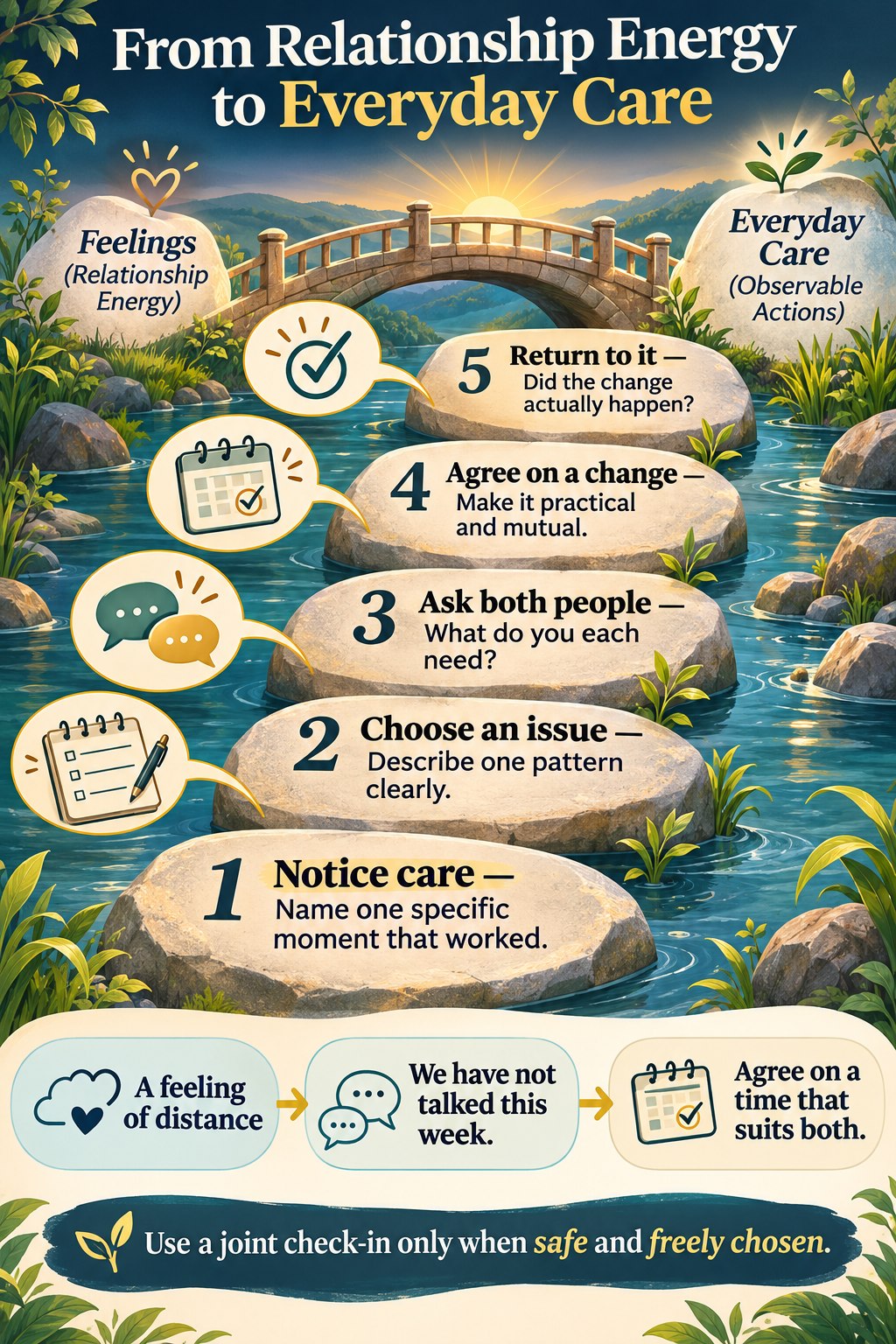
Free five-question relationship check-in
Where it is safe and both people want to participate, set aside a calm time for a short conversation. You can also reflect privately first.
- What is working? Name a specific moment of care or connection rather than a general promise.
- What needs attention? Choose one issue you can describe clearly.
- What does each person need? Ask about preferences and limits without assuming you already know.
- What change can we agree on? Make it practical, realistic and mutual.
- When will we review it? Check whether the change actually happens instead of relying on a prediction.
For example, a plan to communicate schedule changes is something you can observe. “We will raise our relationship’s vibration” may feel meaningful, but it needs a practical agreement if you want it to guide daily life.
When lasting is not the right goal
A relationship ending does not prove that you failed, chose the wrong soul or missed a spiritual lesson. People can care about each other and still want incompatible futures. Either person can choose not to continue.
Duration is not the same as wellbeing. A claim that someone is your soulmate or twin flame does not obligate you to tolerate harm, forgive before you are ready or stay until a supposed lesson is complete.
If there are threats, control, sexual pressure or fear, prioritize safety support rather than a generic instruction to confront your partner or communicate harder. The National Domestic Violence Hotline offers support in the United States: call 800-799-SAFE (7233), text START to 88788 or use its chat. Use a safer device if you are concerned about monitoring. In immediate danger, contact emergency services.
Questions for a relationship reading
If a reading is part of your spiritual life, keep the focus on your own reflection and choices:
- What do I hope this relationship will give me?
- Which needs or boundaries have I not expressed?
- What am I assuming rather than discussing?
- What practical next step can I consider without a guarantee?
Before paying, clarify the service and total cost. You can reject an interpretation, decline further sessions or stop a reading. Be cautious about claims that repeated payments will remove a block, guarantee lasting love or make another person commit.
Our guide to psychic love readings and boundaries offers more ways to keep spiritual reflection separate from assumptions about someone else.
Frequently asked questions
1. What does energy mean in a relationship?
People may use it as spiritual language for warmth, tension or connection. Describe actual experiences and behavior rather than treating the label as proof of a hidden force.
2. Do I need to love myself perfectly before dating?
No. You deserve care while you are still learning about yourself. Perfect confidence or complete healing is not a requirement.
3. Can my vibration cause someone to mistreat me?
Another person is responsible for their harmful behavior. Do not turn self-reflection into blame for being mistreated.
4. How can I practise self-love in daily life?
Notice a practical need such as rest, privacy, support or a slower pace, then consider a realistic action. Different activities suit different people.
5. Is wanting a relationship a sign that I am not whole?
No. Wanting companionship does not establish a personal or spiritual deficiency. You can value yourself and still want a partner.
6. Must I date when I am happy being single?
No. You can choose whether and when to date. A meaningful life does not require a particular relationship status.
7. What helps when partners feel disconnected?
Where it is safe, discuss a specific pattern, ask about changed needs and agree on one manageable step. Both people need room to participate.
8. Can I know what my partner needs without asking?
Do not assume so. Listen to what they communicate and check your understanding rather than relying on intuition as access to private thoughts.
9. Should my partner’s needs always come first?
Care should leave room for both people. You do not need to abandon friendships, privacy or boundaries to demonstrate love.
10. What is the free check-in for?
It helps identify what is working, one concern, each person’s needs, a practical agreement and a review point. It does not determine whether you must stay.
11. Can a reading guarantee a lasting relationship?
No. A reading may offer reflection, but permanence depends on choices, circumstances and behavior. Either person can choose not to continue.
12. Can Akashic records verify my partner’s feelings?
No. Akashic-record interpretations are spiritual beliefs, not a verified archive or evidence of another person’s private feelings.
13. Does a breakup mean a failed soul lesson?
No. An ending is not proof of spiritual failure. You can reflect on the experience without deciding the pain was destined.
14. Must forgiveness include contact or reconciliation?
No. Forgiveness, renewed contact and reconciliation are different choices. Boundaries can remain in place.
15. When should safety take priority over a check-in?
If there are threats, coercion, sexual pressure or fear, seek confidential safety support rather than assuming a direct conversation is safe. Use emergency services for immediate danger.
Trust and communication are undoubtedly critical for a successful relationship. While Akashic record readings might offer unique insights, empirical evidence supporting their efficacy would be helpful.
While communication and trust are indeed pillars of a lasting relationship, the idea of involving metaphysical readings adds an entirely new dimension. I wonder about its effectiveness.
It’s an intriguing take on relationship dynamics. However, relying solely on psychic readings might not be advisable. A balanced approach involving both psychological and metaphysical insights could be more beneficial.
The article highlights essential aspects like communication, trust, and love. Consulting Akashic records might give additional insights but it’s important to combine it with practical efforts.
The metaphysical approach to relationship issues, including Akashic record readings, presents an unconventional but intriguing method. It’s worth exploring but should be viewed with an open yet critical mind.
The article covers important factors for maintaining a relationship. I’m curious about the practical application of Akashic records and how they can tangibly improve relationship outcomes.
The concept of using Akashic records to understand relationship issues is fascinating. It’s interesting how it ties past life actions to present-day problems.
The article provides a comprehensive look at key relationship elements. Introducing Akashic records into the mix might offer new perspectives, though it seems to tread into speculative territory.