

Sometimes attraction feels unusually familiar: conversation flows, you want to be close, and the person seems to touch something important in you. If you believe in twin flames, you may interpret that intensity as a spiritual connection. The feeling can matter deeply without telling you what the relationship must become.
A twin-flame label does not establish mutual attraction, compatibility or consent. You are already a whole person, and neither you nor someone else owes intimacy because a connection feels destined.
What does twin-flame attraction mean?
In twin-flame beliefs, a connection is often described through imagery of mirroring, recognition or two parts of a soul. Treat that as spiritual language, not a verified explanation of attraction or proof that a particular person is your other half.
Some people feel immediate chemistry. Others develop attraction gradually, enjoy emotional closeness without sexual desire, or do not feel drawn to someone at all. None of those experiences requires you to pursue a relationship. There is no universal kiss, sensation or level of vulnerability that confirms a twin flame.
Familiarity can invite curiosity—not instant certainty
You might have interests in common, feel accepted or find it easy to talk. Enjoy those experiences while allowing time to learn who the person actually is. Familiarity does not mean you already know their secrets, values or intentions.
For example, two people may spend a wonderful evening discussing spiritual beliefs and feel an immediate spark. That evening tells them they enjoyed the conversation. Whether they want the same kind of relationship still requires discussion and observation over time.
Keep room for ordinary questions: Are they available for the relationship you want? Do their actions match their words? Can you disagree or slow things down without pressure?
Attraction, trust, compatibility and consent are different
- Attraction is your interest or desire. It does not establish how the other person feels.
- Trust develops through how you treat each other. Feeling familiar is not a substitute for reliable behavior.
- Compatibility concerns your needs, values and expectations. Intense chemistry can coexist with incompatible plans.
- Consent concerns what each person freely agrees to now. Neither a spiritual interpretation nor attraction supplies it.
You can find someone attractive and choose not to act. You can care for someone without wanting sex. You can also change your mind about intimacy or a relationship.
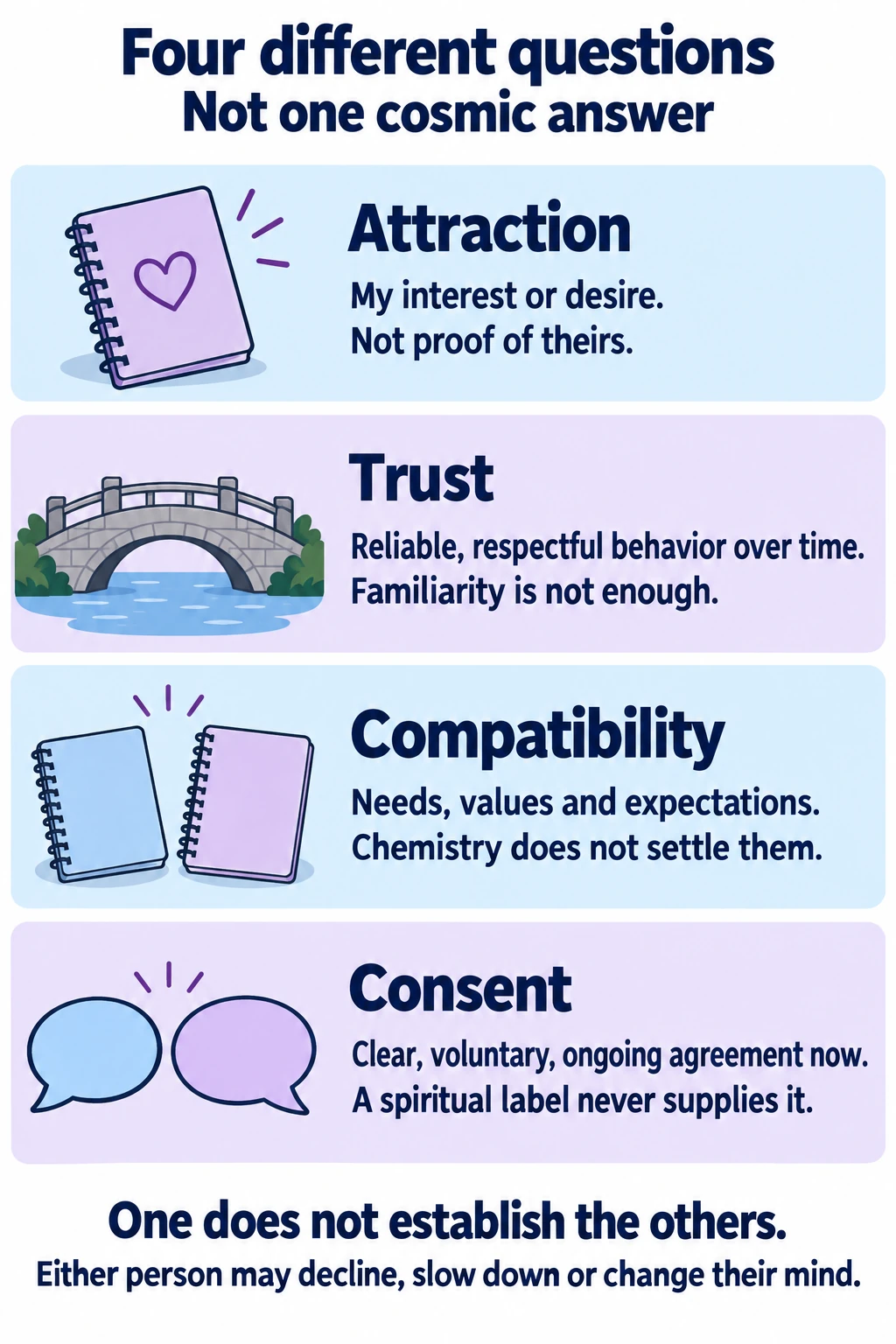
Read the four-concept comparison as text
Four different questions. Not one cosmic answer.
- Attraction: My interest or desire. Not proof of theirs.
- Trust: Reliable, respectful behavior over time. Familiarity is not enough.
- Compatibility: Needs, values and expectations. Chemistry does not settle them.
- Consent: Clear, voluntary, ongoing agreement now. A spiritual label never supplies it.
One does not establish the others. Either person may decline, slow down or change their mind.
Let closeness develop at a pace you choose
The desire to share everything can feel exciting, but you do not have to disclose secrets or painful experiences immediately. Privacy is not evidence that you are blocking a connection. Share what you want when you feel ready, and respect the other person’s pace.
Try “I like getting to know you, and I want to take this slowly.” A caring response makes space for that. Pressure to prove trust through sex, secrets, money or abandoning other relationships is not a requirement of spiritual intimacy.
Instead of expecting unconditional acceptance before you know someone, notice how they respond to a small boundary. Do they respect it, ask a thoughtful question or try to make you feel guilty?
Consent comes before a claimed spiritual bond
RAINN’s consent guide describes clear, voluntary, ongoing agreement without pressure, manipulation or fear. Agreement to one activity does not mean agreement to everything, and someone can withdraw consent.
Ask before moving forward and check in as intimacy develops. Do not treat silence, hesitation, previous intimacy or a bodily response as permission. If someone pulls away, freezes or seems uncertain, stop and check—not interpret the hesitation as “twin-flame resistance.”
“We are meant to be together” does not override a no. Neither does a psychic reading, dream or feeling that your souls have already agreed.
Jealousy is a feeling to handle—not proof of destiny
You may feel jealous when attraction is intense or the relationship is uncertain. Acknowledge the feeling without using it to justify surveillance, controlling friendships or demanding constant reassurance.
Ask what you know and what you are assuming. If you want exclusivity, discuss it directly rather than treating it as automatic. The other person may want something different, and you retain the choice to decide whether that works for you.
Our guide to intense soulmate connections and boundaries offers a practical way to separate feelings, facts and interpretation.
What if one of you is already in a relationship?
Meeting someone compelling does not prove that an existing relationship must end. A spiritual interpretation is not an exemption from honesty, commitments or the consequences of your choices.
Pause before escalating intimacy. Consider what agreements already exist, what you want and how to address your current relationship responsibly. Do not promise someone a destined future while avoiding the practical situation in front of you.
If a relationship is unsafe, seek appropriate safety support rather than relying on twin-flame advice or a generic instruction to confront a partner. You do not have to remain in harm, and a new attraction is not necessary to justify seeking help.
Five questions before acting on the attraction
- What do I know? Separate direct conversations and behavior from feelings or predictions.
- What do we each want? Ask rather than assuming the attraction is mutual or the expectations are shared.
- Can we choose freely? There should be room to decline, slow down or change direction without pressure.
- What needs practical attention? Consider existing commitments, privacy, health and relationship boundaries.
- What would a respectful next step be? It may be a conversation, more time, a pause or no further contact.
If you enjoy psychic readings, use them to reflect on your own values and choices—not to obtain permission on someone else’s behalf. A reader cannot verify consent, guarantee reunion or establish another person’s private desire.
Common questions
Must twin flames feel instant sexual attraction?
No. Twin-flame beliefs do not create a reliable rule about desire. Attraction may be immediate, gradual, absent or nonsexual, and nobody owes intimacy.
Does powerful chemistry prove a twin-flame connection?
No. You may interpret it spiritually, but chemistry cannot establish a supernatural identity or guarantee a healthy relationship.
Should I reveal everything because the connection feels safe?
You can keep privacy and move at your own pace. Let trust develop through respectful behavior rather than treating immediate disclosure as a test.
Can someone say no even if a reading says we are twin flames?
Yes. Their choices and boundaries remain theirs. A spiritual label or reading never replaces consent or authorizes unwanted contact.
Let the attraction be something you can explore, not something that makes your choices for you. A meaningful connection leaves room for honesty, mutual care and the freedom of both people to decide.
The explanation about the instant familiarity with a twin flame is intriguing. How does one distinguish this from a regular deep connection with someone?
The idea that meeting a twin flame could lead to a marriage breakdown is quite concerning. How does one balance this newfound connection with existing commitments?
The concept of twin flames is intriguing, especially the idea of an instant attraction. However, I wonder how this would impact existing relationships?
The description of emotional vulnerability with a twin flame is compelling. It suggests a deep level of personal growth and self-awareness.
Is the twin flame concept rooted in any particular cultural or spiritual tradition, or is it a relatively new idea?
Exploring the notion of twin flames can be fascinating. Does the article provide any scientific or psychological explanations, or is this purely a metaphysical concept?
While the concept of a twin flame is romantic, it’s important to approach it with a level of skepticism. Is there any objective way to verify such a connection?
It would be helpful if the article included examples or testimonials from people who believe they have met their twin flame.