
You have a deck, a quiet moment and a question that matters to you. Then you lay out ten cards—and suddenly there is more to interpret than you know what to do with. A beginner tarot spread gives your reading a little structure, so you can spend less time worrying about where the cards go and more time exploring what their imagery brings to mind.
If tarot feels like a spiritual practice to you, a simple layout can become a meaningful ritual: a chance to listen inwardly, notice a pattern or find words for something you have been feeling. You do not need a complicated spread to have a thoughtful reading.
Start here: Try one card for a daily theme, three cards to explore a question, or five cards when you want room for a challenge and an action. Treat interpretations as symbolic guidance, not reliable forecasts or access to someone else’s private thoughts. Use real-world evidence and appropriate professional advice for health, safety, financial and legal decisions.
Choose a beginner tarot spread that fits your question
A spread assigns a topic to each card position. That topic gives you a starting point; it does not make the card a factual answer. Write the positions down before drawing so you are not changing the layout to fit an answer you want.
- One card: A manageable daily reflection or a first introduction to your deck.
- Three cards: A small story with a past influence, a present theme and a possible scenario.
- Five cards: A closer look at a situation, a challenge and a practical next step.
- Yes/no conventions: An optional way to explore your reaction to an answer—not a decision-making shortcut.
- Celtic Cross: A longer layout to try when you can comfortably interpret smaller spreads.
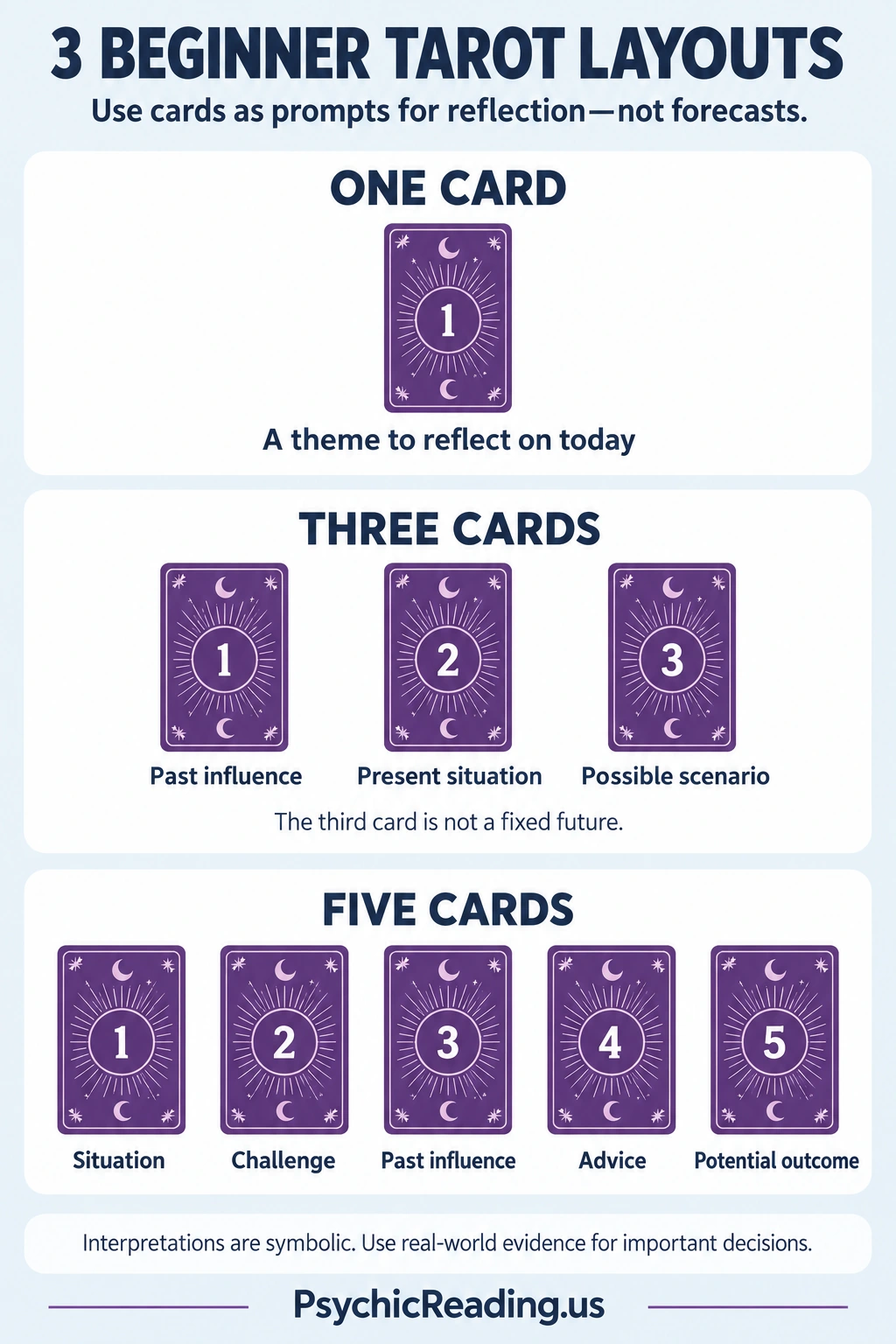
Read the infographic text
Use cards as prompts for reflection—not forecasts.
- One card: A theme to reflect on today.
- Three cards: 1. Past influence; 2. Present situation; 3. Possible scenario. The third card is not a fixed future.
- Five cards: 1. Situation; 2. Challenge; 3. Past influence; 4. Advice; 5. Potential outcome.
Interpretations are symbolic. Use real-world evidence for important decisions.
1. One-card spread: a theme for today
One card is enough when you want to learn without feeling overwhelmed. You can return to its imagery during the day, then see what you noticed in the evening. The aim is reflection, not making every event fit the card.
- Choose a gentle question. Try “What quality would I like to bring to today?” or “What deserves my attention?”
- Shuffle and draw one card. Choose a shuffling method that is comfortable for you. A particular ritual is not required.
- Notice before looking up. Which person, color or detail catches your eye? What feeling or association does it bring up?
- Consult your deck’s guidebook. Compare its interpretation with your first impression, then choose one small, realistic action.
Illustrative example: You draw the Ace of Wands and connect its imagery with a creative spark. Instead of assuming success is promised, you decide to spend fifteen minutes sketching an idea you have been postponing. The card becomes a prompt; your action is yours.
2. Three-card spread: past, present and possible future
Lay three cards in a row from left to right. This familiar format can help you organize a question without trying to interpret everything at once. The “future” position is best approached as a possibility to consider, not a fixed destination.
- Past influence: What experience or habit might still shape how I approach this?
- Present situation: What aspect of the situation deserves attention now?
- Possible scenario: What possibility does this image invite me to explore, and what would I need to check in real life?
Illustrative example: After a difficult breakup, you connect the Three of Swords with old hurt, the Sun with moments of renewed enjoyment, and the Ace of Cups with openness to affection. That reading need not predict a new partner. It might prompt you to make time for supportive friendships and ask what emotional readiness means to you.
If future-focused readings make you anxious, keep the same three-card layout and change the positions to situation, perspective, next step. You can also try what I feel, what I know, what I can do to distinguish an emotional impression from available evidence.
3. Five-card spread: situation, challenge and advice
When a question has several layers, five cards give each layer its own space. Arrange them in a row, or use any clear layout with the positions numbered. There is no need to add more cards simply because an answer is uncomfortable.
- Situation: A theme to consider in relation to your question.
- Challenge: An obstacle or tension to reflect on.
- Past influence: An experience that may be relevant, without treating the card as proof of hidden events.
- Advice: A possible action or attitude to evaluate.
- Potential outcome: A scenario to think through, not a promise that following the advice will produce it.
Illustrative example: In a reading about feeling unsettled at work, you associate the Five of Pentacles with exclusion, the Ten of Pentacles with long-term stability, and the King of Pentacles with steadiness. A useful takeaway could be to clarify your needs, review your options and ask for concrete information. The cards do not establish your employer’s intentions or guarantee prosperity.
Before acting on an “advice” card, ask: Is this within my control? Does it respect other people’s boundaries? Is it sensible even if my interpretation is wrong?
4. Yes/no spreads: understand the limits
Some readers assign positive, negative or neutral labels to one or three cards. Those labels are conventions within their practice, and readers may disagree about them. Counting “yes” cards cannot tell you whether you will get a job, whether a partner is faithful or whether a major decision is safe.
If you enjoy this format, keep it low-stakes and notice your response. You might ask whether to spend your free afternoon painting, then reflect on why a particular draw feels welcome or disappointing. Your reaction may tell you something about your preference; the draw does not authorize the decision.
For important questions, an open-ended spread is more useful:
- Instead of “Will I get the job?” ask “What can I prepare, and what information am I missing?”
- Instead of “Is this relationship destined?” ask “What do I value, what am I observing, and what boundary do I need?”
- Instead of “Should I spend this money?” review your budget and ask “What feeling is influencing this choice?”
5. Celtic Cross: a longer spread for later
A ten-card layout can be interesting once smaller readings feel manageable. Different guides use different Celtic Cross position orders, so follow one clearly labeled version rather than mixing several. Here is one reflective version you can practice:
- Present situation: Your starting theme.
- Challenge: A tension to explore.
- Underlying feelings: What the imagery brings to mind—not proof of a hidden memory.
- Past influence: An experience you recognize as relevant.
- Conscious goals: What you hope to work toward.
- Near-future possibility: A scenario to consider, not something certain to arrive.
- Your perspective: How you are approaching the question.
- External influences: Observable circumstances to check, not other people’s unspoken thoughts.
- Hopes and fears: What you want and what worries you.
- Potential outcome: A possibility to evaluate alongside your choices and the facts.
Read the positions one at a time, then look for themes. If the spread becomes confusing, pause and return to three cards another day. Complexity is not a measure of spiritual depth or reading quality.
Make your reading meaningful without overreading it
Keep a small tarot journal with your question, the positions, the cards and your interpretation. Add one possible action and one thing you still need to learn. Later, record what actually happened—including anything that did not fit. You do not have to turn every coincidence into confirmation.
When a card feels unsettling, describe the image before deciding what it means. Consider more than one interpretation, take a break if needed, and avoid redrawing repeatedly until you get reassurance. A symbol is not a sentence passed on your future.
If you book a reading with someone else, share the topic and ask how they approach uncertainty. Our guide to what to expect in a psychic reading can help you prepare. You can value the spiritual experience and still keep control of your choices.
Your first spread can stay simple
Start with one question and one small layout. Give yourself time to notice the images, explore their symbolism and decide what is useful. The most meaningful takeaway may be a better question, a kinder perspective or a practical step—not a prediction. Let your connection with the cards develop at a pace that feels comfortable to you.
Great overview of beginner spreads! The Three Card Spread is my go-to for quick insights. Just remember, it’s all about your intuition! 📚
This article is fantastic for anyone starting their tarot journey! The explanations are clear and really helpful. 🌟
#Love this post! Tarot can be such a powerful tool for self-discovery when used correctly. Keep spreading the good vibes! ✨
@SkepticalSam, you must be fun at parties! 😂 Seriously though, if it helps some people find guidance, why knock it?
“The Yes or No Spread? Really?” It seems overly simplistic for such a complex practice.
I don’t get the hype around tarot. Seems like just another way to make money off people’s insecurities.
@ChuckleBunny So true! Tarot isn’t just about divination; it’s also a great conversation starter at awkward family gatherings. 😄
While I appreciate the effort, I think it oversimplifies tarot reading. Not every question can fit into a neat little spread!