

Perhaps you are hoping for a fresh perspective on love, reassurance during a transition or a quiet space to explore a spiritual question. A reading can feel intriguing—and a little daunting—when you do not know what the conversation will be like. You can bring curiosity without handing over your judgment.
A psychic reading can take different forms: a phone conversation, a chat, a written response, or a session using cards or another symbolic practice. Knowing the format helps; knowing your own limits matters just as much. Here are ten things to check before and during a session.
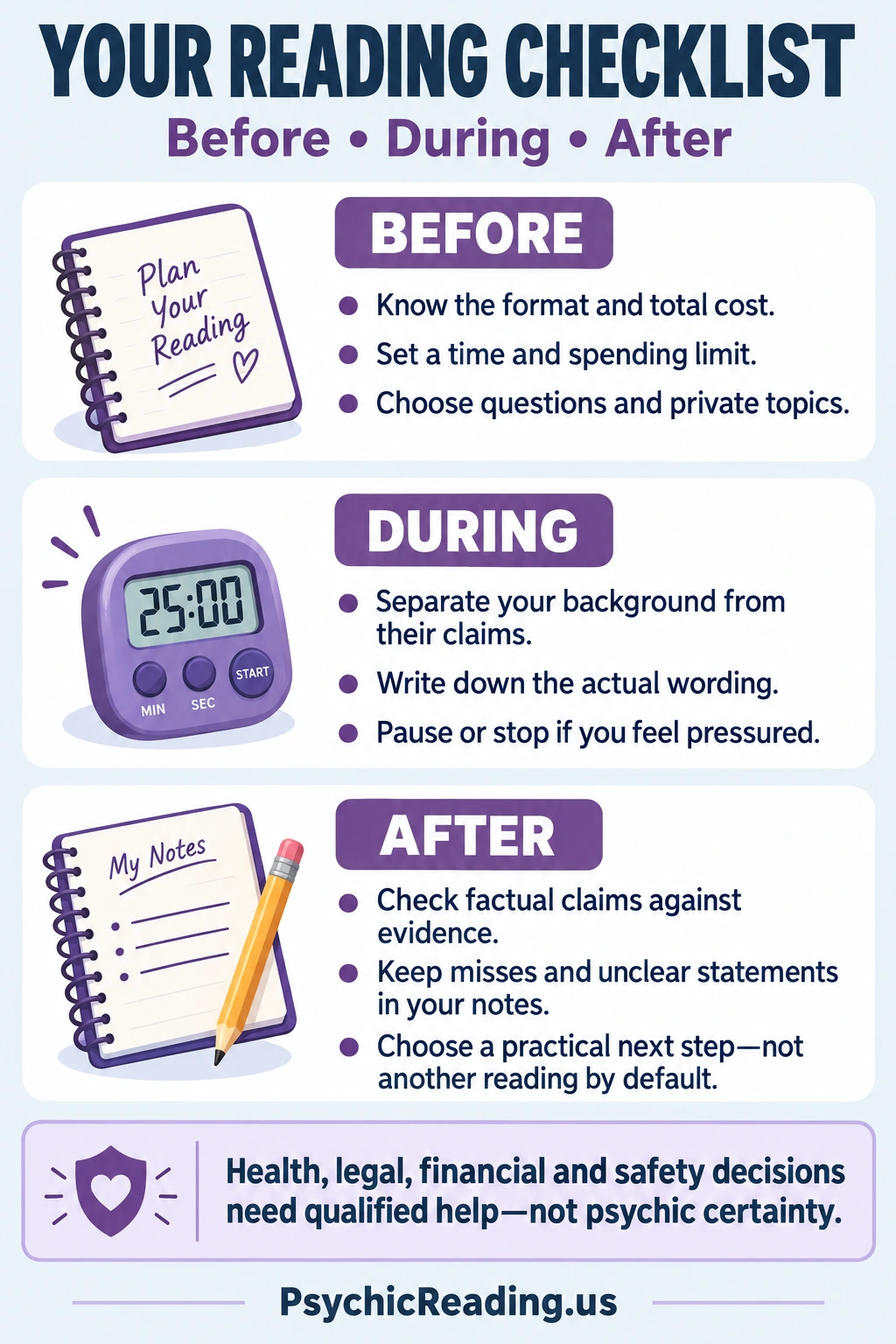
Read the infographic text
- Before: Know the format and total cost. Set a time and spending limit. Choose questions and private topics.
- During: Separate your background from their claims. Write down the actual wording. Pause or stop if you feel pressured.
- After: Check factual claims against evidence. Keep misses and unclear statements in your notes. Choose a practical next step—not another reading by default.
Health, legal, financial and safety decisions need qualified help—not psychic certainty.
1. A clear description of the service
Ask what you are purchasing and what the reader uses: conversation, tarot, astrology, or another approach. A spiritual method describes the practitioner’s framework, not proof that its claims are accurate. Check what the session includes before paying.
2. A price you understand
Find out whether you pay per minute, per message, or for a fixed session. Ask about minimum charges and introductory rates. There is no universal rule that a reading needs at least thirty minutes. Choose a limit you can afford and do not extend it because someone says a message is unfinished.
A simple picture of the session
The exact process depends on the service. You might begin by naming a topic, hear the reader’s interpretation, ask what a statement means and finish with time for questions. In a card-based session, the reader may explain symbols as they appear. None of these steps guarantees a particular insight, emotional experience or prediction.
For example, if you are thinking about changing jobs, you might ask, “What am I overlooking in this decision?” Treat the response as a reflection prompt, then compare it with your finances, available roles and conversations with people you trust. This is an illustrative question, not a promised reading result.
3. Room for your questions
Bring a short list of open questions. “What alternatives could I consider?” can lead to a more useful conversation than demanding certainty about a future date. You can also say that a topic is private or off limits.
- “What part of this situation would I like to understand better?”
- “Which of my values should I keep in view?”
- “What practical options have I not yet considered?”
Questions about your own choices leave more room for agency than asking a reader to reveal another person’s private thoughts.
4. Questions from the reader
A reader may ask for background. That information can shape the conversation, so distinguish what you supplied from what the reader introduced. Being asked questions is not, by itself, evidence of either extraordinary ability or dishonesty.
5. Interpretations—not verified answers
A statement may feel relevant, vague, surprising, or simply wrong. Ask what it means and write down the actual wording. You do not have to reinterpret every miss until it becomes a hit. If a prediction changes, retain the original in your notes.
6. Respect for your decisions
A reader’s statement cannot establish another person’s feelings, prove infidelity, or determine whether a relationship should end. Use direct communication and observable behavior. Do not let a soulmate label override your safety, consent, or boundaries.
7. The ability to pause or stop
You can disagree or end a session. Feeling upset is not proof that your energy is blocking a message, and it is not a reason to pay for additional work. Stop if you feel pressured, frightened, or repeatedly encouraged to spend more.
8. Appropriate limits on advice
Health symptoms, medication, legal deadlines, investments, and serious mental-health concerns belong with qualified professionals. A reading should not replace their assessment or delay necessary action.
9. Privacy and provider information
Check whether the service records calls or retains chat transcripts and how it handles personal data. Share only what you are comfortable disclosing. The reader listings and booking guide can help you explore the available services. Check the provider’s current terms before booking. Provider ratings and badges are not our independent verification of ability.
10. Time to reflect afterward
Compare your notes with what actually happens, including misses and unclear statements. A feeling of relief can be personally meaningful without proving a prediction. You do not need to book another session on a fixed schedule. If repeated readings are increasing anxiety, dependence, or spending, take a break.
Make a little space for spiritual meaning
You may find a symbol, phrase or question personally meaningful. You do not need to dismiss that feeling—or treat it as proof of a supernatural claim. If a reading offers hope, ask how you can carry that hope into a choice that is still yours: a conversation, a realistic plan or a boundary you want to honor.
A reader who does not share your exact beliefs may not be the right fit for your preferences. That is different from judging whether their predictions are accurate. You are allowed to value warmth and spiritual openness while also expecting clear prices and respect.
Keep the useful question
The most constructive part may be a question you had not considered. Turn it into a small practical action that makes sense even if the spiritual interpretation is wrong. For forecasts involving dates, read our guide to timing windows and prediction records. Our editorial policy explains the distinction between provider claims and checkable facts.
‘Psychics aim to ground your energy.’ That’s rich! If only they could help me ground my finances as well! Seriously though, I appreciate the advice about managing expectations during readings.
This article seems overly optimistic about psychics. What about those who just take advantage of vulnerable people? Sure, some may offer insights, but many are simply in it for the money!
I totally see your point! Not everyone has pure intentions, and it’s crucial to approach such experiences with caution and skepticism.
‘Trust your psychic’—what a profound statement! It’s like saying ‘trust your fortune cookie.’ Let’s hope they don’t tell me I’m destined for greatness while I’m still unemployed! 😂
The article provides a comprehensive overview of what to expect from psychic readings. It’s essential to do your research beforehand and understand that psychics aren’t miracle workers. Knowledge is power! 📚
I agree with you, but we must also recognize that anecdotal evidence isn’t enough to validate psychic abilities scientifically. We need more rigorous studies before making claims.
While it’s great to be informed, we should also consider that not every psychic is the same. Some people have genuine talents that can offer real insights, so dismissing them outright may be unfair.
Who knew getting a psychic reading was so complicated? I thought it was just sitting in front of someone who tells you about your future while you sip herbal tea! ☕✨ Now I need to prepare like it’s an exam!
I found this article incredibly enlightening! It really emphasizes the importance of trust in psychic readings. I never thought about how emotions could block energy. Can’t wait to try it out! 🌟
Honestly, this all sounds like a load of nonsense. Trusting someone with your life decisions based on vague predictions? Sounds more like a scam than spiritual guidance to me. 🤨
A positive message at the end of every reading sounds lovely! It’s crucial for emotional healing and growth—something everyone can benefit from during challenging times.