

When a reader says “the next few months,” it is easy to start watching every message and chance encounter. A timing window can feel hopeful without becoming a deadline your life must obey. Here is how to keep that spiritual perspective alongside a clear record and practical choices.
Quick Guide
- Write the prediction before the window begins, with dates and specific criteria.
- List dependencies: which event must happen before another becomes possible?
- Record misses and quiet periods, not only dramatic clusters.
- Use timing windows for scenario planning, never as a reason to delay urgent or time-sensitive action.
Window
Use start and end dates rather than “soon” or “when energy shifts.”
Conditions
Name what must be true for the outcome to become plausible.
Measure
Define a match, partial match, miss, and ambiguous result in advance.
Action
Choose what you will do now, during the window, and if it passes.
Hold hope without putting life on pause
If you believe a reading can offer spiritual insight, you may welcome a sense of possibility around a coming season. Keep room for the outcome to differ. The question is not only “When will it happen?” but “What can I prepare, and what will I do if it does not?”
For example, a reader might suggest a career opportunity in the coming months. You can reflect on that theme while checking actual openings, developing skills and responding to employers on their schedules. A predicted window does not create a job offer or make it safe to ignore a real deadline.
Why life events can cluster
A job offer can trigger a move, which changes a relationship, commute, budget, and social network. Several events appear together because they are causally connected. Deadlines also bunch activity: school terms, leases, tax dates, hiring cycles, and family schedules create shared timing.
Attention adds another layer. When you expect change, you notice related events and remember them as a meaningful sequence. Quiet weeks fade from memory. This does not mean the experience is fake; it means pattern perception should be separated from claims about a supernatural mechanism.
What a timing window should contain
“A shift is coming” cannot be tested. “Between October 1 and November 15, I expect a written interview invitation for one of the three roles already applied to” can. A responsible window includes dates, target, conditions, confidence, and scoring rules. If the prediction changes after the outcome, keep the original beside the revision.
Our article on whether psychic predictions can change explores choice and uncertainty. The guide to what may happen in a psychic reading can help clients prepare without mistaking ordinary session dynamics for proof.
Separate mechanisms from metaphors
| Explanation | What it can mean | What to check |
|---|---|---|
| Momentum | One action creates new opportunities | Which event caused the next? |
| Deadline | Multiple decisions share a calendar | Was the cluster predictable from schedules? |
| Selection | Hits are remembered more than misses | What does the full written record show? |
| “Energy shift” | A spiritual metaphor for change | What observable conditions does it refer to? |
NIST describes quantum information science in terms of storing, carrying and processing information using matter and energy, with applications such as computing, sensing and networks. Borrowing the word “quantum” does not validate a personal prediction. Likewise, you can use Mercury retrograde as an astrological reflection period without treating that interpretation as evidence of what caused a missed email or broken appliance.
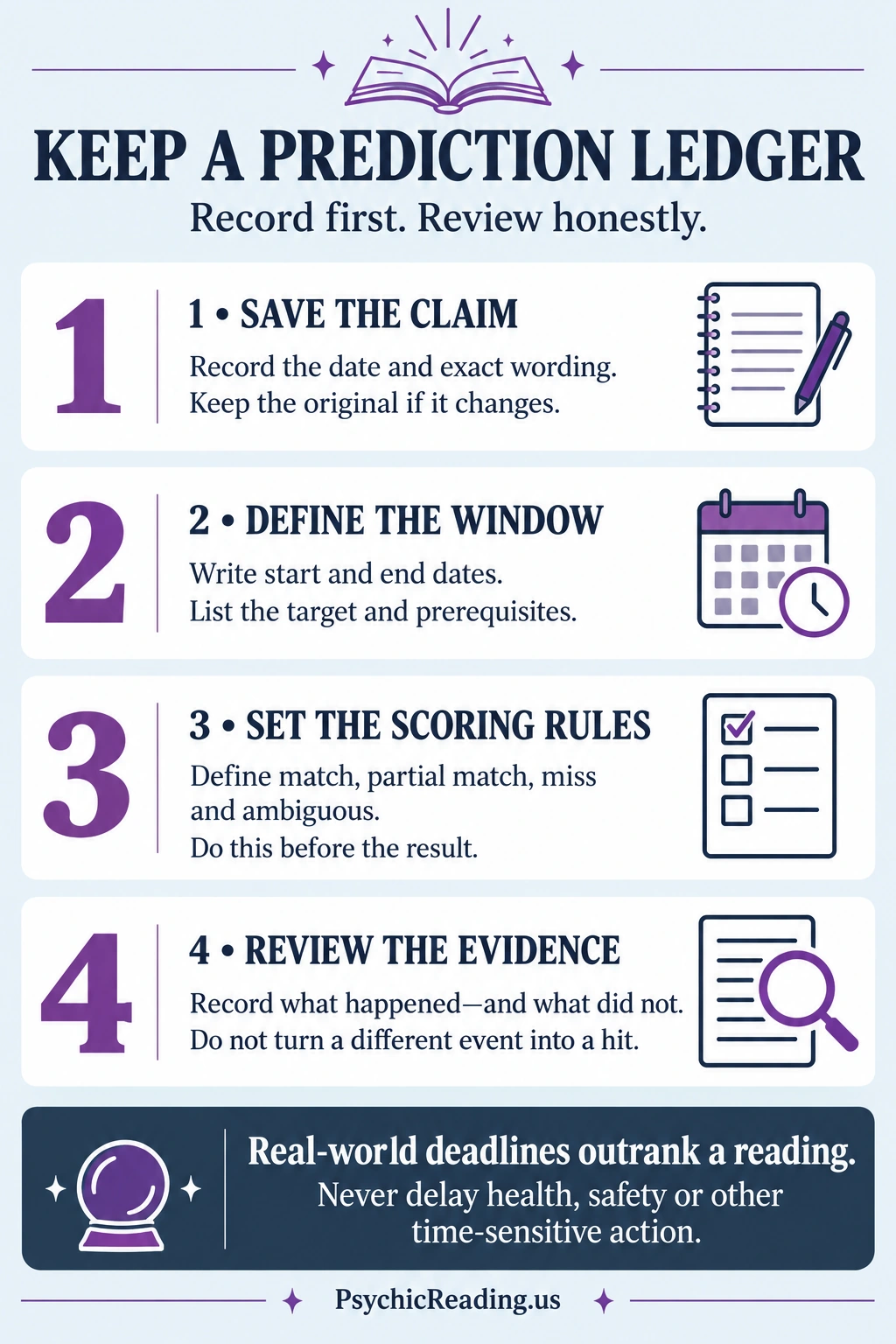
Read the infographic text
Record first. Review honestly.
- Save the claim: Record the date and exact wording. Keep the original if it changes.
- Define the window: Write start and end dates. List the target and prerequisites.
- Set the scoring rules: Define match, partial match, miss and ambiguous. Do this before the result.
- Review the evidence: Record what happened—and what did not. Do not turn a different event into a hit.
Real-world deadlines outrank a reading. Never delay health, safety or other time-sensitive action.
A prediction ledger
Create one row per claim: date recorded, exact wording, earliest and latest date, target, prerequisites, the reader’s stated confidence, result, and evidence. A confidence percentage is a claim, not a validated probability unless supported by an appropriate track record. Score ambiguous wording as ambiguous. Do not count a different event simply because it shares an emotional theme.
Use windows for scenarios, not surrender
A window can organize preparation. If a career change seems more plausible in three months, update your résumé now, verify savings, and set an application target. Plan A covers the predicted outcome; Plan B covers delay; Plan C covers a different direction. This turns timing language into choices rather than passive waiting.
After the window, review without excuses. What happened? What did not? Which actions affected the result? What would you predict differently? A record that allows a clear miss is easier to evaluate than one that explains every possible outcome as correct; neither establishes psychic accuracy.
Key Takeaways
- Events cluster through dependencies, deadlines, momentum, and attention.
- A useful timing claim needs dates, conditions, criteria, and a possible miss.
- Quantum language does not validate personal predictions.
- Use windows to prepare multiple scenarios, never to postpone urgent action.
Frequently Asked Questions
1. What is a psychic timing window?
It is a date range in which a reader believes an event is more likely, not a guaranteed deadline.
2. Why do predictions use windows?
Windows acknowledge uncertainty, but they must still be specific enough to evaluate.
3. Why do life events cluster?
Connected decisions, deadlines, social networks, and shared causes can produce real clusters.
4. Does a cluster prove synchronicity?
It may feel meaningful, but clustering alone does not establish a supernatural cause.
5. Can quantum physics explain psychic timing?
Quantum terminology alone does not validate a personal prediction.
6. Does Mercury retrograde cause delays?
It can be used as an astrological reflection period, but that interpretation is not evidence of what caused a particular delay.
7. How specific should a prediction be?
Include a target, date range, conditions, confidence, and evidence required for a match.
8. What counts as a miss?
A defined event that does not occur in the stated window under the stated conditions.
9. Can a reader move the date later?
They can revise a forecast, but the original should remain recorded and scored.
10. What is hindsight bias?
It is the tendency to see an outcome as more predictable after it happens.
11. What is confirmation bias?
It is favoring matches and explanations that support a belief while neglecting misses.
12. How do I keep a prediction ledger?
Record exact wording, dates, conditions, confidence, outcome, and supporting evidence before and after.
13. Should I wait to act until a predicted date?
No when health, safety, law, money, or a real deadline requires timely action.
14. How can a timing window be useful?
Use it to schedule preparation and compare multiple scenarios rather than to surrender choice.
15. When should I stop seeking timing readings?
Step back when repeated readings increase anxiety, spending, dependence, or avoidance of decisions.