

A prediction can stay with you long after a reading ends. Perhaps it offered hope about a relationship or a new direction at work. When the date passes—or the reader gives a different answer—you may wonder whether the future changed, whether you did something wrong or whether the original prediction simply missed.
Yes, a reader can revise a prediction, and circumstances can change. Those are different things. A revised statement does not establish that the reader accurately saw a future that later shifted. You can value a reading’s spiritual meaning while keeping that distinction clear.
The short answer: predictions are not promises
Some practitioners describe readings as glimpses of possibilities rather than a fixed destiny. Others use language about energy, free will or divine timing. These are spiritual frameworks, not verified explanations for why a particular forecast succeeded or failed.
A prediction may also be wrong, vague, based on information you supplied or interpreted differently after events unfold. You do not have to settle on one explanation immediately. What matters is whether you can examine the original statement without rewriting it to fit every outcome.
Free will: keep your choices in view
Your choices influence your life, but they do not give you control over everything that happens. You can apply for a role, practice a skill or initiate an honest conversation. You cannot decide an employer’s budget, another person’s feelings or every circumstance around you.
If a reader predicts a move for work, consider it a prompt to explore rather than a reason to pack. What roles are available? Would moving suit your responsibilities and finances? Would you still want that change if you had never heard the prediction?
A spiritual belief in free will can be a reminder that you have agency. It should not become a catch-all excuse that prevents any prediction from being evaluated. If both a move and no move are later counted as confirmation, the original claim has lost its useful boundaries.
Other people have choices, too
Relationship forecasts can feel especially personal. You might be told that someone will return, contact you or want commitment. Yet that person has their own preferences and boundaries, and a reader’s statement does not establish what they think or will do.
For example, suppose a reading says an ex will call by the end of the month. If no call arrives, record that result as it stands. Do not assume your doubts prevented the call, and do not use the prediction to justify repeated contact with someone who wants space. This is an illustrative scenario, not a client story.
You can hold hope while respecting another person’s autonomy. Direct communication, consent and observable behavior remain more useful for relationship decisions than repeated assurances about what someone secretly feels.
Personal growth can change what you want
A forecast that once excited you may no longer describe the life you want. Perhaps you become less interested in reconciliation, discover a different career goal or decide that a particular opportunity asks too much of you.
That change can be meaningful without proving that your energy altered a psychic vision. You are allowed to outgrow an interpretation. A reading is not a contract obliging you to pursue an outcome that no longer fits your values.
Try writing two separate sentences: “The reader predicted…” and “What I want now is…”. Keeping them distinct helps you notice whether you are making a current choice or trying to remain loyal to an old forecast.
Doubt does not make a missed prediction your fault
Curiosity and skepticism can coexist. You can listen openly, ask questions and disagree when something does not fit. Neither belief nor a calm mood guarantees predictive accuracy.
Claims that doubt, worry, trauma or insufficient healing blocked the forecast are not evidence that you caused it to fail. You do not need to become perfectly positive to deserve love, an opportunity or respectful treatment.
If a reader explains a miss by blaming your energy, ask what could have shown that the prediction was mistaken. If there is no possible answer, you may be dealing with a claim that cannot be fairly checked. You can end the conversation rather than paying to remove a supposed blockage.
Timing: a new deadline is a new statement
“Soon,” “when you are ready” and “in divine timing” may carry spiritual meaning, but they do not describe a clear deadline. If you want to evaluate a forecast, ask whether the reader is offering a specific time window or a symbolic reflection.
When a date changes, retain both versions. A forecast for June that becomes September should not erase what was said about June. A later event does not automatically validate every earlier version.
Our guide to psychic timing windows and prediction records offers a way to document the wording, dates and outcomes. Keep real-world deadlines separate: do not delay an application, medical appointment or other necessary action while waiting for a prediction.
What about energy and spiritual readiness?
You may use “energy” to describe your mood, a sense of connection or a spiritual atmosphere. Within a practitioner’s beliefs, it may mean something more specific. Ask what they mean instead of assuming the term has one established meaning.
Feeling understood can make a conversation more satisfying; feeling tired or uncomfortable can make it harder to engage. Neither experience establishes whether a reader can predict the future. Grounding, meditation or prayer can be personal rituals, not accuracy guarantees.
Nor does a disappointing outcome prove that the universe is testing you or withholding something until you have learned a lesson. You can find meaning in a difficult period without concluding that you deserved it or must keep waiting.
How to handle a prediction that changes
- Keep the original wording. Note the date, the promised event and any stated conditions. If using a recording, check permission and the provider’s rules first.
- Write the revision separately. What changed: the event, the person, the time window or the explanation?
- Check what actually happened. Include misses and ambiguous outcomes, not just apparent matches.
- Notice pressure. Repeated extensions, fear-based explanations or demands for paid cleansing are reasons to pause.
- Choose a useful next step. Make a decision that stands on practical information, whether or not the forecast eventually comes true.
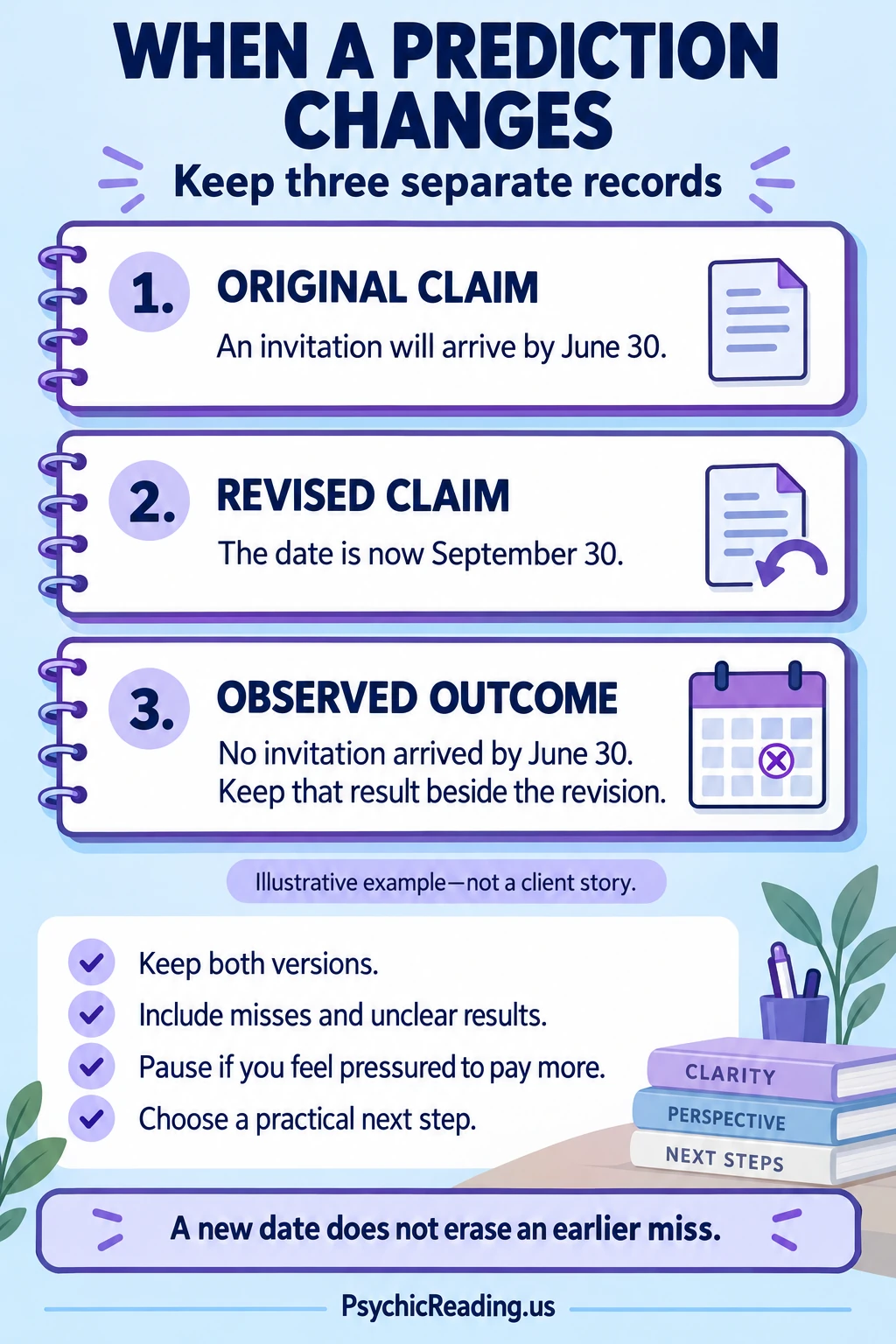
Read the infographic text
When a prediction changes: keep three separate records.
- Original claim: “An invitation will arrive by June 30.”
- Revised claim: “The date is now September 30.”
- Observed outcome: No invitation arrived by June 30. Keep that result beside the revision.
This is an illustrative example—not a client story. Keep both versions, include misses and unclear results, pause if you feel pressured to pay more, and choose a practical next step. A new date does not erase an earlier miss.
Keep spiritual hope without putting life on hold
If a reading gave you a helpful question, keep the question. “What would a more fulfilling relationship look like?” or “Which opportunity would I like to explore?” can remain valuable even when a prediction misses.
Before another session, ask whether you want reflection or reassurance about the same unresolved claim. Set a spending limit and give yourself room to decide without repeated readings. Our psychic-reading preparation checklist covers costs, questions and boundaries.
You do not have to choose between spiritual openness and clear judgment. A reading can be part of personal reflection; it should not become the authority over your future.
Frequently asked questions
Does a changed prediction mean the future shifted?
That is one spiritual interpretation, not a conclusion established by the revision. The original prediction may also have been mistaken or unclear.
Can my doubts stop a prediction from happening?
A missed forecast does not show that doubt caused it. You are entitled to question a reading without accepting blame for the outcome.
Should I book again to get a clearer date?
Another reading is optional, not a necessary next step. Keep the original record, set a budget and consider whether another session would add anything useful.
Can I still value a reading if its prediction was wrong?
Yes. A conversation or symbol may have personal meaning while its factual prediction remains a miss. Those judgments do not have to be the same.
‘Free will’ has significant implications on psychic readings, as mentioned here. This idea aligns with quantum mechanics theories on choice and probability—thought-provoking stuff!
So let me get this straight: my future depends on whether I decide pizza or salad for lunch today? 🍕🥗 What if I go rogue and order sushi instead?
Now that’s some serious pressure! The fate of your entire life rests on one meal!
This is just a bunch of vague statements wrapped in mystical jargon. Psychics are not reliable; they can’t truly predict the future, and claiming otherwise is misleading.
‘Free will’ sounds nice, but it feels like an excuse for when predictions don’t pan out.
While I understand your skepticism, many people find comfort in these predictions, even if they aren’t scientifically proven.
If everything can change due to free will, then what’s the point of consulting a psychic? Seems pretty pointless if they’re just guessing based on current vibes.
Exactly! Why pay for advice when you can figure things out yourself?
The idea that others influence our futures is fascinating yet daunting! We often underestimate the impact people have on our lives—it’s a reminder to choose our company wisely.
So true! The energy we surround ourselves with really shapes our experiences.
I found this article to be incredibly enlightening! The concept of free will influencing psychic predictions really resonates with me. It gives me hope that I can shape my future through my choices. 🌟
I love how this article emphasizes personal growth. It’s a reminder that change is constant and we should embrace it!
Absolutely agree! It’s refreshing to see that our actions matter in the grand scheme of things. It empowers us to take charge of our destinies rather than feeling helpless.
This article reads like a self-help guide for those who want to feel in control of their chaotic lives! Imagine telling someone: ‘Just make better choices!’ Genius! 😂
If only it were that simple—I’d be living in a mansion by now! 😂
Right? Next they’ll tell us that if we just think positive thoughts, we’ll win the lottery too!
‘Psychics can see your future,’ they said! Then why do their predictions always seem so vague? 🤔 This whole thing sounds like wishful thinking mixed with guesswork.