

When two psychics disagree with each other, you don’t have to pick an answer right away or book a third reading to see who is right. Start by looking at what each of them said and how the questions were asked, and what evidence is there outside the readings.
For someone who believes in intuition, guidance that is conflicting can be upsetting. You might like both readers and wonder if one saw a different point of view or if the situation changed. These are possible interpretations in the spiritual framework, but they don’t say that a prediction is accurate.
Psychic readings aren’t dependable verifications about what someone else is thinking or about future actions. A disagreement can make uncertainty stand out, and you can still find value in the reflections, but a claim that affects your health, money, safety, or relationships needs real-world checks.
The best task is to look at a clear view of the decisions that you can make. Look at the readings calmly, find out what is unknown, and then pick an action that makes sense even if neither prediction is correct.
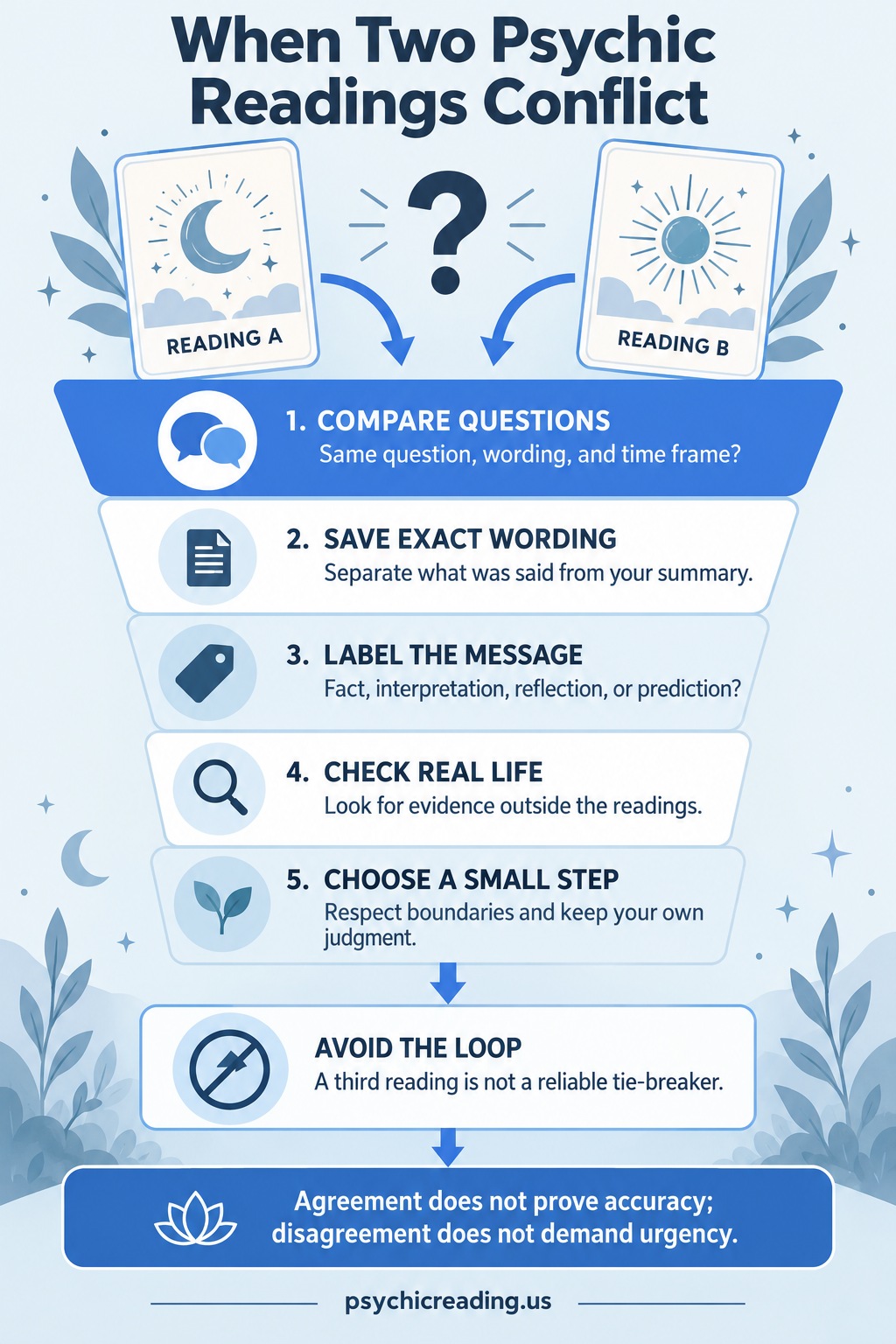
Read the infographic as text
- 1. COMPARE QUESTIONS: Same question, wording, and time frame?
- 2. SAVE EXACT WORDING: Separate what was said from your summary.
- 3. LABEL THE MESSAGE: Fact, interpretation, reflection, or prediction?
- 4. CHECK REAL LIFE: Look for evidence outside the readings.
- 5. CHOOSE A SMALL STEP: Respect boundaries and keep your own judgment.
- AVOID THE LOOP: A third reading is not a reliable tie-breaker.
Agreement does not prove accuracy; disagreement does not demand urgency.
Do the Readings Conflict?
Two answers can sound different without being opposite of each other. One reader might talk about your feelings and another about obstacles. One might talk about next month, and the other might use a broad time limit. Read the original wording before you decide that there is a contradiction in the readings.
One might say, “You need to feel ready to date,” and this isn’t the opposite of “Take time to clarify what you want.” Both are good reflection tools. On the other hand, if they say, “They will contact you this week,” and “They will never contact you again,” these are conflicting predictions if they are about the same person and situation.
Separate the conditions from the definite statements. If they say, “If you apply, you might have an opportunity,” this is different from “You will receive an offer.” Don’t just change the first one because the second reader sounded more confident or because you wanted that outcome.
If you only remember the general impressions, write that down and be honest. You can write about your feelings, and this is different than a quote. You should make a fair comparison and not try to fill things in from memory.
Comparing Questions
Questions interpretations. Ask if a relationship that is “meant to be” is different than setting a boundary. If the reading uses a different question, some differences can come from the tasks that the reader was given.
The information that you gave might be different. You might have told the first reader that your partner was withdrawing and the second reader that you had a nice conversation with them. These different details can change the reading when the reader describes their intuition.
According to Joan Bunning’s guidance on tarot questions, it illustrates a practitioner’s view of how the question directs a reading. The resource concerns tarot practice, not a scientific test of psychic knowledge. It helps explain why wording should be part of the comparison.
Don’t withhold important safety information to test a reader when you’re planning to act on an answer. The reader shouldn’t determine if you disclose an urgent health concern to a doctor or if an unsafe situation is happening.
Notice What Kind of Message You Received
A psychic reading can include several different kinds of messages. Some might describe feelings or energy surrounding a situation. Others can offer spiritual guidance, describe something happening now, or point toward something that could happen in the future.
For example, “You seem torn between staying comfortable and making a change” gives you something to think about in your own life. You can consider if that feeling connects with what you’re experiencing. A message about a promotion already being approved is more specific because it involves something happening in the present. A prediction that a promotion is coming next month gives you something to watch for as time goes on.
Relationship readings can work the same way. A reader might pick up on someone’s feelings, intentions, fears, or the energy surrounding the connection. You can keep those messages in mind while also paying attention to the way the relationship develops in everyday life, including communication, actions, boundaries, and the choices both people make.
Not every psychic message has to fit neatly into the same category. Sometimes a reader receives a feeling, symbol, image, or impression without immediately knowing exactly how it connects. Other messages can come through much more clearly. Giving those messages time to unfold can sometimes bring more understanding later.
If you like keeping notes after a reading, you can use easy reminders beside the messages that stood out. You might write, “This connects with what I’m feeling,” “I can watch for this,” or “I want to see how this develops.” These notes aren’t about scoring the reader or measuring psychic ability. They just give you an easy way to remember what came through and notice how the messages connect with your life as time goes on.
Similar Readings Don’t Mean Accuracy
Three readings that are similar don’t mean that the claim is accurate. Readers might share familiar interpretations, respond to the same information you give, or use broad statements that fit your situation. Agreement can feel reassuring without verifying it.
Also, picking the best answer doesn’t mean it will come true. Picking the worst answer because it sounds honest doesn’t help either. Tone and confidence are part of communication, and they don’t make something accurate.
If you’re wanting to book another reading, ask what kind of new information it could give you. If the purpose is to reduce uncertainty, another reading might have more conflicting answers.
You can decide to take time to pause for as long as you want and use real-world information instead. You can wait for an announced decision at your work, for example, while continuing to put in applications elsewhere. This keeps your options open without needing a spiritual verdict.
Hope and Fear
You might reread an answer you find hopeful and ignore the uncertain parts. Or a scary sentence might overshadow a regular reading. These are reactions that are understandable, especially if the questions really matter to you.
NHS guide to reframing unhelpful thoughts encourages examining evidence and considering other perspectives. It is general well-being guidance, not a method for judging psychic accuracy. A brief pause to inspect your assumptions can help you compare the readings more calmly.
Take time to name your feeling and keep it separate from the claim. Say something like, “I’m relieved by the prediction,” instead of saying, “This prediction is supported.” Separating them doesn’t mean you ignore your feelings; it just gives your feelings a place.
If you can’t look at the notes without getting overwhelmed, put them aside for a while. Talk to someone you trust about their situation and get professional help if it messes with your daily life.
Agreements About Choices
Two readers might disagree about the outcome but still tell you to take good action steps. They might tell you to have better communication, to set budgets, or to take time to think things through. Look at the suggestions independently of the predictions.
If one reader expects reconciliation, and another thinks there will be separation. Both mention that you avoided stating your needs. Having a conversation about your worth might be better and not because they have given you a prediction, but because your needs matter.
Check if the suggested actions respect someone else’s consent. Contacting someone who asked you not to contact them doesn’t get approved because the prediction about love came. A reading doesn’t override a boundary.
Look at proportion. A low-cost reflection exercise is different than leaving your job, moving, or sending money to someone. The harder the action is to reverse, the stronger the basis needs to be before you move forward.
Ask About the Part You Want to Understand Better
If your reading includes the option to ask for clarification, focus on the part that you’re still wondering about. You don’t have to go back through the entire reading or start over from the beginning.
For example, if the reader said that an opportunity feels close, you might ask, “When you said the opportunity was close, did you feel like something was already developing, or did it seem like something that would begin taking shape soon?” This gives the reader a chance to explain the message or psychic impression in a little more detail.
If you’ve also had a reading with someone else, you don’t necessarily need to send the first reader everything the second reader told you. Different psychic readers can pick up on different parts of the same situation, use different methods, or explain similar messages in different ways. One reading doesn’t have to prove that another reading was right or wrong.
Instead, ask about the original message in your own words. This keeps the focus on understanding what that particular reader saw, felt, or received during your reading.
There’s also a difference between asking for clarification and asking for a completely new reading. If you’re just asking what the reader meant by something they already said, they might be able to explain it without starting another reading. If your question moves into a new situation or requires the reader to look more deeply into something, another reading might be needed. Any additional cost should be explained before you agree to continue.
A good reader should be able to talk about something that didn’t make sense without making you feel uncomfortable for asking. They might explain the message differently, tell you if anything more comes through, or say that they don’t have more information about that particular part right now.
If the conversation starts making you feel pressured, frightened, or blamed because you asked a reasonable question, you can end it. You can still appreciate the parts of the reading that were meaningful to you while deciding that a particular reader or reading style isn’t the right fit for you.
Disagreements and Upsells
Some sellers can use conflicting readings to claim that your situation is what blocked it and only they are able to fix it. If you get a request for a fast payment, secrecy, or if you need repeated cleansing services, take a pause. Just because two readers don’t agree it isn’t evidence that you owe someone money for spiritual intervention.
ASA's guidance on responsible psychic advertising addresses misleading claims and vulnerable consumers in UK advertising. It provides a useful reference when considering how services should represent what they offer. It does not verify an individual reader’s abilities.
Keep your payment and complaint records if the experience is a dispute. Focus on the conduct, what was promised, what was given, and if pressure or unauthorized charges happened. These details are better than trying to prove which reader has the best and strongest psychic gifts.
Spiritual trust needs to be voluntary and a reader’s claim that you’re going to suffer if you stop getting a reading is a reason to find appropriate support and to get off the site. You don’t have to purchase reassurance from someone that is trying to scare you.
An Easy Example of Looking at Two Different Readings
Imagine Daniel receives one psychic reading that points toward a job change, while another encourages him to focus on stability for the time being. At first, the messages might sound like they’re pointing in completely different directions. Before deciding that the readings contradict each other, Daniel looks at the questions he asked during each one.
The first reading focused on his ambitions and where his career could be heading. The second focused more on dealing with changes and uncertainty at his current workplace. When Daniel looks at them this way, he realizes that the two readers might have been picking up on different parts of the same situation.
Daniel thinks about what’s happening in his life right now too. He considers his current income, changes his employer has recently announced, and the types of jobs available in his field. He decides to update his resume and talk with a career adviser while continuing to work at his present job.
This gives him room to explore the possibility of the career change that came through in the first reading while also paying attention to the message about stability in the second. He doesn’t have to immediately decide that one reader was right and the other was wrong.
The themes of change and stability can both give Daniel something meaningful to think about. Maybe he’s ready for a new direction but needs to prepare before making the change. The readings could also be describing different stages of the same situation. Sometimes a message makes more sense as events begin unfolding and you can see how different pieces connect.
The same approach can help when two readings seem different about a relationship, move, creative project, or another important part of your life. Look at the questions you asked, what each reader picked up on, and the circumstances surrounding each reading. Different readers can receive different messages, focus on different parts of a situation, or see possibilities from different angles.
You don’t always have to pick which reading is “right” immediately. Give the messages time to settle, notice what connects with your life, and think about the guidance each reading gave you. You can take meaningful spiritual guidance from both readings while still making the decisions that feel right for your life.
Keeping Your Own Decisions
If you have conflicting psychic readings, it can remind you that an interpretation can have uncertainty. Look at the wording and methods, know the differences between reflection and evidence, and don’t try to buy an answer.
You can enjoy your reader’s personality or guidance and still leave a prediction unanswered. Your choices can stay grounded in facts, consent, practical support, and your own values. This is a good way to make space for spiritual guidance without trying to control the outcome.
Final Thoughts: Planning for the Outcome
When a reading is about a future event, make a plan that can work with uncertainty. If you’re waiting for an offer, decide what you will do if it comes, if it’s delayed, or if it doesn’t come. The plan should use deadlines and resources instead of looking for certainty.
For a relationship, look at how you respond to contact and how you’re going to care for yourself if the contact is still gone. Neither of the plans means that you have to decide which psychic wins. Both can have honor and can stay within your limits and boundaries.
Plan for other alternatives so that you can get rid of pressure to want to get another prediction. You don’t have to know the future to take an action step. Keep your plan easy and revisit it when situations change. Use the right language and professional advice for decisions that have a lot of consequences.