

It is important to look at psychic reading notes without hindsight bias; make sure you keep the original wording and compare it with other events using what you wrote down in advance. Memory alone can make a reading seem more precise after the outcome is known. A written record helps you to pay attention to useful reflections and uncertain predictions without confusing them.
If you like psychic guidance, this kind of review can support a thoughtful relationship. You don’t have to dismiss an experience that was meaningful to you, and you can just ask what it actually said, what happened, and which part of the connection you interpreted later.
Hindsight bias makes an outcome seem more predictable after you know what happened. a research review by Neal Roese and Kathleen Vohs examines this phenomenon across judgment and memory. It is not a study validating or disproving psychic readings. Its relevance is the importance of distinguishing an original forecast from the story you tell afterward.
The best thing is to have honest learning. A personal review can tell you if a service suits you, but it doesn’t provide scientific evidence of paranormal abilities. Clear records can help make the experience easier to understand on its own terms.
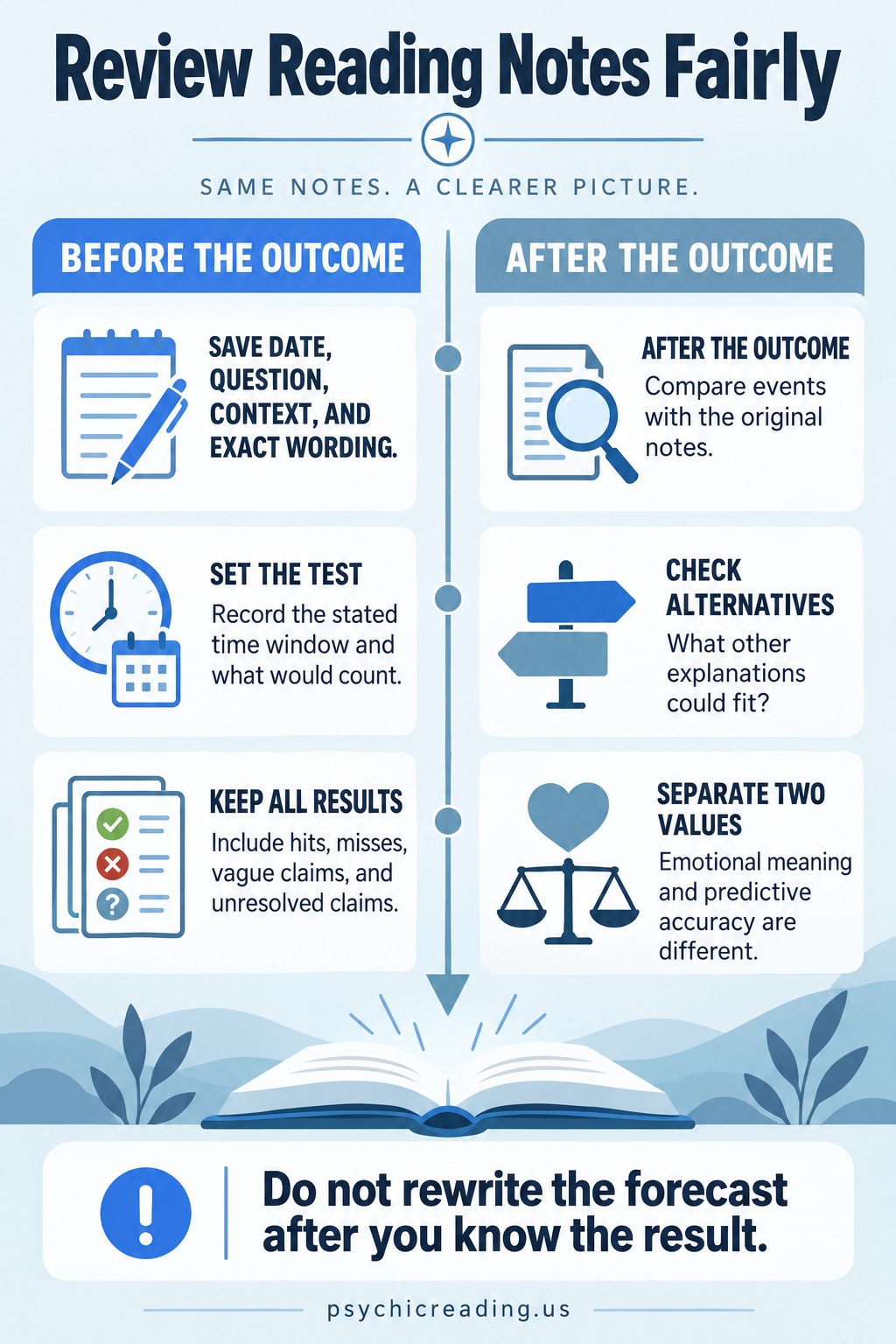
Read the infographic as text
- BEFORE THE OUTCOME: Save date, question, context, and exact wording.
- SET THE TEST: Record the stated time window and what would count.
- KEEP ALL RESULTS: Include hits, misses, vague claims, and unresolved claims.
- AFTER THE OUTCOME: Compare events with the original notes.
- CHECK ALTERNATIVES: What other explanations could fit?
- SEPARATE TWO VALUES: Emotional meaning and predictive accuracy are different.
Do not rewrite the forecast after you know the result.
Start with the Original Information
Use the message, recording, or the notes that you made during the reading. Keep the original unchanged. If you want to add an explanation later, put it in a separate entry so you can still see what you knew when you wrote it down the first time.
Write down the rules of the platform, consent, and the local laws. Ask before you record and follow the policies. If recordings aren’t allowed, take notes and mark any wording that you’re not sure about. Don’t convert an approximate memory into a quote.
Include the question in relevant context. A statement about work can look specific if you later forget what you started with in the reading. The information you gave is part of the reading and not something you should erase from the records.
You can also see how certain the reader sounded in their language. If they said “may,” “could,” “likely,” and “will,” all these are different. Just because the reader had an encouraging voice doesn’t mean the statement was a prediction.
Notice the Different Types of Messages That Come Through
A psychic reading can include several different kinds of information. You might receive guidance about something happening in your life right now, a psychic impression about another person or situation, a message that encourages reflection, or a prediction about something that could happen in the future. Understanding the difference can make it easier to look back at the reading later.
For example, “Think about if you want more independence in your career” gives you something to reflect on. Its meaning might come from helping you recognize what you actually want from your work. A message such as, “It feels like a new job opportunity is coming this month,” is different because it gives you something more specific to watch for as time goes on.
Positive messages and observations can be meaningful too. If a reader tells you, “You care deeply about other people,” that might connect strongly with how you see yourself or something you’re going through. It doesn’t have to be treated the same way as a prediction about an event that hasn’t happened yet.
Sometimes one message can include more than one idea. A reader might say, “You need stronger boundaries in this relationship, and this person will reach out again soon.” The first part gives you something to think about in your own life, while the second part is a prediction you can watch for. Separating the two can help you remember exactly what came through without losing the meaning of either one.
When you look back at your notes, take your time. Notice which messages gave you guidance, which ones described something already happening, and which ones pointed toward the future. This can make it easier to see the different ways a reading connected with your life.
Write Down Predictions While They’re Still Fresh
If a prediction stands out during your reading, write it down as closely as you can remember it. Include any details the reader gave you, such as the person involved, what they felt might happen, or a time frame if one was mentioned.
For example, there’s a difference between a reader saying, “I feel communication coming,” and saying, “I feel your former partner reaching out within the next few weeks.” Both can be meaningful psychic impressions, but the second includes more details about what the reader was sensing.
Try not to add details later that weren’t part of the original message. If the reader only mentioned communication, write it down that way. Then, if something happens later, you can look back at your notes and see how closely it connects with what was actually said.
Some psychic messages are very specific, while others can come through more generally. A reader might receive a feeling, image, symbol, name, number, or sense of timing without getting every detail surrounding it. If something feels unclear, you can ask for clarification during the reading. If the reader isn’t receiving anything more about it, it’s okay to leave the message as it came through.
Timing can work the same way. If the reader gives you a specific time frame, include it in your notes. If they don’t, there’s no need to create one afterward. You can just keep the prediction with the rest of your notes and see how things develop.
Writing predictions down isn’t about turning your psychic reading into a list of right and wrong answers. It gives you a way to remember the messages as they originally came through. Later, you can look back and notice what connected immediately, what unfolded over time, and what might still be waiting to make sense.
Make an Action Step
Readings often affect people’s behavior. If the reader tells you that reconnecting with an old friend can be helpful and you contact the friend, the conversation follows your action. This can be a helpful experience, but it’s different from predicting an event.
Write down what you did after the reading. Did you apply for a new job, have a conversation, or go to an event? These details show the path from the reading to the outcome without saying everything was a prediction.
You should also pay attention to actions you didn’t take. If something was forecasted as conditional on an application and you never applied, the situation might be unaddressed. Don’t just score it as a success or claim that the client caused every missed forecast by not taking action.
Some things that happen are outside your control. An employer’s decision, someone’s consent, and a medical outcome don’t become guaranteed because of a reading. Make sure you keep these limits in mind when you consider what happened.
Look at the Entire Record
Look at all relevant statements, including misses, unclear claims, and items that are unresolved. A match might be what’s in your memory, and different, incompatible predictions disappear. A complete record brings balance.
Don’t count different descriptions of the same event as separate successes. If the reader predicted one conversation in different sentences, those sentences might be one claim. Also, a long list of possible outcomes should not become one exact prediction because one eventually happened.
Keep the original claims visible. If you have one of five predicted matches, this tells a different story than the reading predicted an event. You don’t have to write down a numerical score, but understanding the differences can be a good assessment.
You might find that the service was reflective, but the predictions were weak. A few statements might show a specific communication that was uncomfortable. These things can work together, and your decision about going back can be part of the complete experience.
Different Explanations
Ask what kind of information was already there. A reader might have responded to the details you shared or made a regular statement or said something broad that fits many people. A match can also be made by chance. Always consider the possibilities without assuming the intentions were bad.
Predicting a workplace change after a client talks about restricting, for example, is different than naming a certain event that wasn’t shared. Think of these possibilities and keep the information beside the claim so that you can look at the details honestly.
Joan Bunning’s lesson on interpreting tarot cards describes a practitioner’s use of the question, context, and personal response. This helps explain why tarot interpretations may draw on more than the card alone. The lesson is a spiritual practice resource, not evidence of predictive reliability.
Don’t look at an interpretation as a rescue. If moving to another city becomes a change of desk after an expected move doesn’t happen, the situation has changed. Write down the new things as a reflection and not as an original statement.
An Easy Example of Looking Back at a Reading
Imagine Elena has a reading about her job search. During the reading, the reader tells her that a helpful connection could be coming soon and that the cards point toward building on a skill she already has. Elena had mentioned that she recently attended a professional event, so she keeps that in mind too.
Not long afterward, Elena receives a message from someone she met at the event. The message reminds her of what came through during the reading about a helpful connection. She writes it down with her original notes so she can remember how the situation developed.
She also thinks more about the message involving her existing skills. That part of the reading encourages Elena to update her portfolio and pay more attention to the experience she already has. She feels more confident and prepared when she begins applying for new positions.
Not every part of the reading has to happen at the same time. The helpful contact could be connected with what the reader saw without automatically meaning that a job offer will immediately follow. Elena can keep watching how things develop and notice if other parts of the reading begin connecting as time goes on.
Looking back at a reading this way gives Elena a chance to notice both the predictions that appear to be unfolding and the guidance that was helpful to her along the way. Keeping a few notes can also make it easier to remember what was actually said, especially when a reading includes several messages, predictions, or details that might unfold at different times.
Ask About Something That Isn’t Clear
If something during a reading is confusing, it’s usually better to ask about it while the conversation is still fresh. Readers sometimes receive a symbol, feeling, message, or impression that could use a little more explanation, and asking a question can help you better understand what they’re trying to tell you.
For example, if a reader says, “There’s a change coming within the family,” you might ask, “Do you feel like that’s connected with a particular person or type of change?” This gives the reader an opportunity to explain what they’re sensing without you having to guess what the message means.
You can also write down the clarification with the rest of your notes. If the meaning still isn’t clear, it’s okay to leave it there for the time being. Some messages might connect immediately, while others could make more sense later when something changes, or more information becomes available.
There’s also a difference between asking for clarification and repeatedly asking the same question in slightly different ways because you’re trying to get a certain answer. Clarification should help you understand what came through during the reading, not leave you feeling like you have to keep paying for more readings before you can understand the original message.
A good reader should also be comfortable when something doesn’t connect. They might explain the message another way, tell you that they’re not getting anything more about it, or suggest leaving it for now. You shouldn’t feel pressured to agree with every message or be told that something didn’t connect only because your energy was wrong.
Psychic readings can include information that becomes meaningful at different times. Asking questions, keeping notes, and giving some messages time to unfold can help you look back later and see what connected, what was helpful, and what might still be developing.
Review on a Schedule
Pick a review point that matches the claim’s actual time window. Reading the notes every day can cause ordinary events to become a search for more confirmation. You might start treating every message, meeting, or dream as something that needs to fill the prediction.
Keep the notes in a safe place and go back to your everyday life. If the reading gave you no time window, a single review could be enough to decide how good the wording was for you. You don’t have to keep watching it indefinitely.
NHS guide to examining unhelpful thoughts offers general guidance about checking evidence and considering other perspectives. It is relevant when reviewing notes becomes emotionally loaded. It does not provide a test of psychic ability.
If you feel that you have to search for matches or you can’t relax until the prediction comes true, then take time to pause. The record should help you, and it shouldn’t become another source of pressure or a reason to ignore a situation.
Protecting Privacy
Your private notes might have information about partners, family members, your workplace, or your health. Only share what you need to talk about your experiences, talk to a friend, or write a public service review. Don’t add identifying details about other people.
A public review should focus on things you can observe, like whether the reading came and the pricing was clear. If you talk about a prediction, use the actual wording without claiming that it was scientifically proven.
Don’t write accusations about an absent person based on the reading. A psychic statement is evidence that someone cheated on you, committed a crime, or wants to harm you. Fairness goes beyond the reader to everyone mentioned in the reading.
You could say that a reflection was helpful without sharing intimate details. You could say something like, “The session helped me prepare for a hard conversation,” and this can show value while still keeping things private.
Reviewing the Reading
After you review the reading, ask what you learned and about your preferences. Maybe you like a reader that talks about symbolism clearly and allows for uncertainty. Maybe predictive claims make you feel anxious, or you want a written reading because they’re easier to revisit accurately.
You might also change the questions that you come up with. A request about your choices can become a useful reflection instead of demanding an exact outcome. This doesn’t guarantee a better reading, but it gives you a better basis for judging the situation.
Keep one lesson instead of a long case against yourself or the reader. You might need to set a budget, ask for clear terms, or take a break from readings. The purpose is to make sure your experience is good, not to prove that you should have known everything before you booked one.
Psychic reading notes can keep an interesting spiritual conversation. When you keep the original wording, pay attention to uncertainty and review the full record. It becomes a tool for learning, meaning it can stay personal and claims can be assessed.
Final Thoughts: Emotional Value and Predictions
Maybe a reading helped you feel heard, talk about a concern, or prepare for a conversation. Record the value in your own words. It doesn’t need a successful prediction to count as a meaningful experience.
You can write something like, “The discussion helped me to decide what I wanted,” and “The future claim still isn’t confirmed.” Both of these things can be true. Keep them separate, and this allows you to look at the service honestly and then decide what kind of reading you might want in the future.
This also helps you not think that every good reflection failed because a prediction was missed. Look at each of the parts for what you actually knew and were offered. Your judgment can stay balanced without turning the experience into an all-or-nothing verdict.