
You settle down to meditate, hoping for a little peace or a clearer sense of your inner voice. A minute later, your shoulders are tense, your legs are uncomfortable and you are wondering whether you are doing it wrong. The answer is not to force yourself to sit longer.
A useful meditation posture supports your attention without turning the practice into an endurance test. Whether you meditate for spiritual reflection, mindfulness or a quiet pause, you can adapt the position to your body. A chair is not a lesser choice than a cushion, and moving when you need to is not a failure.
What does good meditation posture mean?
Think supported, comfortable and reasonably alert, rather than perfectly still or rigidly straight. You want a position in which you can notice your chosen focus without spending the session fighting discomfort.
The NHS beginner meditation guide recommends a comfortable place with support and an upright position. It also emphasizes that wandering thoughts are a normal part of practice. Neither a blank mind nor hours of motionless sitting is the goal.
Try a supported chair position first
A familiar, stable chair can make it easier to explore what feels comfortable. This is a starting suggestion, not a posture prescription for every body:
- Check your support. Choose a seat where you do not feel as though you are sinking or sliding. Use the backrest if it helps.
- Let your feet rest. Place them on the floor or a stable support, if comfortable. Adapt this to your mobility and usual seating needs.
- Find an easy upright position. Avoid forcing your chest forward, arching your back or holding yourself stiffly.
- Rest your hands. Let them sit on your thighs or in your lap rather than making your shoulders hold their weight.
- Soften unnecessary tension. Notice your jaw and shoulders. You do not need to hold a particular facial expression or hand gesture.
- Choose your gaze. Close your eyes if that feels comfortable, or keep them open with a gentle focus.
If you use a wheelchair or need a particular supportive arrangement, begin with the setup that works for you. Meditation does not require abandoning an aid or adopting a position that is unsuitable for your body.
Floor sitting, cushions and lying down
If you enjoy sitting on the floor, experiment with a cushion and a relaxed position rather than forcing a lotus pose. You can change the arrangement or return to a chair if your knees, hips or back are uncomfortable. The appearance of the pose matters less than whether it is workable for you.
Resting on a bed or lying down may be a more comfortable option for some people. If you keep falling asleep and want to remain awake, try a supported sitting position or a different time of day. Falling asleep is not evidence of blocked energy, and an upright posture does not guarantee a deeper spiritual experience.
For persistent pain, an injury or a condition that affects positioning, ask an appropriately qualified healthcare professional for advice suited to you. General meditation tips are not a substitute for that guidance.
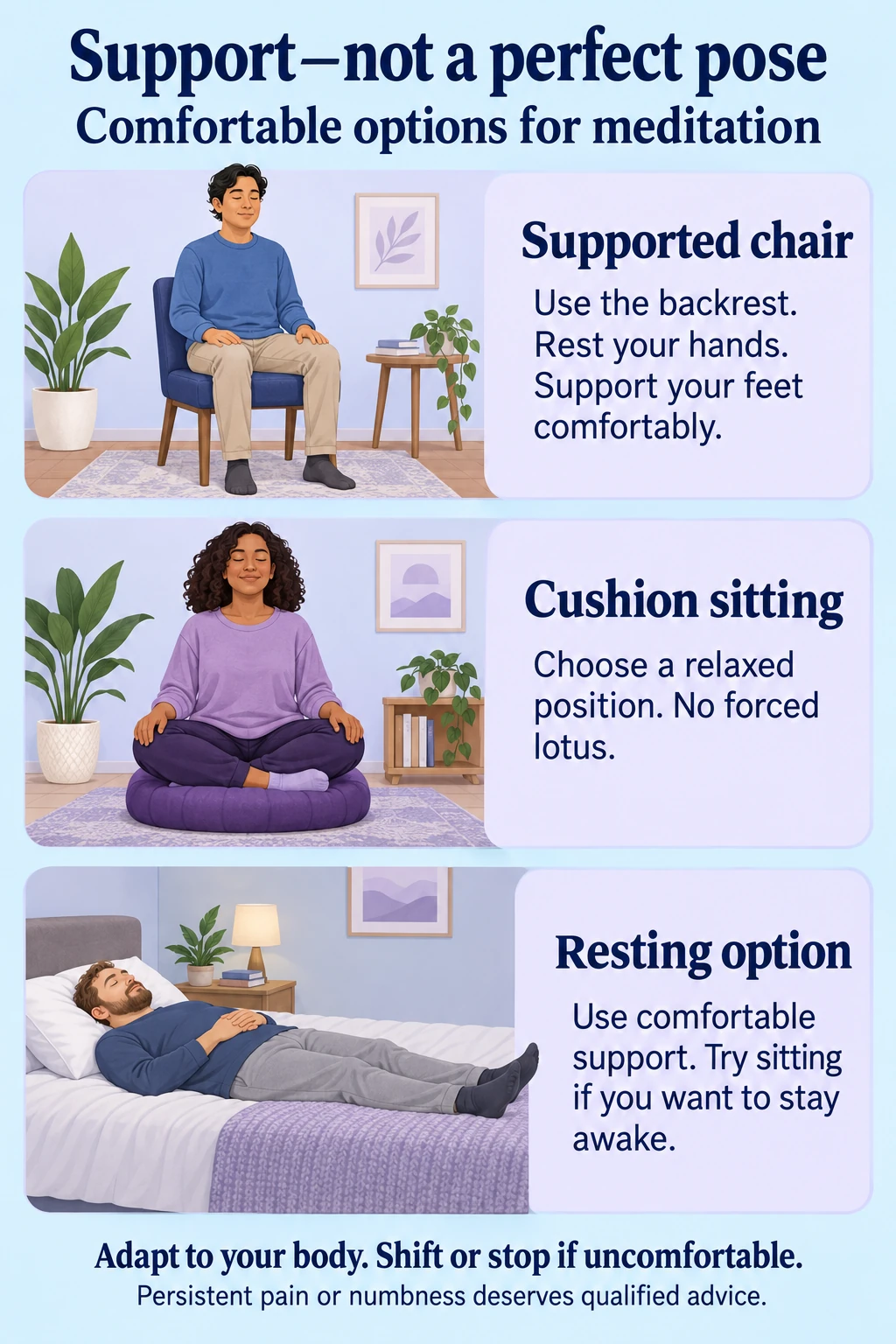
Read the meditation posture illustration as text
Support—not a perfect pose. Comfortable options for meditation:
- Supported chair: Use the backrest. Rest your hands. Support your feet comfortably.
- Cushion sitting: Choose a relaxed position. No forced lotus.
- Resting option: Use comfortable support. Try sitting if you want to stay awake.
Adapt to your body. Shift or stop if uncomfortable. Persistent pain or numbness deserves qualified advice.
A short posture-and-attention practice
Try a few minutes as an experiment, with no obligation to extend it. This suggested routine is not a required duration:
- Settle. Find support and make any adjustments you need before beginning.
- Choose an anchor. Notice an ordinary breath, a sound in the room or the contact of your hands with your lap.
- Return gently. When your mind wanders, notice it and come back to the anchor. You can do this more than once.
- Adjust when needed. Shift position, open your eyes or stop if you become uncomfortable. You do not have to earn stillness through pain.
- Finish deliberately. Look around, notice how you feel and take your time before getting up.
For example: If your shoulders rise each time you try to “sit properly,” rest your hands more comfortably and let go of the effort to look composed. Then return to a sound or your natural breathing. That small adjustment can be part of the practice rather than an interruption to it.
Keep preparation simple
Hydration and meals
Follow your usual hydration needs and any medical advice you have been given. You do not need to drink extra water to create a meditative state or force yourself to avoid a bathroom break.
Choose a time when you feel comfortable enough to settle. Meditation does not require a low-carbohydrate diet, extra vitamins or a special meal plan. If tiredness keeps getting in the way, consider your routine rather than assuming your diet or spiritual discipline is at fault.
Gentle movement
You may prefer a little familiar, comfortable movement before sitting. Stretching or yoga is optional, not a prerequisite. Do not force a stretch or treat discomfort as proof that a chakra is opening. In spiritual traditions that use chakra language, that interpretation is a belief—not a medical explanation for pain.
Light and surroundings
Use lighting that feels comfortable: daylight, a lamp or a softly lit room. Meditation does not require a daily dose of sunlight, facing a particular direction or staring toward the sun. A quiet corner at home can be enough; you do not need an elaborate setting.
Breathing
Start with noticing ordinary breathing rather than trying to make it unusually deep or slow. Advanced breathwork is not necessary for this practice. If focusing on your breathing feels uncomfortable, try a sound or another simple anchor, or stop. Do not push through dizziness or distress.
Make room for spiritual meaning without demanding a message
If meditation is part of your spiritual life, you might begin with an intention such as “I want to listen with patience” or “I want to approach this question with kindness.” A comfortable posture can support the time you set aside, but it does not establish a connection to spirit or prove that an impression comes from outside you.
Afterward, you can write down an image, feeling or thought that seemed meaningful. Explore it as a possible symbol rather than an instruction you must obey. Our guide to meditation imagery and inner vision offers ways to reflect without assuming every image has a universal psychic meaning.
When to pause or seek support
Meditation is not comfortable for everyone, and longer practice is not automatically better. The NCCIH overview of meditation and mindfulness notes that safety research is limited and that some participants report negative experiences, including anxiety or depression.
If the practice increases distress, pause and consider support from an appropriately qualified professional. Do not use meditation to delay care for physical or mental-health concerns. Persistent pain or numbness also deserves attention rather than an instruction to become more disciplined.
Comfort is part of the practice
You do not need to perfect your posture each day or work toward sitting for hours. Find enough support to pay attention, keep the session manageable and allow yourself to adjust. A brief, thoughtful pause in an ordinary chair can be a meaningful part of your spiritual routine.
The connection between hydration and meditation is an interesting point. Staying hydrated is indeed crucial for maintaining overall health, which can, in turn, enhance meditation practices.
The discipline required for prolonged meditation is not often discussed. Building stamina over time by gradually increasing meditation duration is sound advice.
Indeed, stamina is built over time. This gradual approach can help in avoiding any physical discomfort, allowing for deeper meditation experiences.
The advice to not overeat and to chew food well is backed by science. Digestive comfort is crucial for maintaining focus during meditation sessions.
I find the analogy between meditation and sleep consciousness to be quite insightful. Both states indeed require a level of mental stillness and awareness.
The suggestion to use yoga poses for stretching is well-founded. Yoga aids in not only improving posture but also in aligning energies, which can be beneficial for meditation.
It’s important to address the practical aspects of meditation, such as posture and diet. These factors can significantly influence the effectiveness of meditative practices.
Natural lighting and exposure to sunlight are often overlooked yet essential components for overall well-being, which can indirectly benefit meditation practices.
The importance of breathing exercises cannot be overstated. Techniques like Anuloma-villoma pranayama can greatly enhance one’s ability to focus and stay calm during meditation.