

 A message arrives at the wrong moment. Before you have finished reading it, you are already composing a reply. Later, you wish you had asked a question instead. The difference between reacting and responding often begins in that small space—not in becoming perfectly calm, but in giving yourself a chance to choose.
If you believe in a soul’s journey, you may see that space as an opportunity to bring your values into everyday life. You can hold that spiritual meaning without believing that every hardship was chosen, that fear is unreal, or that distress means you have failed to grow.
Reacting and responding: a useful distinction
For this reflection, reacting means acting from the first impulse; responding means considering what is happening and what to do next. These are everyday descriptions, not diagnoses or a ranking of people’s spiritual development.
A reaction may be quick, protective, or understandable. A response may still be firm, emotional, or urgent. The goal is not to replace every feeling with positivity. It is to make room for a choice when there is time and it is safe to do so.
For example, you might feel hurt by a friend’s short reply. Reacting could mean sending an accusation immediately. Responding could mean waiting, asking what they meant, or deciding to discuss the issue later. The feeling is allowed in both cases; what changes is your next action.
A pause is an invitation, not an obligation
You do not need to pause to protect yourself from immediate danger. Nor must you remain available to someone who is threatening or controlling you. A thoughtful response can be ending a conversation, seeking help, or refusing a request.
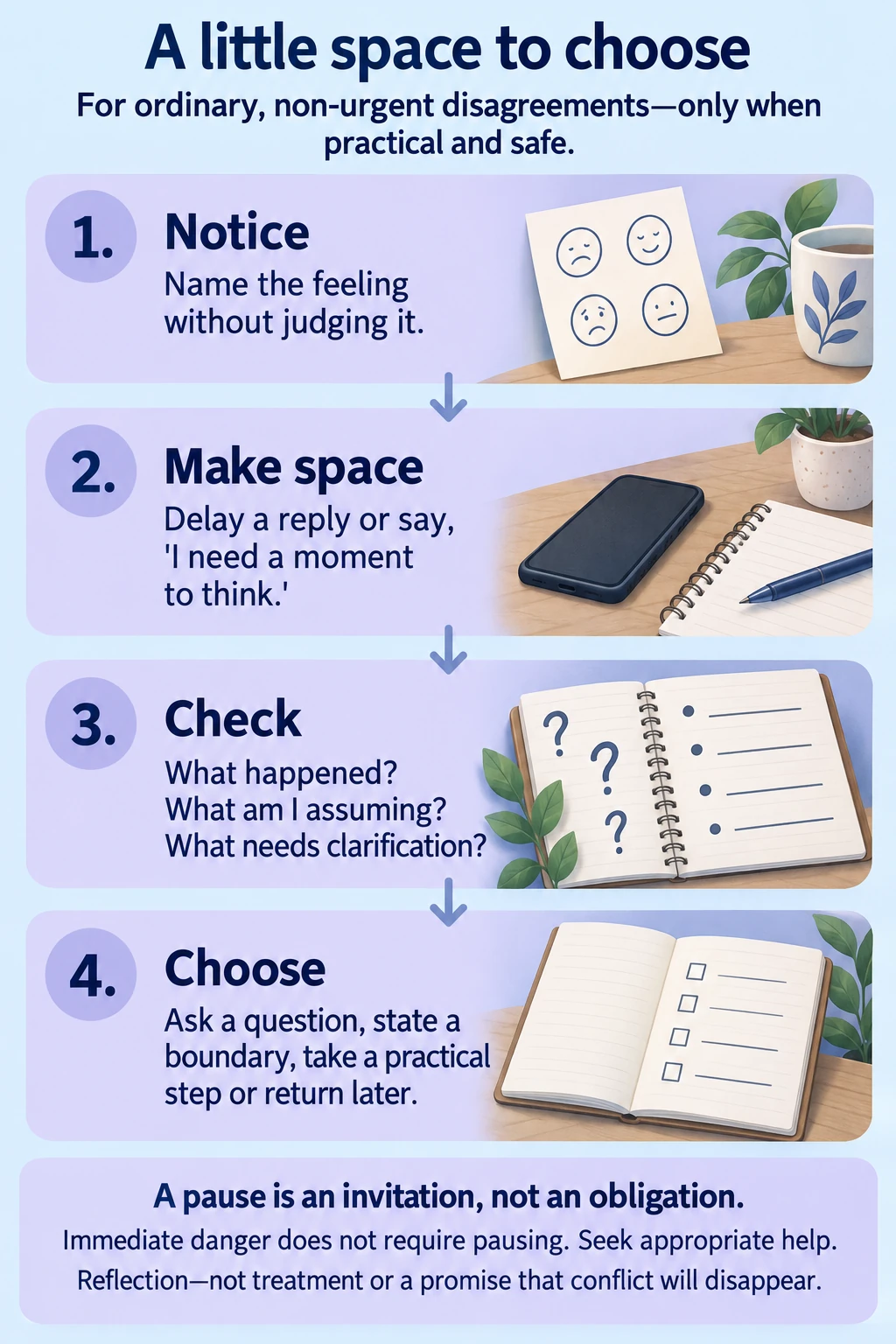
For an ordinary, non-urgent disagreement, you might try this simple sequence:
- Notice: “I feel hurt, angry, worried, or rushed.” Name the feeling without calling it bad energy.
- Make space: If practical, delay the reply or say, “I need a moment to think.” You do not need to solve everything on the spot.
- Check: What happened? What am I assuming? Is there something I need to clarify?
- Choose: Ask a question, state a boundary, take a practical step, or return to the conversation later.
This is a reflection exercise, not treatment or a promise that conflict will disappear. If you cannot find that pause today, you can revisit the moment later without turning it into a judgment about your character.
Read the optional response sequence as text
A little space to choose. For ordinary, non-urgent disagreements—only when practical and safe.
- Notice: Name the feeling without judging it.
- Make space: Delay a reply or say, “I need a moment to think.”
- Check: What happened? What am I assuming? What needs clarification?
- Choose: Ask a question, state a boundary, take a practical step or return later.
A pause is an invitation, not an obligation. Immediate danger does not require pausing. Seek appropriate help.
Reflection—not treatment or a promise that conflict will disappear.
Let intuition start a question—not end it
Readers who value psychic insight may describe a sudden feeling as intuition. You can notice it while checking the situation. “Something feels off” can lead to “What am I noticing?” It does not have to become “I know exactly what this person intends.”
Separate the observation from the story. “They cancelled twice” is an observation. “They want to punish me” is an interpretation. You may need more information, a boundary, or a conversation. A strong feeling or a reading cannot verify another person’s private motives.
If you choose a psychic reading, use it as a space to reflect on your own values and questions—not an authority that decides what happened. You can disagree with an interpretation, leave a session, or choose not to book another.
Meaning does not require blaming yourself
 A spiritual story of transformation can be comforting: the butterfly, the new path, the chance to begin again. Keep the metaphor if it helps. But you do not have to call suffering a gift, express gratitude for harm, or believe that your thoughts caused illness.
Your choices matter, yet they do not control everything. Health, other people’s actions, resources, and circumstances also shape what is possible. Being harmed does not mean you chose victimhood. Needing support does not mean you lack strength. Growth can include acknowledging what was unfair and receiving care.
Instead of “Why did my soul create this?” consider, “What do I need now?” Instead of “How do I stay positive?” try, “What would be a caring and realistic next step?” These questions leave room for grief, uncertainty, and practical help.
Anger and fear are not spiritual failures
You can experience anger without acting cruelly, and fear without dismissing yourself as unevolved. Rather than treating an emotion as an enemy to erase, consider what you want to do with it. That might be setting a limit, talking to someone you trust, or choosing not to continue a discussion.
Not every fear is false evidence. Take real risks seriously. At the same time, when you are unsure what a feeling means, you do not have to force a supernatural explanation. You can seek information and support.
Mental-health care belongs beside reflection
Depression, substance-use problems, and suicidal thoughts are not evidence that someone has failed to overcome their ego. The National Institute of Mental Health explains that depression involves multiple factors and can affect daily life. Persistent symptoms deserve discussion with a healthcare professional; positive thinking or a psychic reading is not a replacement for appropriate care.
You may still find meaning in prayer, journaling, or a supportive spiritual community. Keep these practices separate from medical decisions, and discuss treatment concerns with a qualified professional rather than changing care on a reader’s advice.
In the United States, call or text 988 for emotional distress or suicidal thoughts. Call 911 for immediate, life-threatening danger. Elsewhere, contact local crisis or emergency services. You do not need to be spiritually “ready” to deserve help.
When you wish you had responded differently
Review the moment gently. What did you know at the time? What would you like to try next time? If you hurt someone, you can acknowledge the specific action without making excuses: “I interrupted and raised my voice. I’m sorry. I want to listen now.” Repair is an action, not a declaration that you have become a different soul overnight.
You can also recognize when a conversation is not safe or constructive and choose distance. Reflection does not require forgiveness, reconciliation, or giving someone another chance.
A small practice for your next quiet moment
Write three short lines, if journaling appeals to you: “What happened,” “What I felt,” and “What I need next.” A final question can be, “Which choice fits my values and circumstances?” Keep it practical—one conversation, one boundary, one request for help.
Responding to life does not mean mastering every emotion or finding a positive lesson in every loss. It can mean meeting this moment with honesty: honoring your spiritual perspective, accepting what you cannot know, and choosing the next supported step available to you.
The concept of free will determining our responses, and consequently our life path, aligns with many philosophical teachings. It emphasizes personal responsibility.
It’s intriguing how the article differentiates between reacting and responding to life. This distinction could help people develop more positive approaches to adversity.
The article suggests that personal experiences shape our responses or reactions to life. It’s an interesting perspective on how the mind and spirit evolve through adversity.
The idea that spiritual and mental balance is essential for overall well-being makes sense. The connection between ego-driven reactions and negative health outcomes is compelling.
The correlation between negative emotional reactions and physical health issues is an important point. It encourages mindfulness and emotional intelligence.
The notion that suffering can lead to greater truths is an age-old philosophy. It reminds me of the idea that through struggle, we find strength and understanding.
The analogy of the caterpillar transforming into a butterfly to describe personal growth is quite thought-provoking.
I agree, the transformation metaphor effectively illustrates how people can evolve through life challenges.
Yes, it highlights the potential for personal growth and the importance of how we choose to perceive and respond to life’s experiences.
I found the emphasis on the natural state of love, wisdom, and peace at birth very enlightening. It suggests that life’s experiences can either cloud or enhance these inherent qualities.