
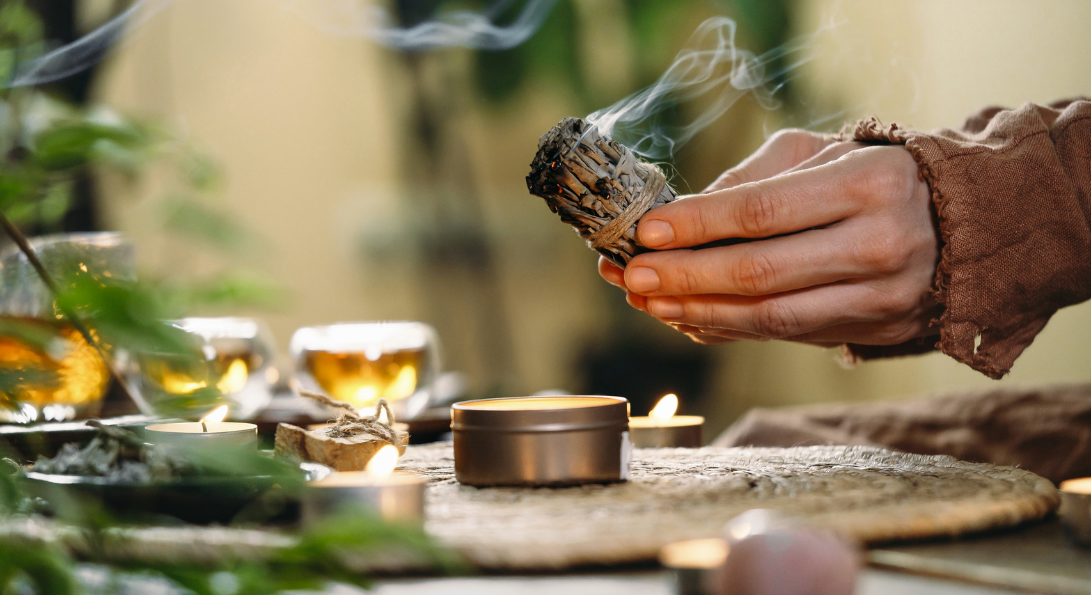
A note on indoor air: Burning herbs is not air purification. Smoke can add particles to indoor air; the smoke-free routine below lets you mark a fresh start without a flame.
After a difficult week, you may want your room to feel like a place you can begin again. A small ritual can give that intention a shape: putting away work, choosing a quiet corner and saying what you want to carry into the evening. If you think of this as clearing energy, you can cherish the symbolism without treating it as a physical cleansing process.
Some people use smoke in a spiritual or personal ritual to mark a transition or set an intention. The language of “clearing energy” is an interpretation, not a measurement of air quality or proof that a harmful force has left a room.
What does smoke cleansing mean?
In a personal spiritual practice, smoke may symbolize release, remembrance or a transition. The meaning depends on the person and tradition; there is no single ceremony or script that fits everyone. A generic home ritual should not be presented as instruction in a community’s named sacred ceremony.
You can also choose a smoke-free gesture with the same personal intention. The point of the routine here is to make space for attention and a practical change, not to prove that an invisible presence has gone.
Do not confuse a ritual with air cleaning
The U.S. Environmental Protection Agency explains that indoor combustion can generate particulate matter. Inhaled particles can affect the lungs and heart; some people, including those with certain heart or lung conditions, children, and older adults, may be more vulnerable. A pleasant or meaningful scent does not establish that smoke is healthy.
The practical implication is to avoid treating burning herbs as a way to disinfect or purify indoor air. Opening a window does not turn a symbolic practice into a proven health intervention.
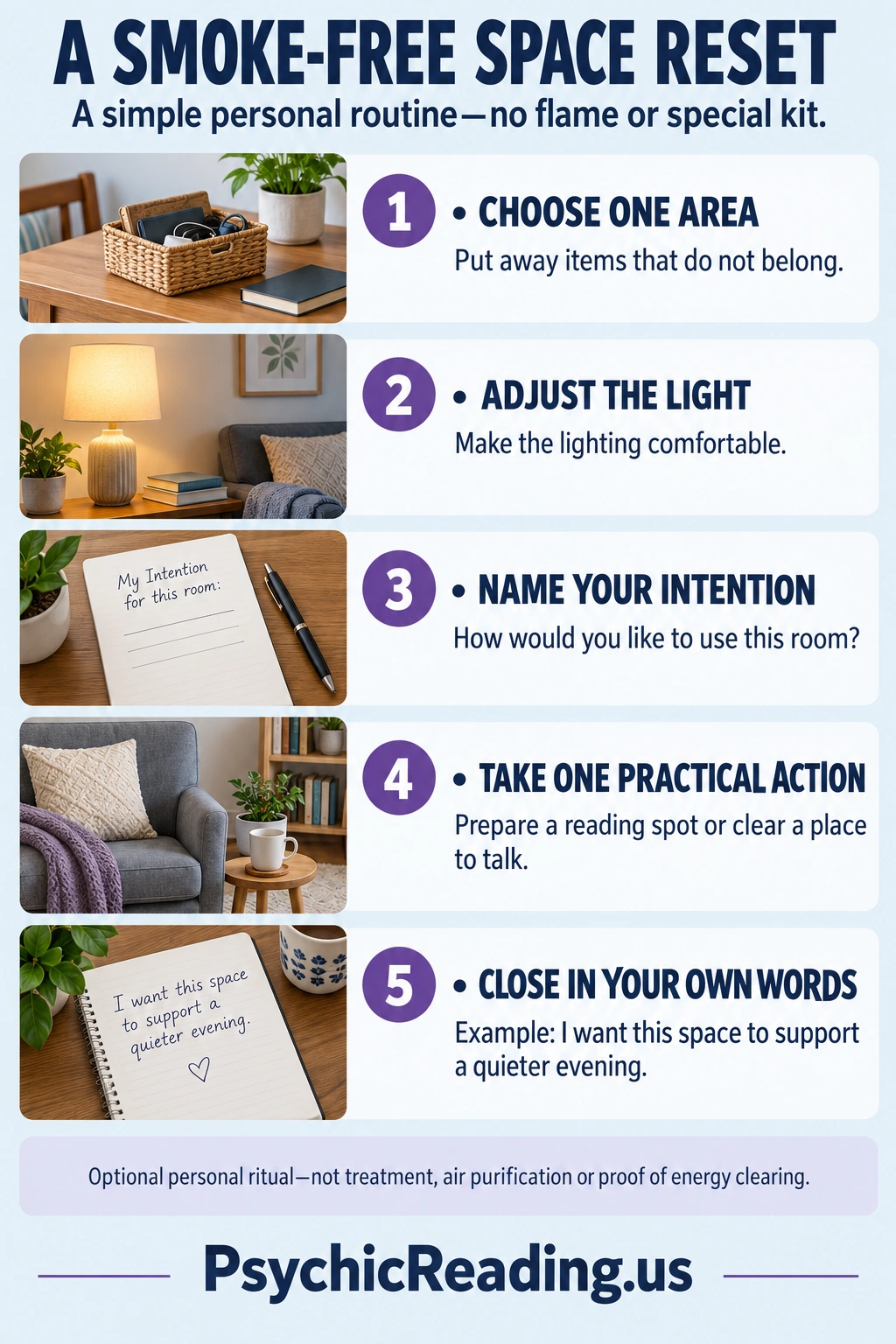
Read the infographic text
A simple personal routine—no flame or special kit.
- Choose one area: Put away items that do not belong.
- Adjust the light: Make the lighting comfortable.
- Name your intention: How would you like to use this room?
- Take one practical action: Prepare a reading spot or clear a place to talk.
- Close in your own words: Example: I want this space to support a quieter evening.
Optional personal ritual—not treatment, air purification or proof of energy clearing.
A smoke-free reset
If your aim is to make a room feel more intentional, no flame is necessary. Try a short, ordinary sequence:
- Choose one small area and put away items that do not belong there.
- Adjust the lighting to something comfortable.
- Pause and name the change you would like to make in how you use the room.
- Choose one practical action: prepare a place to read, set aside work materials, or make space for a conversation.
- Finish with a sentence in your own words, such as “I want this space to support a quieter evening.”
This is an optional personal routine, not a treatment or a guarantee of an emotional result. There is no need to buy a special kit or follow a script said to remove unseen threats.
Make the intention your own
For example, before a reading or an evening of journaling, you might clear one surface, turn on a comfortable lamp and put your phone aside. Try a sentence such as “I want to listen carefully and keep my own judgment.” Then write one question you would like to reflect on. This is a suggested personal routine—not a traditional ceremony or a promise about the reading.
When you finish, notice an ordinary result: you have a place to sit, fewer distractions or a clearer question. A subtle experience is enough; you do not need a dramatic sensation to make the ritual worthwhile to you.
If smoke or flame is involved
Follow product instructions, building rules, and applicable fire restrictions. Do not leave burning material unattended or place it near flammable objects. Consider everyone sharing the space, and choose a smoke-free alternative when smoke exposure is a concern. Do not fill a room with smoke as a measure of how well a ritual is working.
Be thoughtful about language and tradition
Do not assume every smoke-related practice is interchangeable or that a generic internet script represents a particular community’s ceremony. If you want to learn a named tradition, seek information from the community that practices it and respect its boundaries.
Keep shared-space boundaries
Ask before introducing smoke, fragrance, music or ritual objects into a shared room. Another person’s discomfort is not proof that they are spiritually resistant. A personal practice should leave room for their preferences, health concerns and beliefs.
If someone claims your home has a curse and requires repeated paid cleansing, pause before spending. An unsettling feeling does not establish that diagnosis. You can seek practical help for a real household concern without accepting a fear-based spiritual explanation.
Focus on what you can observe
A cleaner surface, less clutter, or a deliberate pause can change your experience of a room without proving an energetic mechanism. Notice those concrete changes rather than assuming discomfort means a spirit, curse, or attachment is present.
For more on describing an experience before interpreting it, read our guide to meditation imagery. The editorial policy explains why we distinguish spiritual language from health claims.
*So you’re telling me all I need is some herbs and smoke to solve my life problems? Where do I sign up? 😂*
Honestly, this sounds like a bunch of nonsense. How can smoke from herbs possibly affect energy? It’s just superstition. 😒
I absolutely love the idea of smudging! It’s such a beautiful ritual to cleanse your space and invite positivity. 🌿✨
*Smudging your house? Sounds like an excuse to throw a mini bonfire indoors! Just don’t forget the marshmallows! 🔥🍫*
Interesting read! Historically, many cultures have used smudging for purification purposes. It’s fascinating how these practices transcend generations! 📚
While I appreciate the traditions behind smudging, isn’t it problematic to claim that negative energy exists? We should focus on psychological well-being instead. 🤔
*Sure, smudging might be nice and all, but wouldn’t it make more sense to just clean your house regularly? Seems way more practical.*
*Great, just what I needed—another reason to burn things in my house while pretending it’s for ‘positive energy.’ 🙄*