
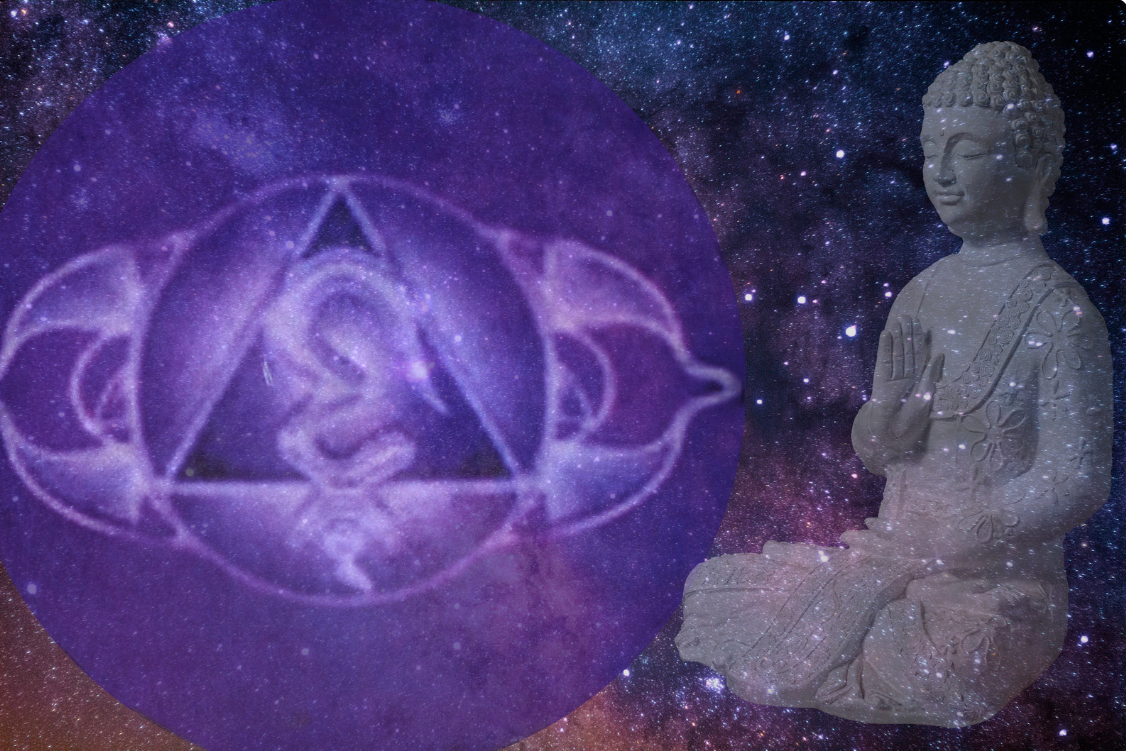
What would it mean to see your life more clearly—not to predict every turn, but to notice what matters beneath the noise? That question is a useful doorway into the Ajna chakra, often called the third eye.
For people drawn to intuition, meditation and psychic readings, the third eye can be a compelling symbol of inner vision. You can explore that symbolism with curiosity while keeping your judgment, physical comfort and everyday responsibilities intact.
What is the Ajna chakra?
Ajna is commonly associated with the brow or eyebrow center in yogic chakra teachings. It belongs to a spiritual understanding of the subtle body, rather than being a visible organ or a medical explanation for how intuition works. Chakra teachings have roots in Indian spiritual traditions, and descriptions differ across traditions and modern interpretations.
In its teaching on Ajna, intuition and self-knowledge, the Himalayan Institute describes the eyebrow center as a “command center” associated with the mind and clear thinking. This is one tradition’s spiritual account, not clinical evidence that a chakra controls mental health.
For a personal practice, you might use the third eye as a reminder to pause, observe and look beyond your first reaction. It need not mean having access to hidden facts or someone else’s private thoughts.
Inner vision is not the same as certainty
An intuitive impression can feel vivid: a dream stays with you, a symbol seems relevant, or a possibility suddenly becomes clear. The feeling may be meaningful without making the interpretation correct.
Suppose you keep imagining a new direction for your work. Instead of deciding that your third eye has confirmed the future, ask what the image brings into focus. Are you craving more creativity? Is there a practical opportunity you can investigate? What information would you need before making a decision?
A helpful journal separates three things:
- The experience: what you noticed, pictured or felt.
- The interpretation: the meaning you currently give it.
- The next step: an ordinary action that can help you learn more.
This makes room for spiritual insight without asking it to carry the whole weight of a decision. A reading can offer another perspective, but neither a reader nor a strong impression can guarantee an outcome.
What does “balancing the third eye” mean?
In spiritual language, balance may describe feeling less scattered and more able to reflect. You can translate that aspiration into questions: Am I rushing to conclusions? Am I listening to myself? Am I giving evidence and other people’s words enough attention?
Feeling distracted or unsure does not prove that Ajna is blocked. Nor are headaches, dizziness, anxiety or changes in vision or hearing reliable signs of a chakra problem. Seek appropriate medical advice for new, persistent or concerning symptoms rather than trying to treat them by opening the third eye.
You do not need an intense sensation, unusual vision or dramatic awakening for a practice to have personal meaning. A quieter, more thoughtful response to an ordinary situation can be a worthwhile result in itself.
A gentle third-eye reflection practice
This short practice uses the brow center as an optional focus for attention. It is not a method for producing psychic abilities. Begin with a few comfortable minutes rather than a demanding goal.
- Settle into a supported position. Sit in a chair or another position that suits you. Keep your eyes open or softly closed; neither choice makes the practice more spiritually authentic.
- Let your breathing stay natural. There is no need to hold your breath, breathe forcefully or match a strict count.
- Choose a gentle focus. Think of the space between your eyebrows without pressing, straining your eyes or trying to create a physical sensation. If that feels uncomfortable, notice your hands or the support beneath you instead.
- Invite one question. Try “What am I overlooking?” or “What deserves my attention today?” Let an answer remain uncertain.
- Return without forcing. When thoughts wander, notice that and return to your chosen focus. You do not have to empty your mind.
- Close with something concrete. Look around, move comfortably and write one observation alongside one practical action.
If chanting is part of a tradition you follow, a familiar mantra such as Om may accompany your reflection. Silence is also an option. Learn the context of a practice from a teacher or tradition you respect, rather than treating a sacred sound as a guaranteed activation switch.
The National Center for Complementary and Integrative Health’s meditation guidance discusses both possible benefits and limits, including unwanted experiences. Stop or adapt a practice that increases distress, and do not use meditation to postpone needed care.
Yoga: movement, not a test of spiritual progress
Yoga may be part of your spiritual life, but a particular pose does not establish that your third eye has opened. You do not need to master a demanding posture to explore intuition.
You may encounter the following poses in classes or articles about chakra practice:
- Child’s pose.
- Pigeon pose.
- Seated forward bend, or Paschimottanasana.
- Wide-angle seated forward bend, or Upavistha Konasana.
- Bound angle pose, or Baddha Konasana.
- Eagle pose.
- Warrior III.
- Humble Warrior.
- Cow face pose.
This list is not a recommended sequence or a promise that these poses affect Ajna. Some require substantial mobility or balance. Work with a qualified instructor who can help you choose suitable movements and alternatives; a supported seat may be all you need for reflection.
NCCIH’s yoga safety guidance advises beginners to avoid extreme practices and forceful breathing. People with health conditions, injuries or pregnancy may need modifications and advice from their health care provider. Pain is not a spiritual milestone to push through.
Where Kundalini practice fits
Kundalini-oriented teachings may combine meditation, movement, chanting and breathing within a broader spiritual framework. Approaches vary, so ask what a class actually involves rather than assuming all classes share the same methods.
Choose instruction that allows questions, modifications and stopping. Be wary of claims that intense practice will reverse aging, cure anxiety or inevitably give you spiritual visions. You can be interested in the tradition without accepting every promised result. Our guide to Kundalini awakening considers spiritual meaning alongside practical support.
Do purple foods, oils or healers open Ajna?
Colors, scents and objects can help create an atmosphere that feels meaningful. They do not demonstrate that a chakra is opening. If purple symbolizes inner vision for you, a notebook or a piece of fabric can serve as a reminder of your intention; no special purchase is necessary.
There is no need to organize your diet around a chakra color. Enjoy foods because they suit your needs and preferences, not because they promise psychic perception. Essential oils are optional rather than required, and this practice does not involve applying them near the eyes or ingesting them.
If you consult a spiritual practitioner, ask what the session includes, its price and whether touch is involved. You can decline a technique or leave. A claim that you have a dangerous blockage is not a medical diagnosis and does not obligate you to buy further sessions.
Questions worth taking into your week
Ajna symbolism can become more useful when it reaches everyday life. After meditation or a reading, consider:
- Where am I confusing a fear or wish with something I know?
- What detail would help me understand this situation better?
- What can I ask directly instead of guessing?
- What small choice reflects my values today?
You can return to these questions without measuring how “open” your third eye is. Spiritual curiosity and careful judgment can support each other.
Common questions about the Ajna chakra
Where is the third eye?
It is commonly associated with the brow or eyebrow center in chakra teachings. That location is part of a spiritual map, not an additional physical eye.
Does forehead pressure mean my third eye is opening?
A sensation alone cannot establish that interpretation. Avoid straining or trying to intensify it. Seek medical advice for symptoms that concern you rather than assuming a spiritual cause.
Can I explore Ajna without yoga poses?
Yes. A comfortable seated reflection, a journal or learning from a respected tradition may suit you better. Flexibility and advanced postures are not requirements for meaningful spiritual inquiry.
Will opening the third eye make a psychic reading accurate?
No practice can guarantee a reading’s accuracy. Treat interpretations as possibilities for reflection, check factual claims and keep decisions about your life in your own hands.
The potential physical symptoms of an unbalanced third eye chakra, such as headaches and dizziness, are noteworthy. How should one address these if they persist despite regular practice?
Indeed, integrating traditional medical practices with holistic approaches can often yield the best results.
Consulting a healthcare professional is always a good decision if symptoms persist. Balancing chakras may complement but not replace medical advice.
It’s crucial to understand that the chakras are a part of Hindu beliefs. While these practices may be beneficial, they should be approached with respect for the culture they originate from.
The article provides a comprehensive overview of the third eye chakra, detailing its importance and how it can be balanced through various practices.
The concept of using essential oils and foods of specific colors is fascinating. I’m curious about the scientific evidence supporting these practices.
The inclusion of specific yoga poses and meditation techniques is quite helpful. The list of poses is particularly beneficial for those looking to incorporate them into their routine.
It’s interesting to learn about the connection between the third eye chakra and intuition. How effective are these techniques for someone new to yoga and meditation?
As someone who started yoga recently, I found that even beginner poses and basic meditation can make a noticeable difference.
Effectiveness varies individually, but consistency in practice is key to observing benefits.
The article’s emphasis on patience and practice in opening the third eye chakra is essential. Spiritual growth is a journey that requires time and dedication.
Meditation as a method to open the third eye chakra resonates with many spiritual traditions. Consistent practice indeed seems fundamental.
Yes, meditation offers numerous benefits beyond just opening the third eye, including stress reduction and mental clarity.