
Some days, your mind arrives home long before the rest of you feels settled. You are still replaying a conversation, thinking about tomorrow or trying to understand what your intuition is telling you. Guided meditation offers a simple way to pause: instead of deciding what to do next, you follow a few gentle prompts.
If spiritual imagery speaks to you, a grounding meditation can include light, earth or a sense of connection. You can also keep it entirely practical. The aim is not to force a message, empty your mind or prove you can control invisible energy. It is to make room for attention and notice what feels helpful.
What is guided meditation?
Guided meditation uses spoken or written instructions to support your attention. A guide might invite you to notice the room, rest your attention on a sound or picture a peaceful scene. You can follow a recording, work with an instructor or read a short script and practice at your own pace.
Guided imagery is one option, not the whole practice. You do not have to see vivid pictures in your mind. A word, an idea or the simple feeling of the chair beneath you can be enough to work with.
There is no need to feel instantly calm. Some sessions may feel ordinary or distracting. You can adjust the practice, shorten it or decide that another way of taking a break suits you better.
What “energy” can mean in a spiritual practice
People often use “energy” to describe vitality, mood, atmosphere or a spiritual sense of connection. You might say a place feels peaceful or that a demanding day has left you drained. This language can express your experience without establishing a measurable energy field.
Energy in physics is a different concept. Scientific uses of that word do not prove that intentions attract matching events, that emotions weaken a spiritual field or that meditation heals illness. Feeling tired also does not mean you have failed to think positively.
You can respond to feeling drained with ordinary care: rest, a meal, practical support or a manageable boundary. If fatigue or other symptoms persist or concern you, seek appropriate healthcare advice rather than assuming you only need to “recharge” spiritually.
Being around someone who is sad or depressed does not make them a harmful energy source. You can care about another person and still recognize the limits of your time and capacity. Boundaries do not require blaming them for how you feel.
Grounding as a sense of steadiness
In this guide, grounding means returning attention to the present and to the support around you. It does not mean that you can make an unsafe situation safe through visualization. If there is a practical problem to address, the meditation can be a pause before action—not a substitute for action.
For a spiritual practice, earth imagery may symbolize stability. You might imagine roots, solid ground or a familiar garden. If that symbolism feels right, use it gently. If not, simply notice the floor and the surface supporting your body.
The four elements as optional imagery
Earth, water, air and fire can serve as personal symbols in a meditation. You do not need to make historical claims about their use or treat them as a physical explanation of the body.
- Earth: A symbol of steadiness, such as a path or a tree.
- Water: A symbol of flexibility, such as a quiet stream.
- Air: A symbol of space, such as an open sky.
- Fire: A symbol of warmth or intention, imagined rather than created with a real flame.
Choose one image rather than trying to work with everything at once. These associations are suggestions for this exercise, not universal rules or healing mechanisms.
Before you begin
- Choose an appropriate moment. Do not follow a meditation while driving or doing anything that requires full attention.
- Get comfortable. Use a chair, cushion or another supported position. You do not need a special pose or an uncomfortable stretch.
- Keep the first session short. Try a few minutes rather than committing to a long recording. You can finish sooner.
- Decide how to focus. Keep your eyes open or closed as you prefer. If attention to breathing feels uncomfortable, use a sound or an object in the room.
- Let yourself stop. A guide’s instructions are invitations, not orders. Avoid recordings that demand you push through fear or promise guaranteed awakening.
For more position options, see our guide to comfortable meditation posture.
A short guided grounding meditation
Read these prompts slowly, leaving a little time between them. If you prefer, read the sequence first and then remember only the parts you want to try. The light and earth imagery are optional.
- Arrive. Notice where you are. Look at a few ordinary objects around you and let your body settle into its support.
- Notice your contact points. Feel the chair, cushion or floor. You do not need to change anything immediately.
- Let breathing stay natural. Notice a comfortable breath without taking unusually deep breaths or holding it. Alternatively, listen to a nearby sound.
- Imagine light, if you wish. Picture a soft white light above you, or simply think of the word “space.” Let it be an image, not a task you must perform correctly.
- Imagine a connection with the earth. Picture the light extending toward the ground, or notice your feet and the floor. There is no need to sense energy moving through your body.
- Allow support to be a symbol. You might imagine steadiness rising from the earth. If that feels unhelpful, return to the actual support beneath you.
- Notice without diagnosing. If you feel tension or distraction, acknowledge it. Do not interpret a sensation as an energy imbalance or a message you must decode.
- Return to the room. Look around, move gently as comfortable and choose one ordinary next step.
A phrase such as “I can take one thing at a time” may help you end the practice. If it does not fit, use your own words or no phrase at all. You have not failed if your mind wandered.
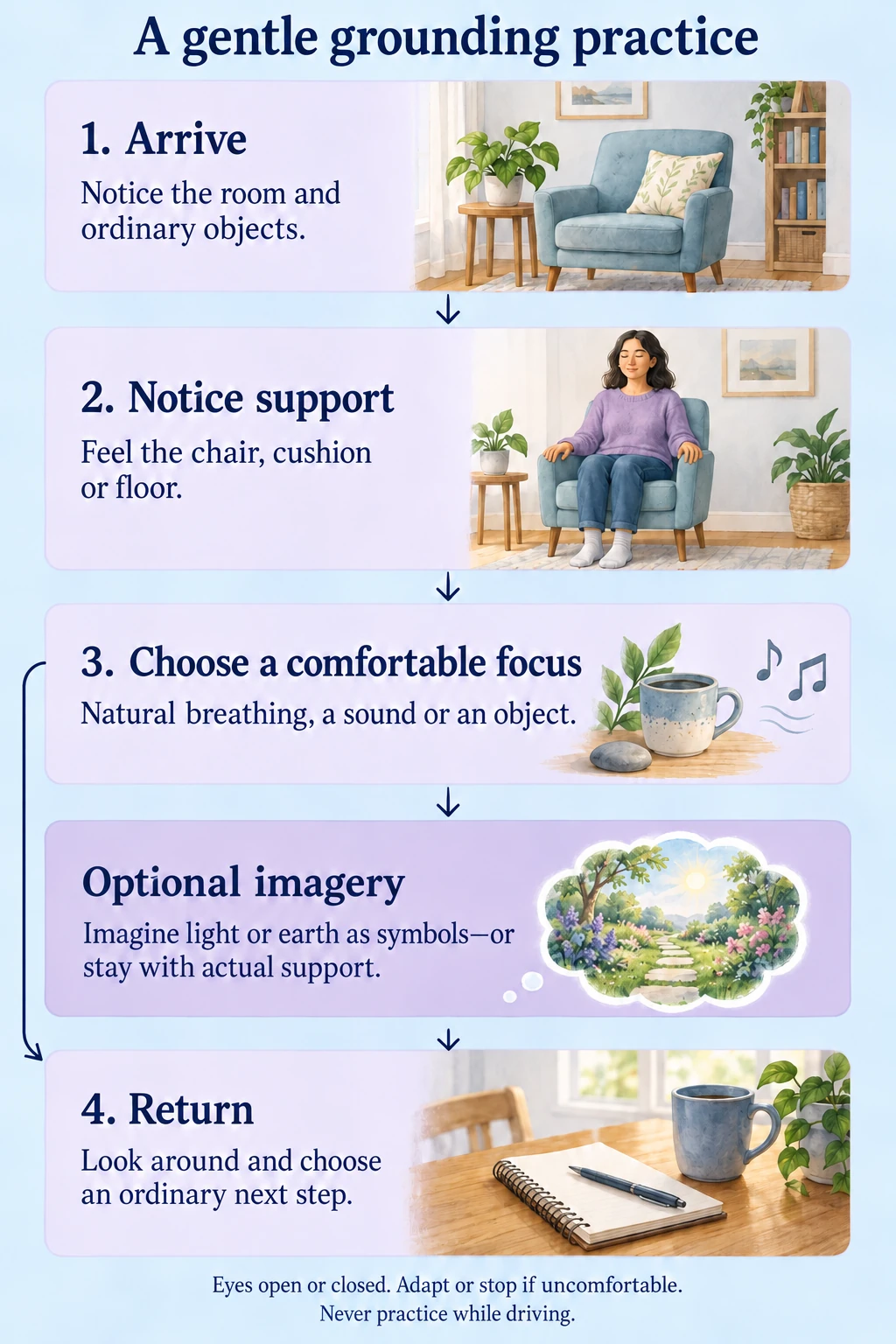
Read the grounding practice guide as text
- Arrive: notice the room and ordinary objects.
- Notice support: feel the chair, cushion or floor.
- Choose a comfortable focus: natural breathing, a sound or an object. If you wish, imagine light or earth as symbols; you can skip imagery and stay with actual support.
- Return: look around and choose an ordinary next step.
Eyes open or closed. Adapt or stop if uncomfortable. Never practice while driving.
Use the pause to support a real next step
Suppose you are hoping for clarity before a psychic reading about a relationship. After the meditation, write down what you want to ask, what you already know and what remains uncertain. That can help you approach the conversation with clearer expectations.
An image that appears during the practice might offer a useful personal association. It does not establish what another person thinks or what will happen. You can value an intuitive impression while checking it against observable facts and direct communication.
Other next steps may be less spiritual: make a small plan, ask for help, have lunch or leave an unimportant task for tomorrow. A moment of calm does not obligate you to solve your whole life.
Choose a guide who leaves room for you
Preview the introduction to a recording before settling in. Look for a pace and voice you find comfortable, clear instructions and permission to adapt. Ask an instructor about their training, approach and how they respond if a participant becomes distressed.
Be cautious about claims that one session will heal you, clear every blockage or unlock accurate psychic messages. Paying more does not establish a practice’s effectiveness. You do not need an app, crystals or a purchased course to use the short exercise above.
When meditation does not feel helpful
If a practice increases anxiety, distress or disconnection, stop and return to your surroundings. Consider an ordinary activity or support from someone you trust instead. Do not assume discomfort is evidence that you must continue to achieve a breakthrough.
The National Center for Complementary and Integrative Health’s meditation guidance notes that some people report negative effects and that safety evidence is limited. It also advises against using meditation to replace conventional care or postpone seeing a healthcare professional.
If distress persists, interferes with daily life or makes you feel unsafe, seek appropriate professional support. Spiritual practice can sit alongside care, but a meditation guide or psychic reading should not diagnose symptoms.
Common beginner questions
Do I need to clear my mind?
No. When you notice a thought, you can gently return to your chosen focus. The practice does not require a perfectly blank mind.
What if I cannot visualize white light?
Skip the image. Notice the chair, a sound or an object instead. Imagery is optional and does not measure spiritual ability.
Should I meditate every day?
You can choose a rhythm that suits you, but daily practice is not a requirement for worth, spiritual growth or health. Adjust the length and frequency to your experience rather than treating a streak as a test.
Does feeling peaceful mean a message is accurate?
No. A peaceful feeling can be welcome without verifying a prediction or interpretation. Give yourself time before acting on an impression, especially for important decisions.
A gentler way to begin
Start with support beneath you, a few quiet prompts and permission to stop. Whether you use earth imagery, white light or no spiritual imagery at all, let the practice be a small space for attention. You do not have to force an extraordinary experience to make that space worthwhile.
The method for grounding meditation is well-explained. It is crucial to find time daily to focus on our own energy and intentions.
I tried the grounding meditation and found it very effective in calming my mind. It’s simple yet powerful.
Focusing on the white light and the energy flow helps in visualizing and realigning my energy. I recommend it to everyone.
Grounding meditation seems like a practical tool for achieving balance and calm. I appreciate the step-by-step guide provided.
The connection between energy and human well-being is fascinating. The idea that energy levels can be managed through practices like meditation and yoga is certainly worth exploring further.
It’s interesting to see how ancient teachings about the four elements are still relevant today in the context of energy management and grounding.
The concept of energy being integral to our mental and emotional health is compelling. The idea that our intentions can influence our energy is something I need to ponder more.
I agree. It would be intriguing to see more scientific research on how our thoughts and emotions impact our energy levels.
Learning to manage and recharge our energy seems crucial in today’s fast-paced world. Practices like meditation and spending time in nature can indeed be very beneficial.
Absolutely. As someone living in a bustling city, I find that these practices help me maintain a sense of peace and stability.
Connecting with the earth element for stability is a profound concept. Activities like gardening or hiking can also help in grounding oneself.
The article provides a good overview of the importance of energy in our lives. It would be useful to see more references to scientific studies supporting these claims.