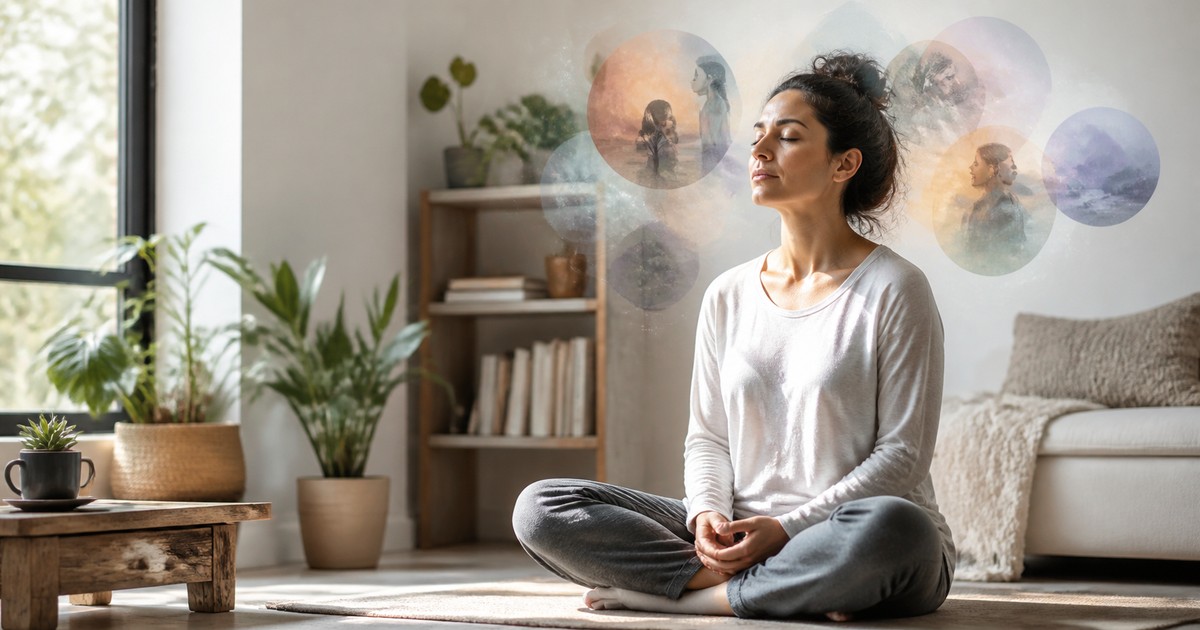
During meditation, some people notice colors, shapes, faces, memories, dreamlike scenes, or a sense of inner space. Others notice nothing visual at all. Both experiences are normal variations of attention and imagery. A spiritual practitioner may call the experience inner vision or clairvoyant imagery, but the image itself is not proof of a message, diagnosis, past life, or external being. The safest method is curious, nonliteral, and grounded.
Quick Guide
Why imagery may appear
Meditation can reduce external input and make internal material easier to notice. Memory fragments, visual imagination, light through the eyelids, expectations, and the transition toward sleep can all shape experience. You do not need to choose a final explanation immediately.
People vary widely in visual imagery. Not seeing pictures does not mean you are blocked or spiritually less capable.
Describe before interpreting
After the session, record what you actually noticed: “a blue oval moved left,” “a childhood room appeared,” or “I felt warmth and sadness.” Then list possible associations. Description slows the leap from sensation to certainty.
Avoid universal charts claiming every color or animal always means one thing. Personal, cultural, and situational meanings differ.
A safe ten-minute practice
Sit somewhere stable where you will not need to drive or supervise machinery. Keep eyes softly open or closed. Notice contact points and ordinary sounds. Follow comfortable breathing for five minutes, then allow images to come and go without chasing them. Finish by naming the date, place, and next task.
If you become frightened, open your eyes, move, look around, and stop.
Use spiritual symbolism as a question
If a symbol feels meaningful, ask: What does it remind me of? What emotion came with it? What current situation shares that quality? What action would be harmless and useful even if the image were random? This keeps interpretation connected to life.
Do not use imagery to diagnose illness, accuse another person, or replace evidence.
Meditation has limits and possible adverse effects
Meditation is often considered low risk, but negative experiences—including anxiety or depression—have been reported. More intensive practice is not always better, and a technique that helps one person may unsettle another.
People with trauma histories or active mental-health symptoms may benefit from shorter, eyes-open, externally anchored practice and guidance from a qualified clinician or trauma-informed teacher.
When to seek professional support
Brief imagery during meditation that ends with the practice may be benign. Seek qualified help when sensory experiences persist outside practice, command you to act, cause major fear, disrupt sleep, impair functioning, or come with confusion or safety concerns.
Spiritual meaning and clinical support do not have to cancel each other. Safety comes first.
Continue Exploring
Frequently Asked Questions
Why do I see colors when I meditate?
Light through the eyelids, visual imagery, attention, expectation, and other ordinary factors can contribute. A color does not have one proven meaning.
Does imagery mean my third eye is open?
That is a spiritual interpretation, not a scientific conclusion. You can explore it symbolically without treating it as proof.
What if I see nothing?
Nothing is wrong. Many people do not experience vivid visual imagery.
Can meditation cause hallucinations?
Meditation experiences vary. Persistent or distressing sensory experiences outside practice should be discussed with a qualified clinician.
Should I follow instructions from an inner voice?
Do not obey harmful, risky, legal, financial, or medical instructions. Stop and seek help if a voice is commanding or frightening.
How long should I practice?
Start with five to ten minutes and increase only if the practice remains helpful and stable.
Should I journal during meditation?
Journal afterward so writing does not become a distraction or safety issue.
Can meditation replace mental-health treatment?
No. It may complement care but should not replace assessment or treatment when symptoms are significant.
Sources and Method
This article distinguishes reflective or spiritual interpretation from established evidence and uses the following sources for factual health or research claims: