

A blue glow, a warm gold light, a feeling of openness around someone: aura language gives spiritual readers a colorful way to describe impressions that can be difficult to put into words. If the idea draws you in, you can explore it with curiosity without making every color a verdict about your character or future.
In spiritual practice, an aura is described as a subtle field around a person. Its colors and layers are interpreted in different ways by different teachers. Those interpretations are beliefs and symbolic frameworks, not a medical scan or reliable access to another person’s private thoughts.
The most helpful starting question may be, “What does this image invite me to reflect on?” rather than “What does it prove about me?”
What is an aura in spiritual language?
Aura teachings often connect the idea of an energy field with feelings, thoughts, relationships and spiritual life. For example, the Barbara Brennan School of Healing describes a seven-level model spanning physical experience, emotions, thought, relationship and spiritual themes. This is an account of that school’s teaching, not scientific confirmation of the field it describes.
You might find the language meaningful because it encourages you to notice how you feel in different settings. Feeling at ease or uncomfortable is worth acknowledging, but it does not establish that you have detected someone’s aura or identified their intentions.
An aura interpretation should not be used to diagnose illness, declare that someone is dangerous, assign spiritual worth or promise protection from harm. Your observations, consent and practical choices still matter.
Seven layers: a vocabulary for reflection
Some contemporary accounts use the following names. Terminology and interpretations vary; do not treat the list as seven measurable shells at fixed distances from your skin. The questions here are optional journal prompts, not tests for whether a layer is healthy.
- Etheric: a body-focused theme. What would help you feel physically comfortable in this moment?
- Emotional: a feeling-focused theme. What emotion can you name without judging it?
- Mental: a thought-focused theme. Which idea are you repeating, and what evidence supports it?
- Astral: a connection-focused theme. Where do you feel supported, and what boundary needs attention?
- Etheric template: a pattern or structure theme. Which routine helps you live according to your values?
- Celestial: a spiritual connection theme. What inspires gratitude, wonder or compassion for you?
- Spiritual: a meaning-focused theme. What matters beyond the demands of this particular day?
You can use one question without accepting every part of a layered model. There is no need to conclude that an invisible structure is damaged because a question brings up a difficult feeling.
Aura colors: personal meaning rather than a fixed code
Colors can offer a vivid starting point for reflection, but readers do not all use the same meanings. A color does not certify a personality trait, a healing ability or spiritual advancement. Your own associations may also differ from a reader’s.
Instead of memorizing a rulebook, try these suggested themes and questions:
- Red — energy or conviction: What matters enough for you to act, and how can you act without rushing?
- Orange — creativity: What would you enjoy making or exploring without needing it to be perfect?
- Yellow — confidence: Where can you take a manageable step using what you already know?
- Green — compassion: How can care include your own needs as well as someone else’s?
- Blue — expression: What would you like to say clearly and respectfully?
- Turquoise — steadiness: What ordinary habit helps you feel supported?
- Gold — meaning: What value would you like your next choice to express?
- Pink — affection: How could you show care without expecting a particular response?
- Lavender — imagination: Which possibility interests you, and what practical information would help you explore it?
- White — perspective: What could you look at with a little more openness?
These are invitations, not a standardized interpretation system. If someone associates a color with anger, that does not mean the color proves you are angry. If “healing” appears in a reading, ask whether the speaker means spiritual comfort rather than treatment of a health condition.
Can an aura photograph show your energy?
It helps to distinguish a colorful portrait from evidence of a spiritual field. AuraCamera’s own description says its system processes signals from two hand sensors and renders colored visuals over a portrait. The manufacturer presents it as a creative experience for entertainment, reflection and personal exploration.
That process is not the same as directly photographing an invisible aura surrounding your body. A portrait can be an enjoyable keepsake or a conversation starter without establishing your mood, health, destiny or psychic ability.
Before paying for a session, ask which equipment is used, how the colors are generated, what the price includes and how your photograph will be handled. Do not assume every service uses the same system. You can decline an interpretation or additional purchase while still enjoying the image.
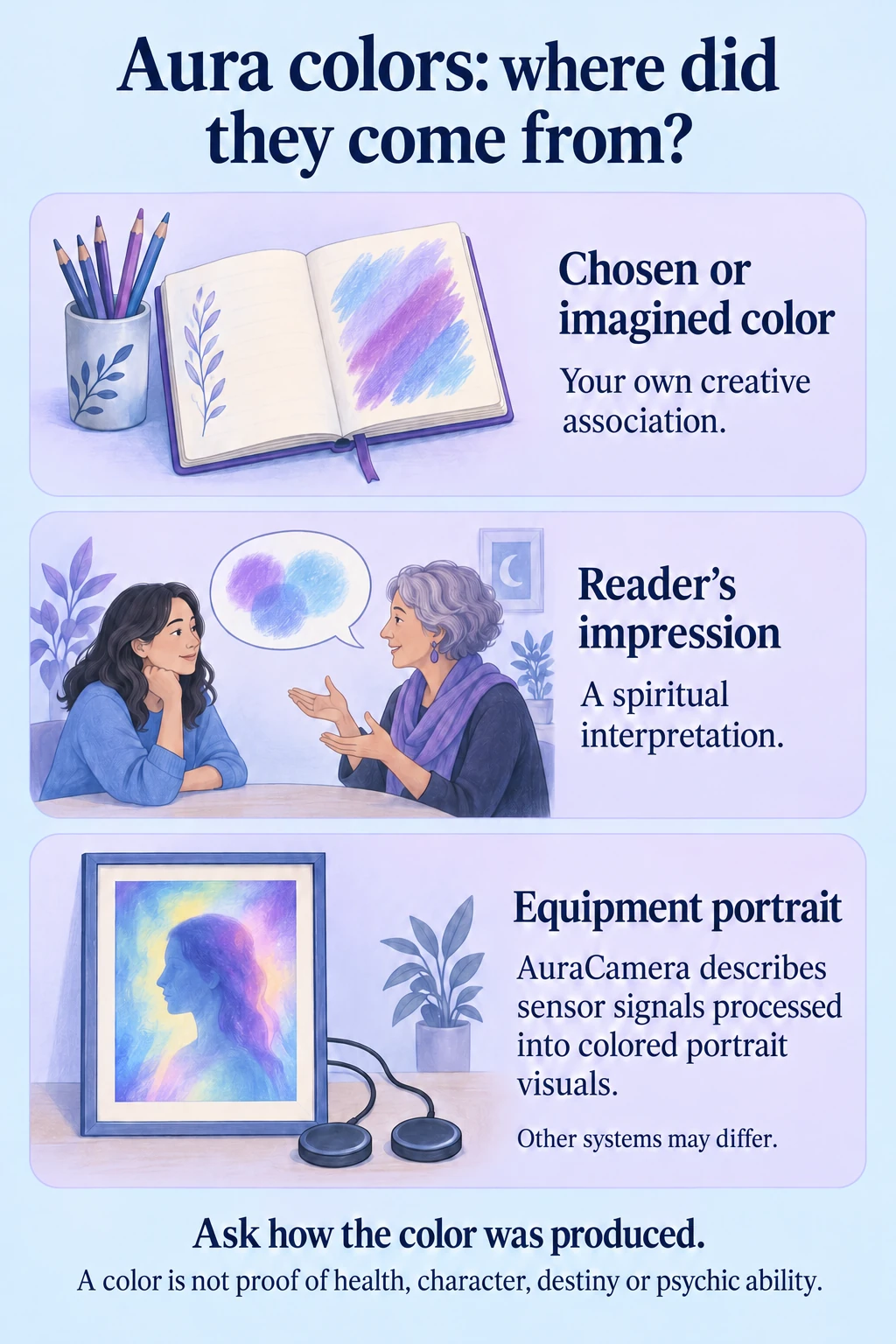
Read the aura-color comparison as text
- Chosen or imagined color: your own creative association.
- Reader’s impression: a spiritual interpretation.
- Equipment portrait: AuraCamera describes sensor signals processed into colored portrait visuals. Other systems may differ.
Ask how the color was produced. A color is not proof of health, character, destiny or psychic ability.
The “clair” senses: what the terms mean
In psychic and mediumship vocabulary, “clair” terms describe claimed forms of spiritual perception. They are descriptions of beliefs, not labels that establish the cause of a sensory experience:
- Clairvoyance, or clear seeing: imagery interpreted as spiritual insight.
- Claircognizance, or clear knowing: a sense of knowing interpreted as arriving without an obvious reasoning process.
- Clairsentience, or clear feeling: feelings or bodily impressions given a spiritual interpretation.
- Clairaudience, or clear hearing: sounds or words interpreted as spiritual communication.
- Clairalience, or clear smelling: scents interpreted as spiritually significant.
- Clairgustance, or clear tasting: tastes interpreted as spiritually significant.
Seeing, feeling and knowing are different ideas, so there is no need to call every aura impression “clairsentience.” Nor does imagining a color, cooking intuitively or recalling a familiar scent prove a supernatural gift.
If you experience voices, sights, smells or tastes without an apparent external source, seek medical advice rather than deciding from this list that you have a psychic ability. The NHS explains that such experiences can have different health-related causes and recommends medical help for hallucinations. A spiritual interpretation does not rule those causes out. Seek emergency help if you feel at risk of harming yourself or someone else, or become suddenly confused.
For a more detailed, supportive discussion, see hearing voices and spiritual interpretation.
A gentle aura-inspired journal exercise
You do not need to stare at yourself, strain your eyes or try to produce a glow. Use imagination deliberately, without treating it as a perception test:
- Choose a comfortable setting. Ordinary lighting and a supported seat are enough.
- Pick a color. Choose one you like, draw it or write its name. It does not have to “arrive” as a message.
- Describe an association. What does the color mean to you today?
- Separate feeling from conclusion. “I feel worried” is different from “My aura proves something bad will happen.”
- Choose one action. Turn the reflection into something practical, such as asking a question, resting or preparing for a task.
For example, choosing blue might remind you of a conversation you have postponed. You could write the sentence you want to say and consider a respectful time to say it. The useful result is your clearer intention, not proof that a chakra or aura has changed.
If the exercise feels uncomfortable, stop. You can explore spiritual meaning through words, music or ordinary observation instead. No daily practice is required, and a lack of imagery is not a failure.
What to ask an aura reader
If you choose a reading, ask how the reader understands their impressions and what limits they place on them. Useful questions include:
- Are the colors an intuitive interpretation, a visualization or an equipment-generated image?
- Do you use a particular tradition or your own symbolic meanings?
- What does the session cost, and are additional services optional?
- Can I decline a topic, disagree with an interpretation or stop?
- If photographs or notes are taken, what happens to them?
A reader’s answer should leave room for your judgment. You do not have to accept claims that a dark color means a curse, illness or inevitable misfortune, or that repeated paid cleansing is the only way to stay safe. For related questions, see what to expect before an aura-cleansing session.
Common questions about auras
Does an aura color reveal who I truly am?
No color interpretation can establish your whole identity. You can consider a theme without allowing it to define your worth, choices or future.
Can colors change?
Some spiritual accounts describe changing colors, but that is part of their interpretation system. An imagined color or a different portrait is not proof that a spiritual field has changed.
Do I need to develop psychic senses to explore aura ideas?
No. You can use the language for reflection without claiming a psychic ability. Meditation is optional and should not be presented as guaranteed training in supernatural perception.
Can an aura reading diagnose a health problem?
Do not rely on it for diagnosis or treatment. Seek an appropriate health professional for symptoms or concerns, and do not postpone care because of an aura interpretation.
Keep the wonder, and keep your choices
Aura language can be a creative way to explore what feels meaningful, what needs attention and how you want to live. Its most helpful use leaves you curious, not frightened or trapped by a label.
You can enjoy a colorful portrait, a symbolic reading or a quiet journal exercise while remaining honest about uncertainty. Let the interpretation begin a thoughtful conversation rather than decide your life for you.
The relationship between auras, chakras, and clair senses is well-articulated. It sheds light on how intuition and spiritual gifts can enhance one’s perception of the world.
The idea that colors within the aura can change based on one’s mood or energy levels offers a dynamic perspective on personal and spiritual evolution.
The detailed description of the different layers and colors of the aura is quite informative. It’s intriguing how each layer correlates with specific chakras and aspects of our lives.
The concept of an aura and its layers is indeed fascinating. It provides a holistic view of the human energy field, which can be instrumental in understanding one’s emotional and mental state.
The notion of using photography to see auras is intriguing. It would be interesting to learn more about how this technology works and its accuracy.
Indeed, understanding the scientific basis of aura photography would add a layer of credibility to these concepts. It warrants further exploration.
The explanation of clairsentience and other clair senses highlights the diverse ways individuals can tap into spiritual insights. It’s a compelling read for those interested in metaphysical studies.
Training and developing the ability to see auras sounds like an interesting practice. It would be beneficial to explore how different methods, such as clairsentience, are employed in this process.
Understanding the significance of various aura colors and their connection to chakras offers a comprehensive framework for personal introspection and spiritual growth.