

Sometimes the clearest message you need is not a prediction about your future. It is the quiet realization that your week has no room left in it. You may still care about your work, family and spiritual life, yet feel too depleted to enjoy any of them.
If you describe that feeling as being burned out, start with compassion rather than another self-improvement assignment. You do not have to earn rest by finishing everything first. A calendar reset, a realistic boundary or a request for help can be a meaningful beginning—but exhaustion is not always something you can solve by planning better.
What does feeling burned out mean?
In everyday conversation, people use “burned out” for many kinds of overwhelm. The World Health Organization’s ICD-11 description uses burnout specifically for an occupational phenomenon linked to chronic workplace stress, with exhaustion, distance or cynicism toward work and reduced professional effectiveness. It is not classified there as a medical condition.
You can still take exhaustion from caregiving, study, household demands or other pressures seriously without fitting that occupational definition. This article is a practical reflection guide, not a way to diagnose the cause of tiredness.
For spiritually minded readers, feeling drained may bring up questions about energy or intuition. Those words can express your experience, but they do not establish an energetic cause. You have not failed spiritually because you are tired, and you do not need to raise your vibration before asking for support.
1. Look at your calendar—and the work it does not show
Review the coming week before agreeing to anything new. Include travel, preparation, household tasks, caregiving and recovery time, not just appointments. An apparently empty evening may already carry several hours of invisible work.
Sort commitments into three groups:
- Keep: Important commitments you can reasonably meet.
- Reschedule: Tasks that can move, with an agreed new time.
- Decline: Optional requests you do not currently have capacity for.
For example, you might keep a necessary appointment, ask to move a nonurgent meeting and decline organizing a social event. You do not have to remove every enjoyable activity; a low-pressure visit with someone supportive may matter more than an optional task.
Necessary responsibilities cannot always be dropped. If your load exceeds what you can manage, ask about sharing tasks, adjusting priorities or getting practical assistance. At work, a conversation might be: “I can complete A or B by Friday, but not both. Which is the priority?”
Do this without comparing your capacity with someone else’s. Your circumstances, resources and needs are not visible in another person’s calendar.
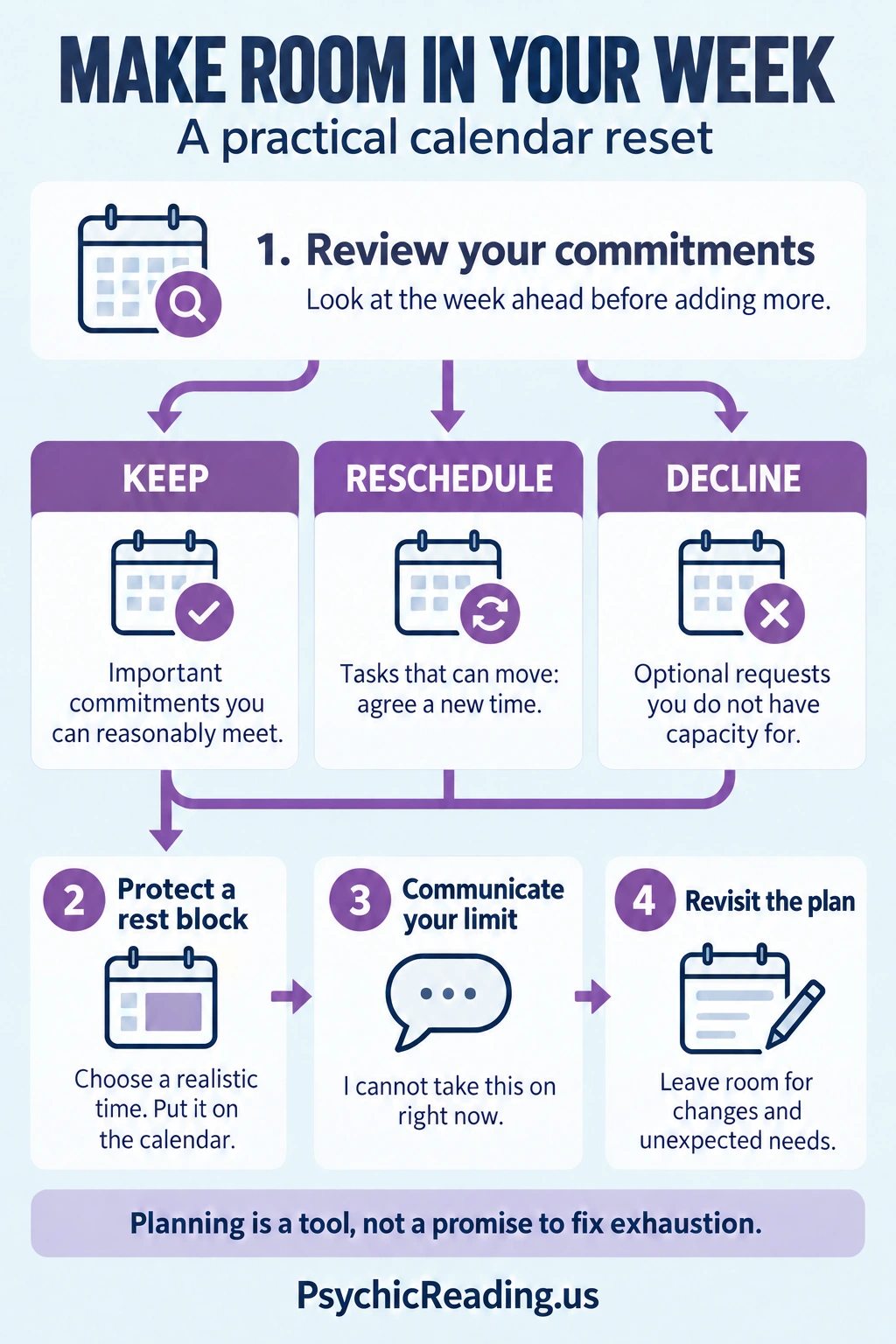
Read the infographic text
Make room in your week: a practical calendar reset.
- Review your commitments. Look at the week ahead before adding more.
- Keep: Important commitments you can reasonably meet.
- Reschedule: Tasks that can move: agree a new time.
- Decline: Optional requests you do not have capacity for.
- Protect a rest block. Choose a realistic time. Put it on the calendar.
- Communicate your limit: “I cannot take this on right now.”
- Revisit the plan. Leave room for changes and unexpected needs.
Planning is a tool, not a promise to fix exhaustion.
2. Say no clearly, without turning it into a spiritual test
A boundary can be kind and specific. You do not need to prove that someone has “bad energy” to decide that you cannot take on another commitment.
- “I cannot help with this this week.”
- “I can offer twenty minutes, but I cannot manage the whole task.”
- “I need to check my schedule before I agree.”
- “I am keeping that evening free for rest.”
You may feel guilty even when your limit is reasonable. That feeling does not automatically mean the boundary is wrong. At the same time, other people may have legitimate needs or be disappointed; you can acknowledge that without promising capacity you do not have.
If saying no could put you at risk, prioritize support and safety rather than forcing a confrontation. Workplace power, finances and caring responsibilities can make boundaries complicated. A trusted person, manager, representative or appropriate support service may help you explore realistic options.
3. Protect rest without making self-care another job
Self-care does not have to mean appointments, products or an expensive retreat. It may mean eating a meal without multitasking, making room for sleep, asking someone to cover a task or sitting comfortably for a few minutes.
Choose a rest block you can actually protect. Tell anyone who needs to know what will happen during that time, especially if you share caring responsibilities. Start small if that is what your circumstances allow; do not turn a missed break into another reason to criticize yourself.
If prayer, a quiet ritual or journaling feels nourishing, you can include it. Try a simple intention: “For these few minutes, I do not need to solve everything.” You can also take a break from spiritual practice if readings, meditation or searching for signs have become another demand.
Rest may help, but it is not a guarantee of recovery. If the same workload repeatedly overwhelms you, consider what needs to change around you—not only what you need to do differently within yourself.
4. Reduce sensory demands in a way that suits you
When everything feels too much, experiment with one manageable adjustment: lower a screen’s brightness, silence nonessential notifications, move to a quieter space or step away from a crowded conversation. Keep necessary alerts available, and avoid blocking your awareness where that would be unsafe.
You do not have to sit in darkness, close your eyes or take deep breaths. Some people prefer an open window, gentle music or looking at a familiar object. A comfortable bath may be pleasant if it is safe for you, but salt water does not remove a medical cause of fatigue or prove that negative energy has been cleared.
A gentle grounding pause
- Find a supported position. Sit or stand somewhere safe and comfortable.
- Notice contact. Feel the chair, the floor or another steady surface supporting you.
- Let breathing stay natural. There is no need to hold your breath or force a deeper one.
- Choose one anchor. Notice a color, a sound or the texture of something nearby. You do not need to involve every sense.
- Name the next need. Perhaps it is water, food, a quieter space, help with a task or a healthcare appointment.
Keep the pause brief and optional. Stop if focusing inward makes you uncomfortable. “Grounding” here means a simple attention exercise, not a promise to restore an energy field or make symptoms disappear.
5. Ask what support would actually reduce the load
Instead of asking only “How can I cope better?”, try “What would make tomorrow less demanding?” A concrete request is often easier to respond to than a general description of being overwhelmed.
You might ask someone to handle one school pickup, take over a household task or help you prepare for a conversation about workload. If exhaustion is affecting your ability to manage everyday life, professional support can be part of caring for yourself—not evidence that you have done self-care incorrectly.
A psychic reading, if you choose one, can be a space for symbolic reflection about priorities or boundaries. It cannot diagnose burnout, explain persistent fatigue or replace healthcare. Set a budget and avoid booking repeated readings because someone says your energy must be repaired before you can rest.
When tiredness needs a healthcare check
Tiredness has many possible causes, including sleep difficulties, stress, illnesses and medicines. The NHS guidance on tiredness and fatigue advises a healthcare check when fatigue has continued for a few weeks without a clear explanation, affects daily life or comes with other symptoms. Do not assume that ongoing exhaustion is simply overwork or an energetic imbalance.
If you are worried, speak with a healthcare professional about what you are experiencing, how long it has lasted and any changes in sleep, mood or physical symptoms. You do not need to finish a self-care plan before seeking help.
A small plan for today
Choose one commitment to review, one need to attend to and one person or service you could ask for support. That is enough for a starting point. The aim is not to create a perfect routine; it is to make a little more room for the person living inside it.
Frequently asked questions
Is feeling burned out a sign of blocked spiritual energy?
It may be a meaningful metaphor for how you feel, but it does not establish the cause of exhaustion. Consider your demands, rest and health rather than relying on an energetic explanation.
What if I cannot remove anything from my schedule?
Look for tasks that could be shared, priorities that could be clarified or support you could request. Real constraints matter; limited control over your schedule is not a personal failure.
Do I need to meditate when I am exhausted?
No. Meditation is optional, and rest does not need to become a spiritual exercise. Choose what feels manageable, and stop practices that add pressure or discomfort.
Will a calendar reset fix burnout?
It may help make commitments clearer, but it is not a cure or guarantee. Persistent workload problems, caregiving pressures or unexplained fatigue may require other changes and support.
The article makes a compelling argument for scheduling self-care time. It serves as an important reminder in our busy lives.
Allocating time for self-care like it’s an appointment is a practical tip. More people should adopt this strategy.
A well-rounded approach to health includes taking care of both your mental and physical state. The article covers both aspects well.
I agree that setting boundaries and learning to say no are crucial for mental well-being. It’s something many of us need to practice more.
The practical tips on breathing exercises and grounding techniques are useful for immediate stress relief.
The advice to minimize sensory overload by reducing screen time is particularly relevant today.
Agreed, taking breaks from social media can greatly improve mental clarity and focus.
Absolutely, disconnecting from electronics can significantly reduce stress levels.
It is important to highlight the role of self-compassion in maintaining good health. This article does a good job emphasizing that.
The section on letting go of comparisons with others is particularly insightful. It’s a crucial step towards personal well-being.