
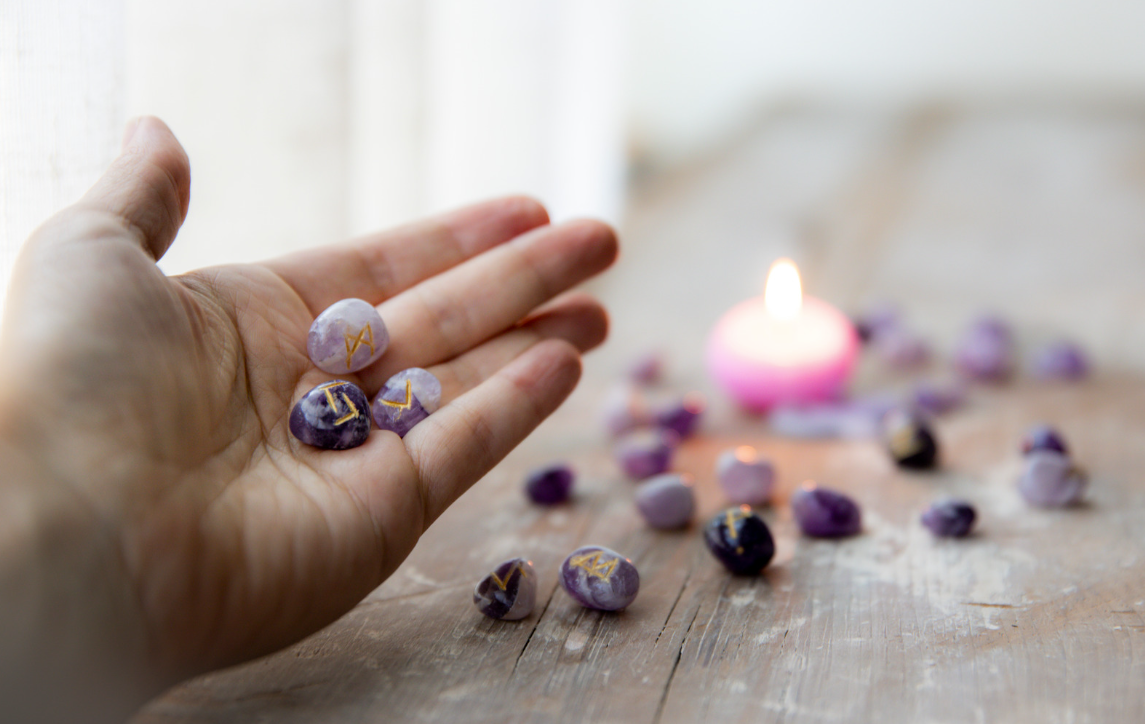
A handful of rune stones can turn a vague worry into a question you can actually sit with. The appeal is partly in the ritual: slowing down, drawing a symbol and noticing what it brings to mind. If you enjoy psychic readings or other forms of divination, learning to read runes can offer a quiet, hands-on way to explore your own thoughts.
You do not need an expensive set or instant knowledge of every symbol. Start with one question, a simple layout and a notebook. Treat the reading as spiritual reflection rather than proof of what will happen or what another person secretly thinks.
What are runes?
Runes are more than markings on divination stones. Historically, they were a writing system. The National Museum of Denmark describes their use as a Germanic method of writing. Its guide to Iron Age runes explains that an early rune alphabet had 24 characters, while the later alphabet used in the Viking Age had 16.
Modern rune-reading practices give symbols interpretive meanings for a question or situation. Historical inscriptions and a modern spiritual reading are different activities. Learning a little about both can deepen your interest without treating every modern spread as an ancient, universally agreed method.
Choose a rune set you will enjoy using
Wood, stone and crystal sets are all options. Pick pieces that are comfortable to handle, with symbols you can distinguish easily. A material can feel meaningful to you without being more powerful or more accurate than another.
- Check the system: Find out which rune alphabet the set uses and whether its guide matches those symbols. Do not assume every set contains the same number of pieces.
- Check the guide: A beginner-friendly booklet or book should identify the symbols clearly. If a set includes extra pieces, look for an explanation of how its maker uses them.
- Keep the budget comfortable: Attractive crystal stones may cost more, but price does not establish the quality of a reading.
- Choose a useful bag: It should let you mix the pieces and draw one without deliberately selecting its symbol.
Before your first reading, lay out the set and compare each marking with your reference. This is less frustrating than trying to identify unfamiliar symbols while also interpreting a spread.
Make your own runes if you prefer
Creating a set can become part of your personal ritual. Use smooth stones or wooden pieces, then draw or paint one symbol on each. Follow a reliable reference so similar-looking symbols remain distinct. Keep the pieces reasonably similar in size if you want drawing from a bag to feel less predictable.
Avoid sharp edges, and use appropriate tools and materials safely. A painted set on a familiar table can be just as satisfying to practice with as something purchased from a specialist shop.
Prepare a calm reading space
Choose a private place with enough light to see the markings and enough room for your spread. A clean cloth protects the surface and makes scattered pieces easier to see. A dedicated rune cloth is optional; a plain cloth works too.
If facing north, reading at night or using a particular cloth is meaningful within your spiritual practice, you can include it. None is required for the layouts below, and a direction or a “witching hour” should not be presented as a guarantee of divine power. Choose a time when you feel comfortable and able to concentrate.
You might take a few quiet breaths before starting. Meditation is optional. The aim is to arrive at the question with attention, not to achieve a perfect mood or force a special sensation.
Ask a question that leaves room for insight
Open-ended questions work well for reflection because they invite you to consider choices rather than hunt for a yes-or-no verdict.
- “What deserves my attention in this situation?”
- “What challenge am I overlooking?”
- “What small action could help me move forward?”
For example, instead of asking whether someone will contact you on a particular day, ask what you need while waiting and what communication is within your control. Keep one question in mind for the whole spread. Write it down before drawing so you do not keep changing it to fit the stones.
A simple three-rune reading
Mix the runes gently in their bag. Draw three pieces one at a time and place them face down, if you want to reveal them together. For this guide, place the first on the right, the second in the middle and the third on the left. Right-to-left is the arrangement illustrated below; other readers may use different conventions.
- Situation: The right-hand rune is a prompt for what is happening or what currently holds your attention.
- Challenge: The middle rune invites you to consider a difficulty, tension or overlooked angle.
- Next action: The left-hand rune offers a theme to explore when choosing a practical next step.
Reveal the symbols and look up each in the guide for your set. Read the meaning alongside its position and your original question. A symbol is not an instruction you must obey. If an interpretation feels unhelpful, acknowledge that instead of forcing your situation to match it.
Another labeling option is past, present and future. If you choose that version, decide before drawing and keep it separate from situation, challenge and next action. Use the “future” position to reflect on a possible direction or consequence, not as a verified prediction. Mixing both schemes halfway through can make almost any interpretation seem to fit.
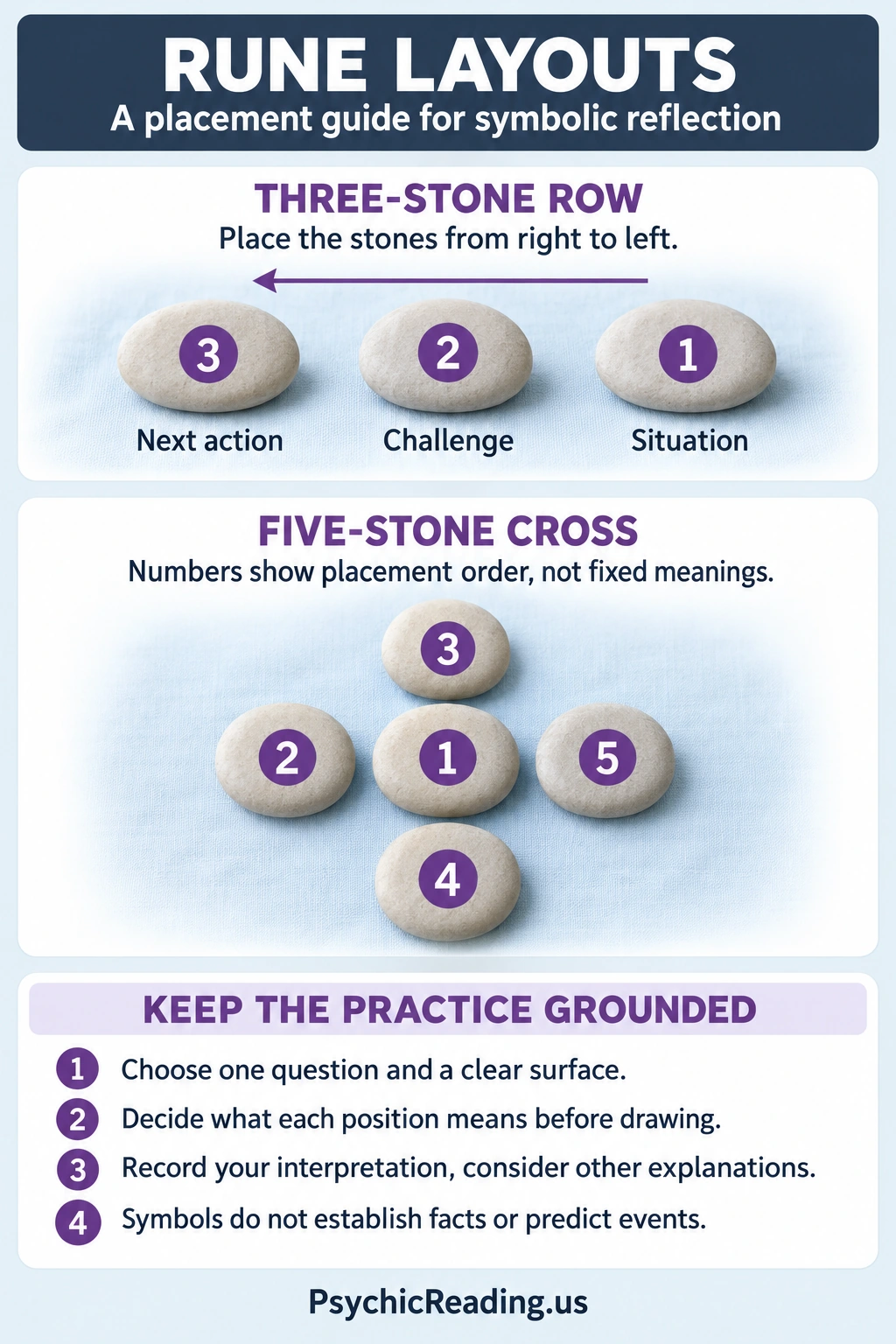
Read the infographic text
Rune layouts: a placement guide for symbolic reflection.
Three-stone row: Place the stones from right to left. Stone 1 on the right: situation. Stone 2 in the middle: challenge. Stone 3 on the left: next action.
Five-stone cross: The numbers show placement order, not fixed meanings. Place stone 1 in the center, stone 2 to its left, stone 3 above it, stone 4 below it, and stone 5 to its right.
Keep the practice grounded: Choose one question and a clear surface. Decide what each position means before drawing. Record your interpretation; consider other explanations. Symbols do not establish facts or predict events.
Try a five-rune cross when you want more detail
Use the placement order in the infographic: one in the center, two to its left, three above it, four below it and five to its right. Those numbers show where to put the stones, not universal meanings.
For a practice reading, you could assign the following prompts before you draw. This is a suggested reflective scheme, not a claim that every rune reader uses these positions.
- Center — the main situation: What is at the heart of your question?
- Left — the challenge: What tension needs attention?
- Top — a perspective: What different way of looking at things could help?
- Bottom — a resource: What support or strength can you draw on?
- Right — a next step: What action might be worth considering?
Interpret the stones individually first, then ask how their themes relate. More pieces do not automatically make a reading better. If five feels confusing, return to the three-rune row.
What about a nine-rune scatter?
Some readers draw nine runes and scatter them on a cloth rather than arrange a row. If you try this, decide beforehand which pieces you will read and what placement will mean. You might begin with face-up symbols only, or turn all nine over. Either choice is a convention you adopt, not evidence that hidden pieces reveal future events.
Take time with each symbol and look for recurring themes. A piece near the edge can be used as a prompt about outside influences if that is your chosen method. It cannot identify who is helping or harming you, and an uneasy feeling about a stone is not proof of someone else’s intentions.
For a beginner, nine symbols can produce more information than you can use. A small spread with a clear question is often easier to reflect on than a large scatter with no agreed rules.
Interpret with curiosity, not certainty
Give each symbol time before jumping to a conclusion. A simple notebook entry can keep the reading useful:
- Record: Write the question, symbols, positions and the guide’s interpretation.
- Notice: Describe your first association and why it seems relevant.
- Consider: Write another possible interpretation, especially if the first feels alarming.
- Act: Choose one reasonable step you can evaluate in ordinary life.
Suppose a reading brings up a theme you connect with communication. Your next step might be to ask a clear question, draft a message or decide what boundary you want to express. You do not need to conclude that the stones know what the other person will say.
Follow the conventions of your chosen guide for sideways or reversed pieces rather than improvising a rule after seeing the result. If guides disagree, note the difference. Keep intuition as one part of reflection alongside observable facts, your values and direct conversation.
Common beginner questions
Do I have to memorize all the meanings?
No. Keep a reference beside you and learn gradually. Familiarity grows through reading, comparison and practice; needing a guide does not make the ritual less personal.
Should I draw again if I dislike the result?
You can end the reading, but repeated draws until you get reassurance can make the practice less useful. Try writing down what bothered you and returning to the question later rather than chasing a comforting answer.
Can runes tell me exactly what will happen?
Some people approach runes as divination, but a spread does not establish future events. You can value its spiritual significance while keeping important decisions grounded in reliable information and appropriate professional advice.
How do I know when to stop?
Stop when you have a useful reflection or one realistic next step. If a reading leaves you anxious or stuck checking the same question, put the stones away and reconnect with something ordinary and reassuring.
Let the practice grow at your pace
Your first reading does not need to feel dramatic. It might simply give you a better question or help you name a feeling. Begin with three runes, keep the positions consistent and leave room for more than one interpretation. Over time, you can build a practice that feels spiritually meaningful without handing your choices over to the stones.
The variety in rune casting methods, from using three runes to a more complex cross shape spread, caters to different levels of inquiry and provides flexibility in the practice.
The approach to creating your own runes appears to be very engaging. Crafting them by hand could certainly enhance one’s connection to the practice.
Yes, personalizing the runes could make the readings more meaningful. It’s a blend of art and spirituality.
Also, the advice on using smooth materials and ensuring safety while making them is quite practical and thoughtful.
I find it interesting that different materials of runes could have different influences or energies according to this article. The use of crystals, in particular, seems quite unique.
The method described here for reading runes seems quite detailed and structured. It’s fascinating how rune stones are used for divination purposes.
Indeed, the step-by-step guide makes it accessible for beginners while maintaining the depth for more experienced practitioners.
The method of shaking the runes and focusing on a single question at a time seems like it helps in maintaining clarity and intention during the reading.
The text’s recommendation to use a clean cloth specifically for rune readings is a detail that underscores the importance of respecting the practice.
The methodology for interpreting runes is quite layered. Understanding the symbols and their positions seems integral to getting accurate readings.
Absolutely, the highlighted step of interpreting the order in which the runes fall is crucial for comprehensive readings.
The emphasis on a distraction-free and north-facing space adds a cultural and historical dimension to the practice. It shows the depth of tradition involved.