

You are considering a change, and a strong feeling says, “Don’t do it.” Is that useful intuition, worry about the unknown or a response to something genuinely unsafe? The feeling alone may not answer the question.
If you value intuition, you do not have to ignore it. You can listen and then check what it is pointing toward. Fear and intuitive impressions can overlap, and neither calmness nor intensity proves that a conclusion is true.
Fear versus intuition is not a simple test
In spiritual conversations, intuition is often described as inner guidance or a sense of knowing. That language can be meaningful, but it does not establish psychic certainty. An impression may also reflect experience, expectations, hopes or details you have noticed without consciously putting them together.
Fear can be uncomfortable and still alert you to a real concern. A calm impression can feel convincing and still be mistaken. Instead of asking only “Which voice is this?”, ask “What do I know, what am I assuming, and what response is sensible?”
The following eleven reflection points replace rigid rules with questions you can use. They are not a diagnosis, a psychic-ability test or a reason to dismiss a safety concern.
1. The past is shaping the present
Remembering an old disappointment may make a new situation feel risky. That does not mean the memory is irrelevant: experience can offer useful information. The important distinction is between recognizing a similar pattern and assuming the same outcome must happen again.
Ask what is actually similar, what is different and what evidence you have now. A new colleague being quiet is not proof they will treat you like someone who hurt you before. Repeated disrespect, on the other hand, deserves attention even if you would prefer to feel hopeful.
2. You feel urgency or panic
Urgency can make it harder to consider options, but panic does not prove that a concern is false. First consider whether there is an immediate danger or genuine deadline. If not, you may be able to pause before making a commitment.
You do not need to reach perfect calm before protecting yourself. A decision to step away from a threatening situation does not require knowing whether the feeling is fear or intuition.
3. A hunch becomes a judgment about your worth
“They may not choose me” is different from “I am not good enough for any job or relationship.” The second is a broad conclusion, not a fact established by your feelings.
Try naming the specific uncertainty: “I do not know whether this role fits my experience.” That gives you something to investigate. Feeling unsure does not make you irrational or spiritually disconnected.
4. You have not had room to listen
A noisy day, other people’s opinions or constant scrolling can make your own preferences harder to identify. If it is comfortable, take a short quiet pause and ask what you want, what worries you and what information is missing.
Being alone is optional. A trusted person may help you think more clearly. If quiet reflection increases distress, do not force yourself to keep digging for an answer.
5. You are repeatedly analyzing the same feeling
Checking an impression is sensible; intuition does not become more trustworthy by being exempt from questions. The issue is whether you are learning anything new or circling the same uncertainty.
Write down the question you are trying to answer. Identify one useful check, such as reading the actual requirements, clarifying a conversation or comparing the options. If there is no new information, consider setting the question aside temporarily rather than checking it again and again.
6. You want to avoid or leave the situation
The urge to leave can arise in both unfamiliar and genuinely unsafe situations. Do not assume it is merely fear, and do not make yourself stay to prove that you trust your intuition.
If the issue is a low-risk new experience, a smaller step might help you learn more. If someone is threatening, pressuring or controlling you, prioritize practical safety. The National Domestic Violence Hotline’s safety-planning resources offer support for thinking through an abusive situation. You do not need a reading to justify seeking help.
7. Your body feels unsettled
A headache, stomach discomfort or difficulty sleeping cannot tell you whether an impression is psychic intuition. Physical symptoms may have several explanations.
The National Institute of Mental Health’s guidance on stress and anxiety explains that both can affect the body and mind, including sleep and physical discomfort. It recommends professional support when symptoms persist or coping is difficult. Seek appropriate medical advice for symptoms that are new, persistent or concerning rather than assigning them a spiritual meaning.
8. The underlying worry is hard to name
“Something is wrong” can be a starting point, but it may help to ask what specifically worries you. Is it rejection, money, conflict, loss of control or a behavior you have noticed?
You might find several concerns rather than one hidden message. Naming them separately can make it easier to decide what needs information, reassurance, a boundary or outside support.
9. You feel pressure not to question the message
A useful impression can withstand consideration. You do not have to treat it as unquestionable truth or defend it against every alternative explanation.
This matters in readings, too. If a reader insists that doubt blocks your guidance or that you must obey an interpretation, you can disagree or stop. Spiritual curiosity does not require giving another person authority over your choices.
10. Your imagination shows only the worst outcome
Ask whether you are considering a realistic range of possibilities. What evidence supports the feared outcome? What other outcomes are plausible? What would you do if the difficult possibility occurred?
The goal is not to replace a frightening prediction with a guaranteed positive one. It is to make room for uncertainty and a practical response. An unpleasant possibility may need preparation without being inevitable.
11. Fear feels like the only thing you can hear
You do not have to find a spiritual answer immediately. It may be more useful to rest, speak to someone supportive or get help with the specific problem. Persistent distress is not a failure to listen to your inner wisdom.
If anxiety is interfering with daily life, consider a qualified mental health professional. A psychic reading or repeated card pull is not a substitute for that support.
A grounded way to check an impression
For a non-urgent decision, try this short process:
- Name the feeling. “I feel uneasy about accepting this invitation.”
- Describe the facts. Write what happened, without adding motives you cannot know.
- List the interpretation. “I think I may be pressured to agree to something.”
- Consider alternatives. What else could explain the feeling or situation?
- Choose a proportionate step. Ask for details, take time, decline or seek support according to the actual circumstances.
- Review what you learn. Leave room to revise your first conclusion.
Suppose an opportunity sounds exciting but comes with pressure to pay immediately. You need not identify the feeling’s spiritual origin. Asking for written details and time to consider is useful either way. The other person’s response provides information that a feeling alone cannot.
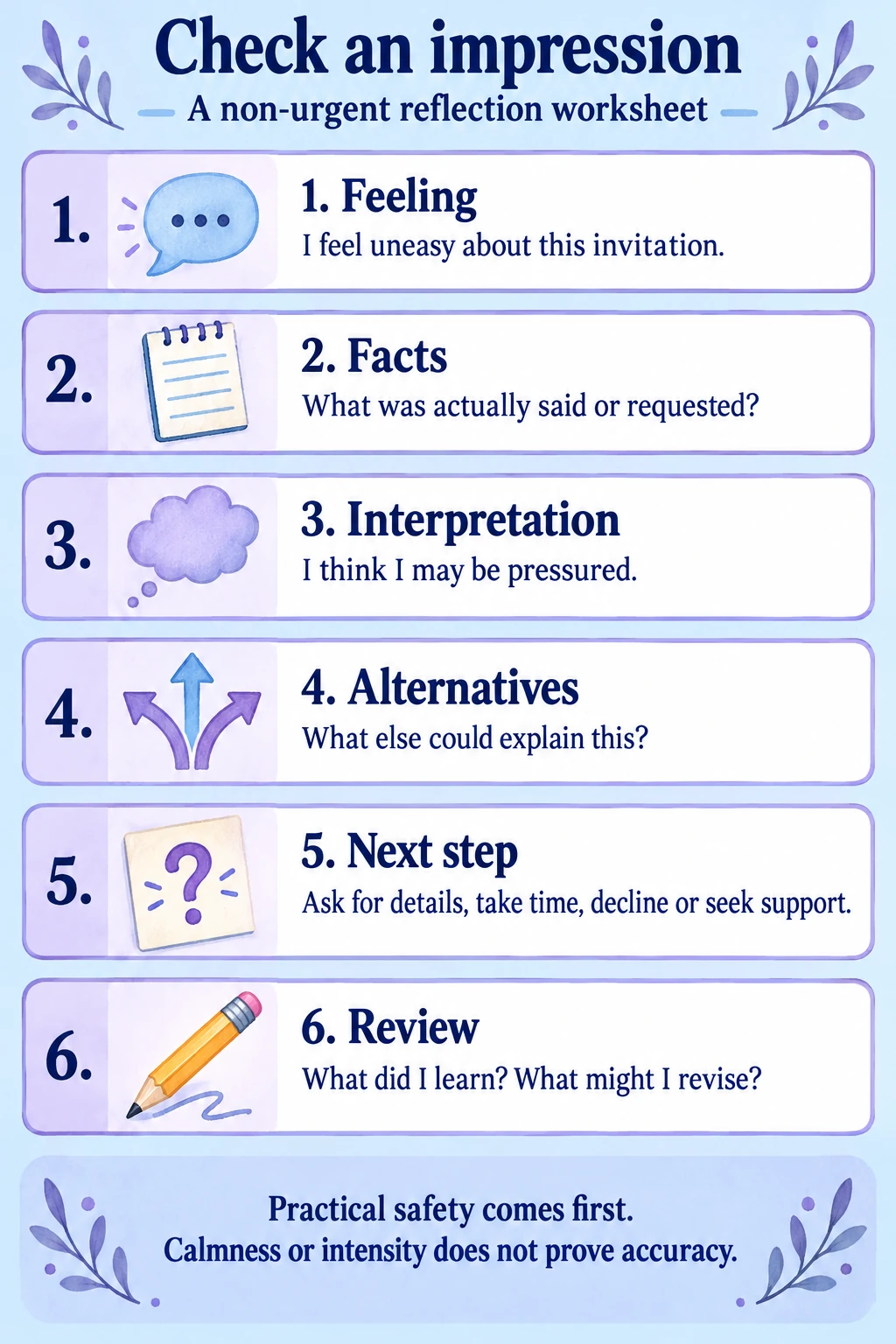
Read the impression-check worksheet as text
This is a reflection worksheet, not a test of spiritual ability.
- Feeling: I feel uneasy about this invitation.
- Facts: What was actually said or requested?
- Interpretation: I think I may be pressured.
- Alternatives: What else could explain this?
- Next step: Ask for details, take time, decline or seek support.
- Review: What did I learn? What might I revise?
Practical safety comes first. Calmness or intensity does not prove accuracy. You do not have to complete this worksheet or reach calm before protecting yourself.
Keeping spiritual reflection in perspective
Meditation, prayer or journaling may be meaningful ways to explore your values. You can ask, “What matters to me here?” without expecting a ritual to reveal someone else’s intentions or a certain future.
If you choose a reading, keep the question open and your spending limit clear. Record the interpretation separately from the facts you can check. Avoid repeatedly seeking reassurance until a reader gives you the answer you want.
Common questions about fear and intuition
Is intuition always calm?
No emotional tone reliably proves that an impression is accurate. A calm thought can be mistaken, and fear can accompany a real concern.
Should I ignore a feeling because it comes from a past experience?
No. Consider what the experience may have taught you, while checking whether the current situation actually follows the same pattern.
Can a psychic tell me which feeling to trust?
A reader may offer an interpretation, not a definitive test. Keep safety, factual checks and your own decision-making independent of the reading.
What if I cannot decide?
When possible, reduce the size of the decision, gather one useful piece of information or ask for appropriate support. You do not have to force certainty before taking a careful next step.
You can respect your inner life without making every feeling a verdict. Listening, checking and choosing can belong to the same practice.
It’s useful to see practical indicators like physical symptoms or feeling the need to run. These cues can really help in identifying if one’s reaction is fear-based.
The idea that intuition is calm and clear contrasts sharply with the panic and chaos of fear. I find the comparison insightful.
The notion that analyzing a gut feeling usually means dissecting fears is an interesting perspective. It suggests that true intuition needs no overthinking.
While the points are valid, I wonder how one can reliably practice tuning into their intuition in a fast-paced world.
Taking time for mindfulness and meditation might help. Slowing down could make intuition more discernible.
Indeed, daily practice and reflection could be key. It’s about creating a habit of listening to oneself.
I appreciate the emphasis on the present moment. Being grounded in the present can indeed help in distinguishing intuition from past-driven fears.
The connection between physical symptoms and emotional well-being is well-documented. It’s critical to be mindful of such signals from our bodies.
Learning to listen to intuition over fear is a valuable skill. It seems it could lead to more grounded and authentic decision-making.
The distinction between fear and intuition is subtle and often overlaps. It requires a lot of self-awareness to differentiate them accurately.