

A connection can feel so familiar that ordinary words seem too small for it. Perhaps you call it a twin flame: someone who brings your hopes, fears and desire for growth into sharp focus. The language can be meaningful, especially when you are trying to understand a relationship that changed how you see yourself.
But a powerful feeling does not come with a relationship timetable. Twin flame stages are a spiritual framework, not a verified sequence that every couple must follow. You can explore the symbolism without treating pain as proof of destiny, a breakup as a test you must pass or another person’s refusal as an invitation to chase.
This guide keeps the familiar eight-stage story while asking a more useful question at each point: how can you honor what the connection means to you and still protect your freedom, dignity and everyday life?
What does “twin flame” mean?
In some spiritual teachings, a twin flame is described as a mirror soul or the other half of one soul. People may use the phrase more loosely for an unusually intense, transformative bond. These are beliefs and interpretations; the label does not establish that two people share a soul or are destined to become partners.
You do not need to think of yourself as incomplete while waiting for someone else. A relationship can enrich your life without supplying a missing half. Your friendships, interests, work, rest and spiritual practice matter whether this particular connection continues or not.
Also, one person’s spiritual interpretation does not determine the other person’s feelings. A mutual relationship needs freely expressed interest, ongoing consent and compatible choices—not just a strong inner conviction.
The eight twin flame stages, viewed as reflection themes
The following stages are one way to organize a spiritual relationship story. They are not a checklist for identifying your twin flame, and a relationship does not become more authentic by moving through every stage.
1. Longing and preparation
This theme begins with wanting a deep connection. You may imagine a partner who understands your inner world, shares your spiritual curiosity or helps you feel seen. Instead of waiting for a promised arrival, use that longing to clarify what you actually want.
Ask yourself what a nourishing partnership would look like on an ordinary Tuesday. Would you feel comfortable disagreeing? Would both people make time for one another? Could you keep your own friends and interests? These details turn an idealized wish into values you can recognize in real life.
Preparation can mean strengthening routines, practicing honest communication and getting support for old hurts. It does not mean becoming perfectly healed, endlessly positive or worthy enough to attract someone. Having trauma or difficult feelings does not disqualify you from love, and another person’s availability is not a measure of your spiritual progress.
Reflection: “What do I hope this relationship will give me, and what part of that need can I begin caring for now?”
2. Recognition and curiosity
Some people describe recognition through a dream, a striking coincidence or an immediate sense of familiarity. You can enjoy the meaning of that experience without deciding that it identifies a future partner. A dream can be a prompt to explore what you long for; it cannot tell you whether another person wants a relationship.
If you meet someone and feel drawn to them, allow curiosity to unfold at a comfortable pace. Notice their actual communication, how they respond to your boundaries and whether interest is mutual. If they are unavailable or already partnered, respect that reality rather than interpreting it as a cosmic obstacle you are meant to overcome.
For example, dreaming about an old friend might inspire you to journal about feeling understood. It does not require contacting them repeatedly, especially if they have asked for distance.
Reflection: “What have I directly observed, and what meaning am I adding to it?”
3. Attraction and intense feelings
The third theme is the rush of connection: excitement, fascination and the feeling that this person reflects something important in you. That can be beautiful. It can also make it tempting to fill in the unknown parts of someone with the qualities you hope they possess.
Enjoy attraction while leaving room to learn. Keep ordinary commitments, maintain friendships and take time before major decisions about money, living arrangements or shared responsibilities. You do not have to surrender your judgment to prove that your heart is open.
Intimacy is not a competition in intensity. A quieter relationship may be deeply loving, while an overwhelming connection may or may not become a workable partnership. Look for kindness and consistency alongside chemistry.
Reflection: “Am I getting to know this person, or mostly getting to know the story I have built around them?”
4. Building a relationship
If both people want to be together, the next theme is turning a feeling into shared choices. Talk about what you are agreeing to: dating, exclusivity, contact, privacy, sexual boundaries and the pace that feels comfortable to each of you.
A long-distance relationship also needs practical conversations. How often would you like to talk? What can each person realistically afford for visits? What will you do when schedules change? Spiritual closeness does not remove the need for clear expectations.
A honeymoon period may feel especially tender, but neither its length nor its intensity proves a divine connection. Let affection coexist with individuality. You can trust a partner and still keep private thoughts, independent interests and boundaries around access to your devices or finances.
Reflection: “What have we both agreed to, rather than simply assumed?”
5. Differences and challenges
As a relationship develops, differences may become clearer. You might disagree about communication, time, commitment or how spirituality fits into daily life. Those disagreements are not automatically an “ego battle,” and having a need or concern is not a failure of spiritual growth.
Where it is safe to do so, name a specific issue rather than judging someone’s spiritual maturity: “When plans change without a message, I feel unsure. Can we agree to let each other know?” Give each person room to say what they can genuinely offer.
Useful habits include listening without interrupting, choosing a calmer time for difficult conversations, taking an agreed break and returning to the issue. Apologies matter most when they are accompanied by changed behavior. Patience is not the same as accepting the same hurt indefinitely.
You may decide to keep working together, take space or end the relationship. None of those choices proves you failed a soul lesson. Threats, coercion, control and abuse are not ordinary challenges that love requires you to endure.
Reflection: “Are we both willing and able to work on this, and are my boundaries respected?”
6. Distance, separation and the “runner–chaser” story
Twin flame discussions often describe one person as a runner and the other as a chaser. Be careful with these roles: they can turn a clear request for distance into a story about hidden love, or label one person spiritually superior for continuing to pursue the other.
If someone ends a relationship, declines contact or blocks you, respect their boundary. Do not seek access through new accounts, friends, surprise visits or repeated messages. You do not need to persuade them that the connection is real. Silence is not reliable evidence that they secretly want you to keep trying.
If you are the person who wants distance, you do not have to adopt a spiritual label to explain that choice. If you are missing someone, you can grieve, seek support and redirect attention toward your own life without waiting indefinitely for a reunion.
A simple plan may help: stop checking for signs of their return, choose a trusted person to talk to, restore one neglected routine and write down what you need from a reciprocal relationship. Those are acts of care, not rejection of your spiritual beliefs.
Reflection: “What boundary has been communicated, and how can I honor it while caring for myself?”
7. Surrender as acceptance, not self-abandonment
In a gentler interpretation, surrender means releasing the need to control an outcome. You can admit that you love someone and also accept that the relationship may not continue. You can hold spiritual meaning without making your peace depend on their return.
Forgiveness, if you choose it, does not require renewed contact, immediate trust or reconciliation. Nor must both people take equal responsibility for harm one person chose to cause. An apology or a spiritual explanation does not erase a need for safety and accountability.
If both people voluntarily want to rebuild, discuss what will actually change and how you will recognize it over time. Do not rush past unresolved concerns because you believe you have reached the surrender stage. If you are moving on, a private letter you do not send or a simple closing ritual may help express what mattered.
Reflection: “What can I release without giving up my needs, values or safety?”
8. Integration and a sustainable connection
The final theme is often called union. Instead of imagining a perfect, unbreakable relationship with no fear or disagreement, consider integration: carrying what you have learned into a life that feels more honest and grounded.
For a mutual couple, that may mean dependable communication, shared decisions, respect for separate identities and willingness to repair mistakes. Spiritual practice can be something you enjoy together without becoming a test of loyalty.
Integration can also happen without reunion. You might understand your needs more clearly, reconnect with friendships or stop confusing intensity with obligation. A meaningful relationship can remain part of your story without becoming the whole of it.
Reflection: “Does this connection support the life I want to live—not only the future I imagine?”
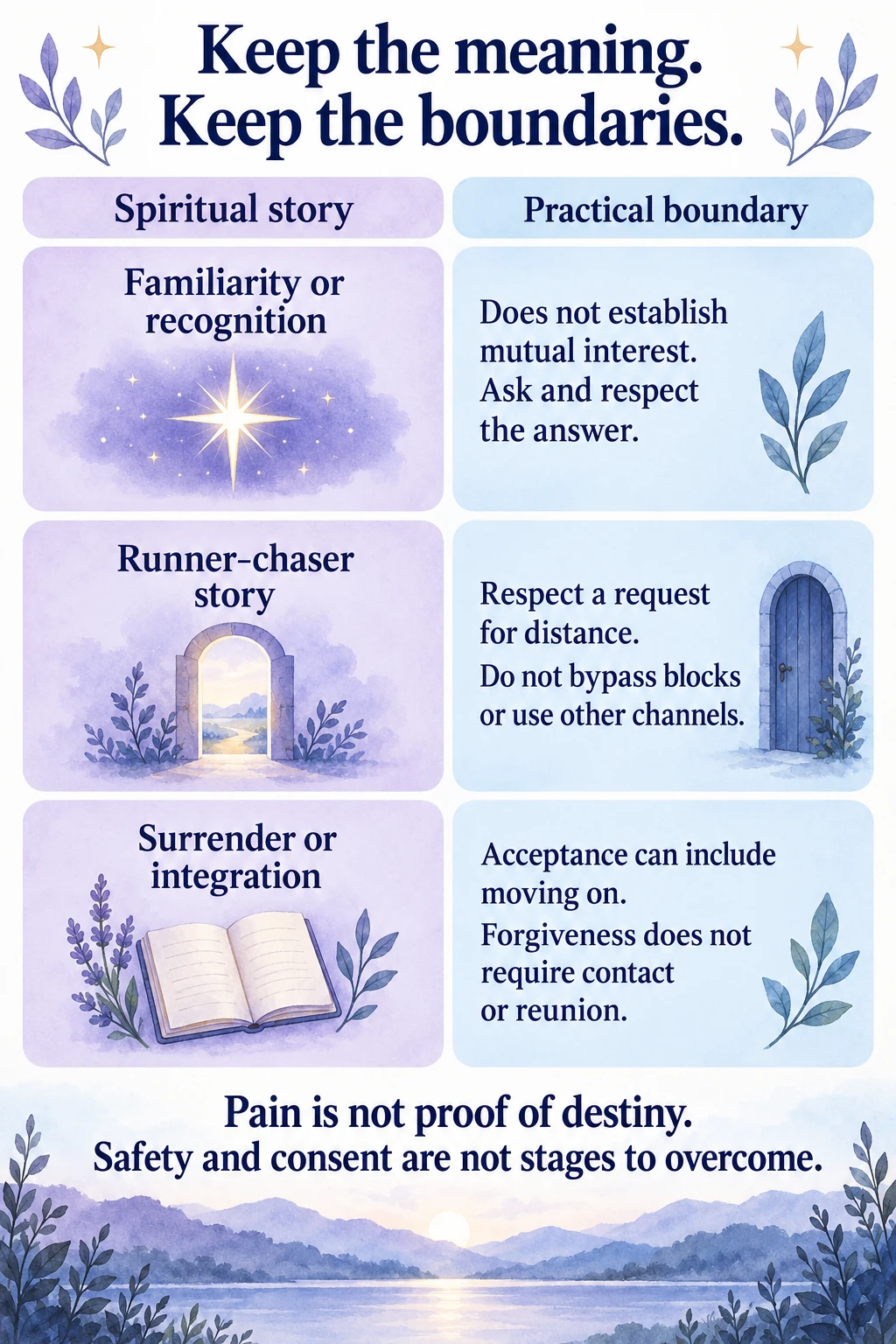
Read the meaning-and-boundaries comparison as text
- Familiarity or recognition: Does not establish mutual interest. Ask and respect the answer.
- Runner–chaser story: Respect a request for distance. Do not bypass blocks or use other channels.
- Surrender or integration: Acceptance can include moving on. Forgiveness does not require contact or reunion.
Pain is not proof of destiny. Safety and consent are not stages to overcome.
Do the stages happen in order, and how long do they last?
There is no established eight-stage timetable for twin flame relationships. Accounts differ, and people may recognize some of these themes, several at once or none at all. There is no reliable way to calculate a reunion date from a stage label.
Rather than counting weeks in separation, choose a practical check-in for yourself. Ask whether you are sleeping, keeping commitments, maintaining supportive connections and making decisions based on what is happening now. That check-in is for your wellbeing, not a deadline to make another person return.
Using a psychic reading for reflection
If psychic readings are part of your spiritual life, focus questions on your own perspective and choices. Try “What pattern am I ready to change?” or “How can I honor this connection without putting my life on hold?” You can also explore relationship-reading questions and boundaries.
A reading cannot establish another person’s private feelings, override a refusal or guarantee a reunion. Set a budget before booking and pause if you feel pressured to buy repeated sessions, remove a supposed curse or prove your faith through payment. You are allowed to disagree with an interpretation.
When the spiritual story starts excusing harm
Keep the relationship’s observable behavior in view. The National Domestic Violence Hotline’s relationship guide emphasizes respect, communication, equality, consent and boundaries. Those qualities matter regardless of the label you use.
If a partner uses destiny to justify control, isolation, threats or sexual pressure, you do not need to settle whether they are your twin flame before seeking help. In the U.S., you can contact the Hotline at 800-799-SAFE (7233), text START to 88788 or use its website chat. Use a safer device if you are concerned about monitoring; in immediate danger, contact emergency services.
Frequently asked questions
Does a painful relationship prove someone is my twin flame?
No. Pain and intensity do not establish a spiritual identity. Your interpretation can matter to you, but it should not excuse disrespect, coercion or disregard for your boundaries.
Do I have to wait for a “runner” to return?
No. Respect requests for distance and make your choices around your own needs and the relationship’s actual circumstances. You are not required to put your life on hold.
Can a twin flame reading predict reunion?
A reading may offer symbolic reflection, but it cannot guarantee another person’s choices or a reunion date. Consider mutual interest and behavior instead of treating a prediction as a promise.
Can I keep the spiritual meaning and still move on?
Yes. You can value what the connection taught you and choose a different future. Moving on does not require denying your feelings or declaring the experience meaningless.
I appreciate the emphasis on self-improvement and healing past traumas before being able to connect with a twin flame. It makes sense that one must be whole before finding their other half.
The stages described seem to be not just about a unique romantic relationship but also a spiritual journey. It aligns well with the idea that significant relationships can be catalysts for personal development.
This article offers a structured look at the twin flame relationship, highlighting the importance of self-awareness and personal development. The stages seem to reflect a balance of challenges and emotional fulfillment.
The concept of twin flames is quite intriguing, and it’s interesting to see how the stages of this connection unfold. The idea of personal growth being necessary for meeting your twin flame is particularly compelling.
The narrative about twin flames suggests a profound and transformative experience. The idea of stages, especially the transition from personal preparation to deep connection, is thought-provoking.
The twin flame journey appears to be a mix of spirituality and emotional connection. The emphasis on stages and personal readiness before meeting your twin flame is logically structured.
The detailed stages provide a roadmap to understanding the twin flame experience. It’s interesting to note how the process emphasizes personal growth and facing past issues.
It’s fascinating to see how the twin flame journey is depicted as both challenging and deeply rewarding. The stages of meeting, connecting, and evolving together are well articulated.