
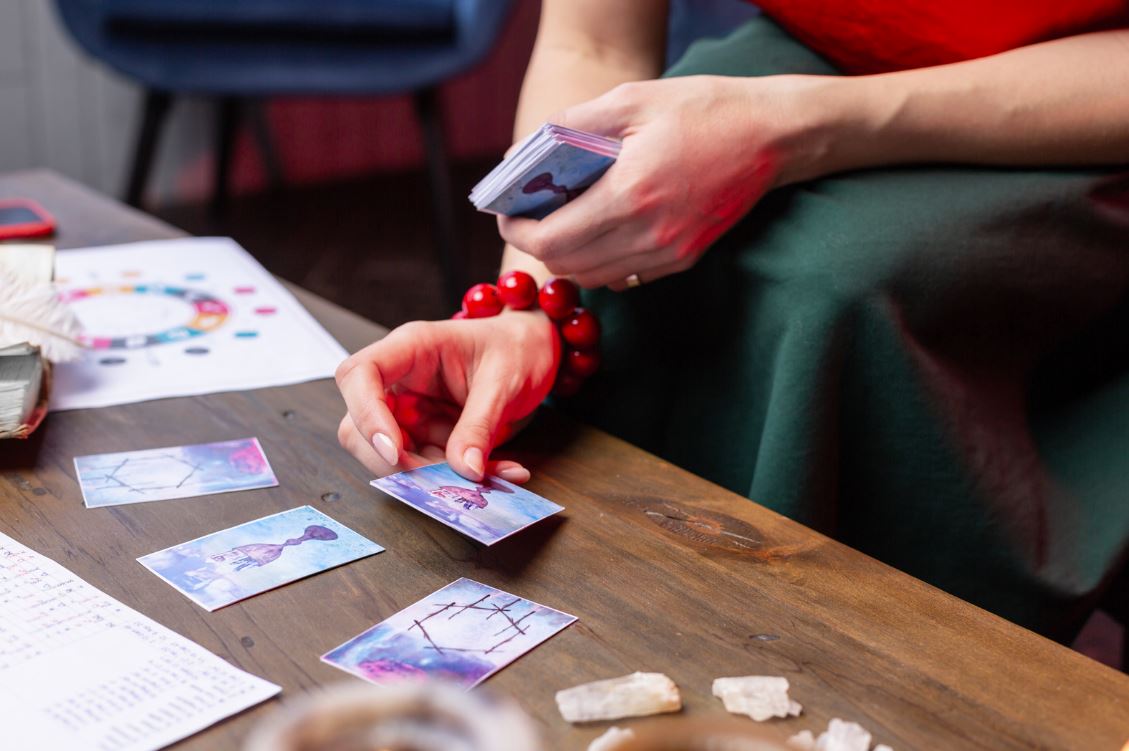
You do not need a dramatic vision or a complicated ritual to begin reading oracle cards. A deck, a thoughtful question and a little time can be enough to explore a symbol and consider what it brings to mind.
For some people, a reading is a spiritual conversation with intuition or guidance. For others, it is a creative reflection practice. Either approach leaves room for the same important principle: a card offers something to consider, not a command you must obey or a guaranteed prediction.
Start with a deck you can understand
Choose artwork and themes that interest you, but also look at sample cards and the guidebook. Can you read the text comfortably? Does the creator explain the symbols? Are the instructions clear enough to use without buying another course?
Decks may explore angels, animals, nature, affirmations or other themes. Learn how the creator uses those ideas rather than assuming every deck shares the same meanings. You can feel drawn to an image without believing it confirms a spirit connection.
The guidebook is not a sign that you lack intuition. It gives you the creator’s context, which you can compare with your own response. For example, Hay House’s guidance on missing guidebooks says its authentic oracle decks include a printed guidebook. Check the publisher’s information for the particular deck you choose; packaging rules are not identical across all publishers.
You do not need several decks to start. One you enjoy using is a better beginning than a collection you feel obliged to buy.
Ask a question that gives you room to act
A useful question turns your attention toward reflection and choice. Instead of asking a card to reveal a fixed future or someone else’s private feelings, ask what you can understand or do.
- “What deserves my attention today?”
- “What perspective could help me approach this situation?”
- “Which boundary would I like to practice?”
- “What is one small step toward the life I want?”
- “What might I be overlooking?”
Notice the difference between “Why am I failing to reach my highest self?” and “What would help me make a thoughtful next step?” The second does not begin by assuming something is wrong with you.
Keep medical, legal, financial and safety decisions grounded in appropriate information and professional advice. An oracle card cannot diagnose a condition, establish another person’s intentions or tell you that a risky situation is safe.
How to do a one-card oracle reading
A single card is a manageable place to begin. Set aside a few minutes and decide to stop after one reading rather than drawing until you receive an answer you prefer.
- Settle and choose your question. Find a comfortable place and write the question down. A brief quiet pause is optional; elaborate preparation is not required.
- Shuffle in a way that suits you. Move small packets from hand to hand, shuffle gently on a table or use another method that is comfortable and does not damage the deck.
- Draw one card. Take the top card or choose from a spread-out deck. Pick a method before looking, rather than searching for the most reassuring card.
- Notice the card itself. What image, word or detail catches your attention? Describe it before deciding what it means.
- Read the guidebook. Compare its explanation with your first impression. Neither has to fit perfectly.
- Choose a practical response. Write one possible interpretation and one action you can take, then put the cards away.
If a card falls out while shuffling, you may choose to include it or return it to the deck. Decide on your approach in advance. A dropped card is not proof of an urgent message, and you do not need to feel frightened or compelled by it.
Interpret the image without forcing a message
Suppose your question is about taking on another obligation and the card shows a bridge. You might associate it with transition, connection or meeting halfway. The guidebook may offer a different theme. Rather than insisting the bridge means “say yes,” explore both possibilities.
Ask, “Would accepting help me move toward something important, or am I trying to keep everyone happy?” Then look at your time, capacity and commitments. The card has helped you frame a question; the decision still belongs to you.
A useful journal entry can be brief:
- Question: what you asked.
- Observation: the card’s image or wording.
- Interpretation: what you think it may suggest.
- Reality check: facts or alternative explanations to consider.
- Action: one manageable next step.
It is fine to write “This did not resonate.” You do not have to invent a message to prove that the reading worked.
A simple three-card reflection layout
When one card feels familiar, you can give three cards different roles. Place them in order from left to right. This layout focuses on understanding and action rather than declaring a fixed future.
1 · Notice
What deserves my attention?
2 · Consider
What other perspective could help?
3 · Choose
What practical step can I take?
In words: card one highlights something to notice, card two invites another perspective, and card three suggests an action to consider. Read each through its assigned question. If the cards seem contradictory, record the difference instead of pulling more cards to force agreement.
This is an optional layout, not a rule that all oracle decks must follow. If your deck has its own suggested spread, learn that approach too.
Using cards for boundaries and self-reflection
A card can become a reminder to pause before an automatic yes. If you identify as an empath or enjoy helping others, try asking, “What can I offer without overextending myself?” Then write an actual boundary: a time limit, a task you can decline or a conversation you want to have.
Cards are not necessary for setting boundaries, and they cannot guarantee relief from stress or physical problems. Their role here is to prompt reflection. If a reading leaves you more anxious or makes you feel unable to decide without the deck, take a break.
Reading for someone else
Ask whether the person wants a reading and explain your approach. Do not turn an unsolicited impression into a statement about their health, relationships or hidden past.
Use open language: “This image makes me think about change—does that bring anything to mind for you?” is more respectful than “You must leave your job.” Let the other person disagree, decline a question or stop the reading.
Avoid making claims about an absent person’s thoughts or treating a difficult card as proof of harm. You can offer a reflective conversation without presenting yourself as a therapist, clinician or other professional you are not qualified to be.
Common questions about oracle cards
Do I need to memorize every card?
No. Begin with the guidebook, note recurring themes and become familiar with the deck over time. Learning the creator’s meanings can sit alongside your own reflection.
Do cards have to be read upside down?
Check your deck’s instructions. Do not assume all decks use reversed meanings. You can choose a consistent method rather than changing the rules whenever a card feels inconvenient.
What if I draw a card I do not like?
Pause and consider whether it offers a useful question. It is not an order, a curse or certain bad news. You may leave an interpretation aside if it is unhelpful.
How often should I read?
Choose a rhythm that fits your life. One thoughtful reading with time to reflect can be more useful than repeatedly checking the same question. There is no required frequency or spiritual penalty for taking a break.
Begin simply: one question, one card, one observation and one grounded next step. You can make the practice meaningful without surrendering your judgment to it.
The dual function of oracle cards for both guidance and self-help is noteworthy. They appear to be versatile tools for personal growth and stress reduction.
Oracle cards seem to offer a unique way for empaths and healers to manage their emotional and physical boundaries. This application could be very beneficial in daily life.
The practical approach of using intuition to interpret oracle cards is intriguing. It seems like a simpler and more personal way to gain insights compared to traditional tarot.
The suggestion to pick a deck that resonates personally is important. Connection to the tool seems to enhance the overall experience and effectiveness of the practice.
The idea of cards falling out during shuffling as a sign to pay attention is a subtle yet powerful detail. It adds a layer of spontaneity to the reading.
Interesting point on how oracle cards might be less complex than tarot. It may be a good starting point for those new to divination practices.
Asking clear and direct questions to the oracle cards seems to facilitate meaningful insights. A straightforward approach like this can be quite useful.
The emphasis on intuition over strict guidelines is a refreshing take on divination tools. It potentially democratizes the practice by making it more accessible.