

You have a favorite place to meet, their name makes you smile and you are starting to picture them in your future. Yet one question keeps returning: are you building a serious relationship, or enjoying something neither of you has defined?
That uncertainty can feel especially intense when the connection seems spiritually meaningful. You may notice synchronicities, trust your intuition or wonder what a love reading would say. Those experiences can help you explore your feelings, but relationship status comes from what you both agree to—not from a sign, a text or someone else’s prediction.
The most useful question is not simply “Are they serious about me?” It is “What are we each choosing, and do those choices fit?”
Casual and serious: different intentions, not different levels of respect
A casual connection may involve less long-term planning or fewer shared commitments. A serious relationship usually means the people involved are intentionally investing in an ongoing partnership. Neither description tells you every detail, and neither removes the need for honesty, consent and consideration.
Casual dating does not mean “no expectations.” You can still agree on communication, safer-sex boundaries, privacy and whether you are seeing other people. Serious dating does not mean ownership, constant availability or a promise that the relationship will last forever.
Exclusivity is a separate conversation. Some committed relationships are monogamous; others have mutually agreed non-monogamous arrangements. Do not assume you have the same agreement simply because you use the same label.
You do not have to choose a serious relationship because something is “missing” in you. Being single, dating casually or seeking a committed partner can all be valid choices. The important part is whether the arrangement is honest and genuinely wanted.
Six areas worth discussing
Patterns can give you useful information, but they are conversation starters rather than proof. Look at what has actually happened, ask what it means and listen to the answer.
1. Making plans
Do you make time for each other in a way that works for both of you? Are plans discussed and followed through, or are you often left waiting without knowing whether a meeting will happen?
Shared plans can reflect investment, but a busy schedule or a need for advance notice does not establish lack of interest. Nor should you assume every weekend belongs to your partner. Try: “I like seeing you, and planning ahead helps me. What kind of time together would work for you?”
Consistency matters more than guessing that an unspoken invitation exists. If someone regularly cancels, you can discuss the effect on you without trying to diagnose their motives.
2. Being seen as a couple
Friends may assume you are together because they see you often. That assumption does not create an agreement between you. Meeting family can feel significant, but different people have different timelines, family circumstances and privacy needs.
Ask how you would like to introduce each other. “What words feel comfortable when we meet friends?” is clearer than treating an introduction as a secret test. If privacy leaves you feeling hidden or uncertain, name the concern and ask what the arrangement means.
3. Invitations and shared activities
Being included in someone’s everyday world may feel warm and reassuring. You might share a hobby, join a gathering or spend an ordinary evening together. These experiences can help you learn how you fit into each other’s lives.
They do not mean you must attend everything together. A partnership can include separate friendships and time alone. Ask whether invitations are welcome, whether anyone feels obligated and what kinds of shared activities you both enjoy.
4. Texting and communication
A good-morning message can be lovely, but there is no universal texting frequency that proves commitment. Work, caregiving, accessibility needs and personal preferences can shape how someone communicates.
Instead of counting messages, discuss what feels considerate. For example: “I don’t need constant texting, but I appreciate knowing when plans change. What contact feels manageable for you?”
You are allowed to want more contact, and the other person is allowed to have a different preference. The question is whether you can find a workable agreement, not whether you can make them pass a texting test.
5. Dating other people and exclusivity
If exclusivity matters to you, ask about it directly before assuming it. Do not rely on the number of dates, sexual intimacy or an affectionate nickname to establish the agreement.
You could say: “I’m interested in dating exclusively. Is that something you want too?” If the answer is no, you can decide whether the available relationship fits your needs. Agreeing reluctantly in the hope that someone will change may prolong the uncertainty.
Discuss dating-app use and other boundaries openly. Looking through a phone or asking a psychic to establish whether someone is seeing another person does not replace honest conversation or justify invading privacy.
6. Labels and expectations
Words such as partner, boyfriend or girlfriend can be helpful, but the same word can mean different things to different people. Some prefer fewer labels while still making clear commitments. Others want a label because it communicates something important.
Ask what the word includes: exclusivity, future planning, regular contact, introductions or something else. You do not need to settle every future question at once, but you should be able to talk about what you are offering each other now.
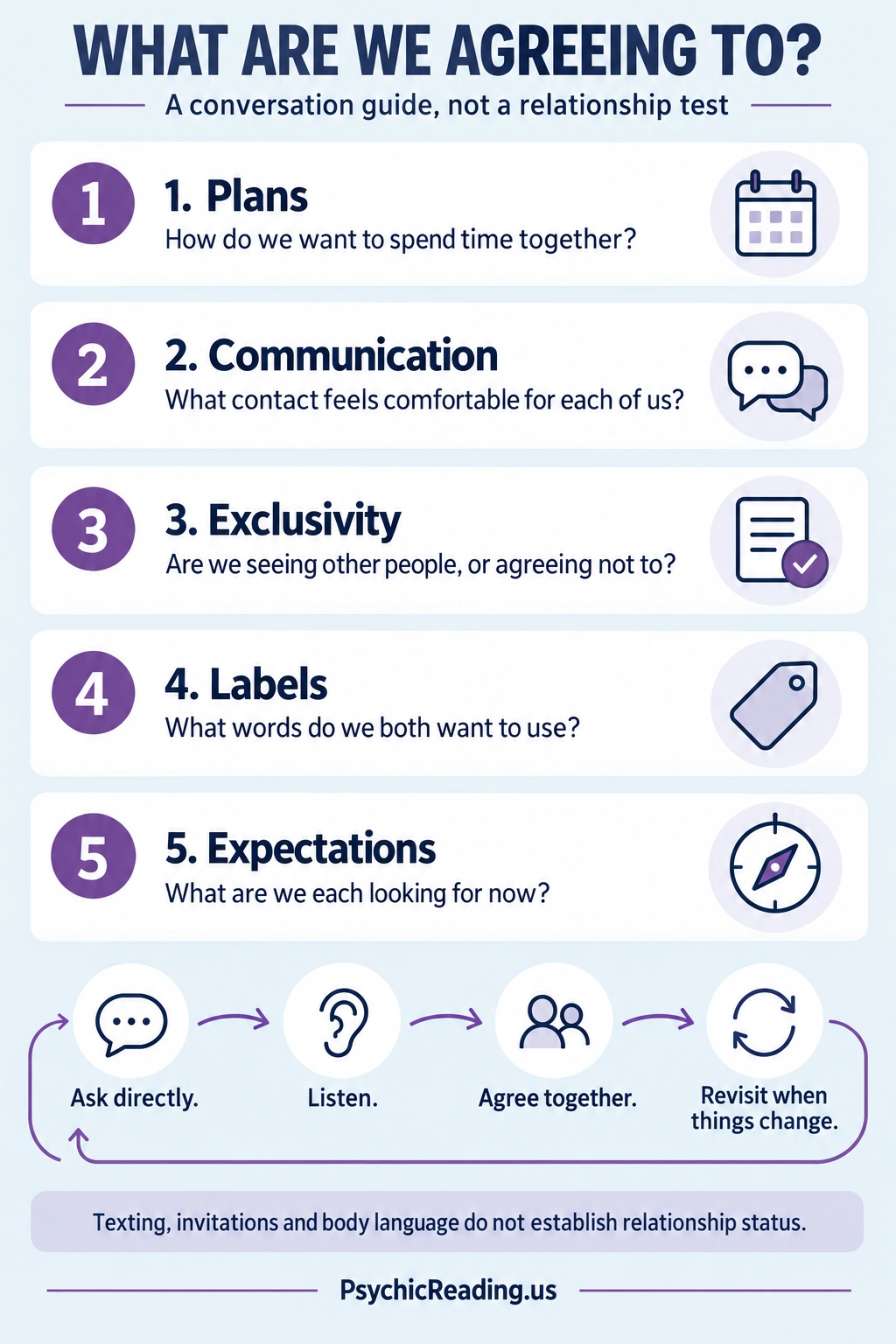
Read the infographic text
What are we agreeing to? A conversation guide, not a relationship test.
- Plans: How do we want to spend time together?
- Communication: What contact feels comfortable for each of us?
- Exclusivity: Are we seeing other people, or agreeing not to?
- Labels: What words do we both want to use?
- Expectations: What are we each looking for now?
Ask directly. Listen. Agree together. Revisit when things change.
Texting, invitations and body language do not establish relationship status.
Prepare for the “what are we?” conversation
Before asking, give yourself a little space to identify what you want. A quiet journal entry or an optional spiritual reflection can help separate your hopes from your assumptions.
- What do I know? Record the agreements you have actually made.
- What am I interpreting? Note the texts, invitations or intuitions you have been treating as evidence.
- What do I want now? Be specific about the relationship you would choose.
- What am I willing to accept? Identify your boundaries without presenting them as threats.
Choose a reasonably calm moment when neither person is rushing. You could begin: “I’ve enjoyed getting to know you, and I’m interested in something ongoing. I’d like to understand what you’re looking for and whether we want the same things.”
Then listen. Leave room for an answer different from the one you hoped for. You are asking for clarity, not persuading someone to promise a relationship they do not want.
What to do with the answer
If you want the same thing
Turn the label into a few practical agreements. Discuss contact, time together, exclusivity if relevant and how you will raise concerns. Revisit the conversation when circumstances change rather than expecting one discussion to cover the whole future.
If they are unsure
You can ask what “unsure” means and decide whether you want to continue under the current conditions. If you both want time to think, you might agree to revisit the conversation at a mutually comfortable point. You do not have to wait indefinitely or treat uncertainty as a challenge to win.
If you want different relationships
A mismatch can hurt without making either person wrong. Someone’s honest wish for casual dating is not a promise of eventual commitment. Your wish for a serious partnership is not unreasonable simply because they do not share it.
You can step back if the arrangement does not meet your needs. Leaving room for your own choice is different from issuing an ultimatum to control theirs.
Serious is not the same as healthy
A label or future promise does not outweigh how you are treated. The National Domestic Violence Hotline’s relationship guide emphasizes mutual respect, communication, boundaries and consent, and distinguishes these from control and coercion.
If you feel afraid of your partner’s response, or there are threats, monitoring, pressure or isolation, you do not have to confront them to prove you communicate well. Consider reaching out to a trusted person or an abuse-support service to discuss your situation and safer options. Spiritual chemistry is not an obligation to stay in a harmful relationship.
Where intuition and a love reading can fit
Intuition can alert you to a feeling worth examining: perhaps you want more consistency, feel uncomfortable with ambiguity or realize you are ready for commitment. Try translating that feeling into a question or boundary you can express.
If you choose a psychic love reading, keep its role reflective. Ask about your values, communication or what you want to learn about yourself. A reader cannot establish your partner’s private intentions, verify exclusivity or guarantee a shared future. A prediction should not override a clear answer from the person you are dating.
For more reflection on this distinction, see our guide to psychic love readings, communication and boundaries.
Common relationship-status questions
Can a relationship be serious without a label?
Yes, if you both understand and genuinely want the commitments involved. If the lack of a label leaves you confused, discuss it. Clear agreements matter more than guessing what an undefined relationship means.
Does frequent texting mean they want commitment?
Not on its own. Enjoy the contact, but ask about intentions rather than treating the number of messages as a relationship-status measure.
How soon should we have the conversation?
There is no rule that fits every connection. Raise it when knowing would affect your choices, emotional investment or boundaries. You can ask for clarity without demanding an immediate lifelong promise.
What if they avoid every discussion?
You cannot force an answer, but you can decide how much ambiguity you want to remain in. Repeated avoidance is information about what is available to you now, even when the person’s private reasons remain unknown.
Choose clarity over guessing
A meaningful relationship does not require you to decode every message. Let yourself enjoy the connection, ask what you need to know and take the answer seriously. Spiritual reflection can help you understand your own heart; mutual agreement is what defines the relationship you are building together.
Examining past relationships to gain insight is a valuable approach. The advice here seems applicable to many scenarios.
The article provides a clear framework for evaluating a relationship. The questions suggested are quite practical.
The points about making plans and being seen as a couple are very insightful. It helps in identifying the nature of the relationship.
The emphasis on expectations and commitment resonates well. It’s important to set clear boundaries early on.
The distinction between casual and serious relationships is well articulated. It’s crucial to understand the level of commitment involved.
The comparison between making implicit plans and having no plans at all is telling. Very useful for distinguishing relationship types.
It’s interesting how open invites to events can signal a serious relationship. This is a useful observation.
Understanding the level of communication can indeed highlight the seriousness of a relationship. Consistent texting is a good indicator.