

A psychic reading can feel like an invitation to slow down and look at your life through a different lens. Perhaps you want to explore a relationship, consider a change or make space for a spiritual question you have not been able to put into words.
The “best” reading is not necessarily the most dramatic one. It is an experience you can approach thoughtfully, afford comfortably and leave with your own judgment intact. A reader’s confidence, a moving moment or an accurate-sounding detail does not establish supernatural ability or guarantee what happens next.
You can remain open to spiritual meaning without handing over your choices. The steps below help you prepare, ask useful questions and recognize when to pause or walk away.
Choose the experience you actually want
Start with the topic and format, rather than a promise that someone is the perfect psychic. Tarot, other symbolic readings, intuitive consultations and mediumship can involve different approaches. Read the description and ask what a session includes.
Are you hoping for reflection on your own choices, or expecting an exact answer about someone else’s thoughts? Clarifying that difference may help you set realistic expectations. A reading cannot verify private intentions, diagnose a health condition or replace professional financial or legal advice.
Online and in-person sessions are both options. Choose what suits your comfort, access and privacy needs. Neither format proves a reader is genuine, accurate or safer from fraud. Phone and text conversations can still involve information you share or details already available publicly.
Check the practical details before booking
- Price: Is the session charged by the minute or at a fixed rate? What is the total you are willing to spend?
- Timing: How long is booked, and how do you end a session or prevent an unwanted extension?
- Policies: Read the actual provider’s cancellation, refund and billing terms. Do not assume they match another service’s rules.
- Privacy: Ask whether a session is recorded, what information is requested and how it is handled. Do not assume a confidentiality practice that has not been stated.
- Scope: Ask what topics the reader will discuss and where they set limits.
A profile or review can tell you how someone describes their service or what a customer reports. It does not independently establish predictive accuracy. You do not have to keep buying sessions to decide whether the experience suits you.
How much should you tell the reader?
You do not need to make a reading a guessing contest. You can provide the context you choose, ask a clear question and also decline details you would rather keep private. Agree on the approach before the session rather than assuming silence is a test of authenticity.
A reader may ask questions or notice your reactions. That alone is not proof of fraud, just as a correct detail is not proof of psychic ability. What matters for the interaction is whether questions are transparent, your boundaries are respected and uncertainty is acknowledged.
Be alert if ordinary details you have provided are presented later as extraordinary discoveries, or if vague statements are repeatedly reshaped until you agree. You are allowed to say, “That doesn’t fit,” without inventing a connection or blaming yourself for not being receptive.
Do not share passwords, identity numbers or banking credentials as part of a reading. Use the provider’s stated payment process rather than sending sensitive account information to an individual reader.
Prepare your questions in order of importance
Write down two or three priorities before booking. A long list may be hard to cover in the time available. Group your questions by theme—relationships, work or personal direction—so you can focus on one topic at a time.
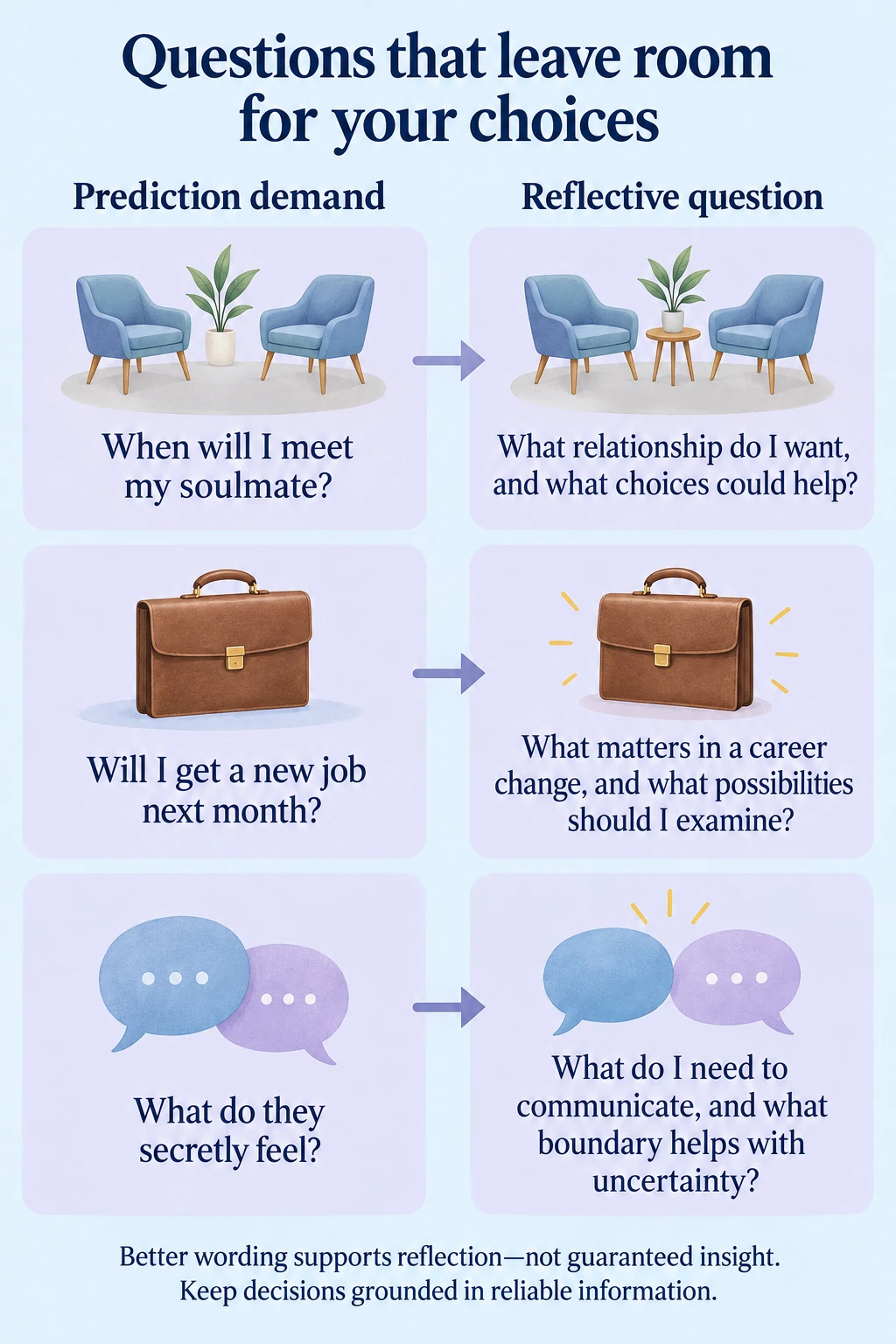
Open-ended questions can make a reflective conversation more useful because they focus on what you can consider or choose:
- Instead of “When will I meet my soulmate?” try “What kind of relationship do I want, and what choices could help me pursue it?”
- Instead of “Will I get a new job next month?” try “What matters most to me in a career change, and what possibilities should I examine?”
- Instead of “What does this person secretly feel?” try “What do I need to communicate, and what boundary would help me handle uncertainty?”
The wording does not unlock guaranteed insight. It simply helps keep the conversation connected with your own agency. Use reliable information and appropriately qualified advice for decisions about money, health, legal matters or other high-stakes concerns.
Read the question worksheet as text
- Prediction demand: When will I meet my soulmate? Reflective question: What relationship do I want, and what choices could help?
- Prediction demand: Will I get a new job next month? Reflective question: What matters in a career change, and what possibilities should I examine?
- Prediction demand: What do they secretly feel? Reflective question: What do I need to communicate, and what boundary helps with uncertainty?
Better wording supports reflection—not guaranteed insight. Keep decisions grounded in reliable information.
Name your feelings without making them a test
Before the session, write a few words about what you are feeling: hopeful, grieving, uncertain, excited or tired. You may decide to share them, or keep them as a private reminder of what brought you to the reading.
You do not have to “prepare your energy” perfectly or maintain the right mood for a reader to perform. Nervousness and skepticism are not faults. If the experience disappoints you, that does not mean you blocked a message.
A short pause, a glass of water or a quiet moment may help you arrive with less pressure. You can also postpone if you are too overwhelmed to decide comfortably about spending or taking advice.
Set an intention, not a required outcome
An intention might be “I want to explore what matters to me” or “I want to hear another perspective without rushing a decision.” It does not have to mean believing everything the reader says.
If you choose mediumship, remembrance may be part of your intention. You might think about your loved one, keep a meaningful object nearby or decide which topics you do not want to discuss. None of these steps guarantees contact, and an absence of a message is not evidence that you did something wrong.
Mediumship is a spiritual practice, not verified communication with a deceased person. A meaningful feeling can still be personal and valuable without proving the source of a statement. For more preparation ideas, see what to consider before visiting a medium.
Keep time and spending in your hands
Decide your limit before an emotionally engaging conversation begins. You could say, “I have fifteen minutes today, and these are my two main questions.” Use whatever duration fits your booking; the example is not a rule about how long a reading should be.
Brief questions can help with focus, but there is no obligation to let the reader take over or to remain silent. Ask for clarification when something is unclear. If a session is metered, consider your own timer and confirm how to stop billing.
You can end the session without purchasing more time, an additional ritual or a follow-up. A claim that something terrible will happen unless you pay is a reason to stop, not a spiritual obligation.
Write down what was actually said
Notes can help you reflect without relying only on the most memorable parts. Separate the reader’s statement from your own interpretation.
- Statement: Record the wording as accurately as you can, including uncertainty.
- Your response: Note what resonated, what did not and what you had already shared.
- Possible meaning: Write your associations without calling them established facts.
- Next step: Identify an action you can evaluate in ordinary life.
Ask permission before recording and check the provider’s rules. If you did not capture something, acknowledge the gap rather than filling it in later. You do not need to make every statement fit, and an interpretation becoming meaningful later does not automatically verify a prediction.
How to handle dates and predictions
An exact date is not a reliable test that sorts readers into “real” and “fake.” Nor does a vague forecast become reliable simply because it includes a free-will explanation. Treat predictions as uncertain claims, not commitments from the future.
You can ask, “How should I understand that timing?” and keep a record of the answer. Avoid putting your life on hold, ignoring contrary evidence or booking repeatedly to obtain a more reassuring date. Our guide to psychic predictions and personal choice explores that distinction further.
Pressure is not part of a meaningful reading
Step back from threats, demands for secrecy, guaranteed reconciliation, medical promises or claims that only one reader can protect you. You do not owe someone more money because they say they found a curse or dangerous blockage.
The Federal Trade Commission’s phone-scam guidance warns about pressure to decide immediately and demands for payment methods that make recovery difficult. Those warnings are relevant even when an offer is framed spiritually. Believing in readings does not require accepting fear-based sales tactics.
If you believe you were scammed, save the messages and receipts and contact the company you used to pay promptly. The FTC’s guide to steps after a scam explains how to ask about recovering money and reporting fraud. Recovery is not guaranteed. Do not pay another person who promises to recover your money for an upfront fee.
Common questions before a reading
Should I book several readers to find the right one?
You can decide a service is not for you without continuing to spend. If you try another, keep a clear budget and purpose. Repeating the same question until you hear a desired answer may add confusion rather than clarity.
Can I disagree with the interpretation?
Yes. A respectful interaction leaves room for questions, disagreement and ending the session. You do not have to supply a story that makes a statement seem accurate.
Does a strong emotional connection prove the reading is true?
No. A conversation can be moving without verifying supernatural claims. Let the feeling matter to you while keeping factual decisions grounded in evidence.
What makes a reading worthwhile?
That depends on your purpose and expectations. You may value a symbolic perspective, a thoughtful question or a chance to reflect. None requires a guarantee, an expensive session or surrendering control of your next steps.
Leave with perspective, not dependence
Give yourself time after the session. Revisit your notes, consider what was useful and choose one practical step rather than acting on every impression. A spiritual experience can be meaningful while your choices, boundaries and everyday life remain firmly yours.
The article provides a comprehensive guide on preparing for a psychic reading. The importance of asking open-ended questions was particularly insightful.
The advice on how to phrase questions effectively is valuable.
Open-ended questions do seem to yield more detailed and useful insights.
The idea that online psychics might be more genuine due to the lack of physical cues is an interesting perspective. It certainly gives one something to ponder.
The discussion on how psychics read body language was enlightening. It adds a layer of understanding to how some psychics might operate.
The tips on preparing for a reading are practical and actionable.
I agree, especially the advice to write down questions beforehand. It helps in organizing thoughts.
Indeed, preparation can make the session more productive and focused.
The section on knowing your feelings before the reading resonates. Self-awareness can indeed aid in getting more accurate readings.
Breaking down questions into categories is a solid strategy.
Yes, it prevents confusion and allows for more thorough exploration of each issue.
I appreciated the emphasis on differentiating between real and fraudulent psychics. This is crucial information for anyone seeking psychic consultations.