

You sit down with your journal intending to listen to your intuition, but the same question keeps returning: Why do I keep responding this way? Perhaps you rush to make everyone happy, feel responsible for getting every detail right, or collect so much advice that your own voice becomes difficult to hear.
The Enneagram offers nine personality patterns to explore those questions. For someone drawn to psychic readings, tarot or spiritual growth, it can be a companion to reflection: a way to notice the expectations you bring to a reading and the choices you make afterward. It does not reveal a proven soul identity, measure psychic ability or diagnose a mental-health condition.
You do not need to squeeze yourself into a number. Begin with curiosity, keep what helps you understand your experience, and leave room for the parts of you that no description captures.
What is the Enneagram?
The Enneagram is a personality framework represented by a circle with nine numbered points and connecting lines. Its descriptions focus on motivations, fears and familiar responses, rather than simply sorting people by their favorite activities. Different teachers develop and interpret the system differently.
In the Enneagram Institute’s approach, the nine types are grouped into three centers: instinctive or body types 8, 9 and 1; feeling or heart types 2, 3 and 4; and thinking or head types 5, 6 and 7. A “wing” refers to an adjacent number: someone exploring Type 9 might also consider 8 or 1. Numbers are not ranks of spiritual achievement, intelligence or worth.
Some schools teach that a basic type remains stable. Treat that as part of their theory, not a scientific finding that your identity is fixed forever. Your behavior, circumstances, relationships and understanding of yourself can change.
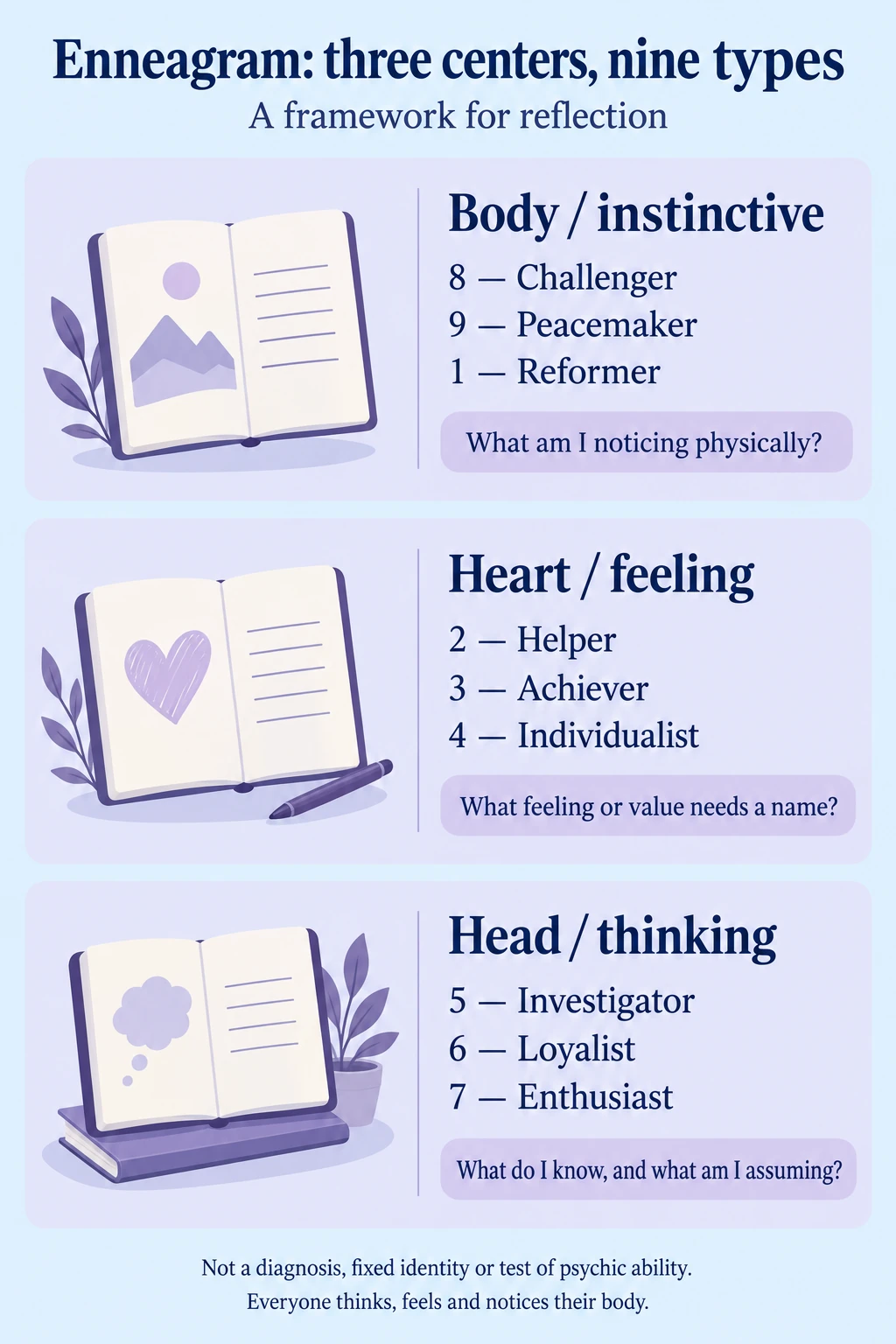
Read the three-center overview as text
- Body / instinctive: 8—Challenger; 9—Peacemaker; 1—Reformer. Reflection: What am I noticing physically?
- Heart / feeling: 2—Helper; 3—Achiever; 4—Individualist. Reflection: What feeling or value needs a name?
- Head / thinking: 5—Investigator; 6—Loyalist; 7—Enthusiast. Reflection: What do I know, and what am I assuming?
This is a framework for reflection—not a diagnosis, fixed identity or test of psychic ability. Everyone thinks, feels and notices their body.
Where did the modern system come from?
According to the Institute’s account of the tradition, G. I. Gurdjieff taught the Enneagram symbol without the nine personality types used today. Oscar Ichazo later developed personality-related teachings, and Claudio Naranjo helped bring those ideas into further psychological discussion.
That distinction matters: the symbol’s history and the modern personality model are not the same story. A spiritual tradition can be meaningful without claiming that today’s type descriptions have been handed down unchanged for thousands of years.
Spiritual meaning and scientific evidence
Many spiritual readers use the language of “essence” for qualities they hope to express more freely, and “ego” for familiar defenses or self-images. You might understand those ideas as metaphors for moving from automatic reactions toward intentional choices. You do not have to regard your ordinary personality as an enemy or believe that pain proves you are spiritually asleep.
The evidence for the personality system is limited. A 2021 systematic review of 104 independent samples found mixed support for reliability and validity and little research supporting secondary features such as wings and movement between types. Some studies reported benefits for personal or spiritual growth. Finding a description meaningful is different from establishing that it accurately measures everyone’s personality.
Use the framework for questions, not verdicts. It should not decide a diagnosis, career, relationship outcome or another person’s trustworthiness. Persistent distress deserves appropriate professional support, not an explanation that you have the “wrong” type.
The nine types: patterns to explore, not boxes to live in
The following introductions use the Institute’s type names, with links to its fuller descriptions. The reflection exercises are optional prompts for everyday life. A strength or difficulty can appear in anyone; recognizing one trait does not establish your type.
Type 1: The Reformer — integrity without perfection
The Type 1 description emphasizes principles, responsibility and the wish to improve things. Its challenging side involves harsh criticism and difficulty accepting imperfection. If this pattern resonates, you may recognize the tension between caring deeply about doing good and feeling that nothing you do is quite enough.
In spiritual practice, that tension might look like judging a meditation because your mind wandered, or believing a journal entry must produce an important revelation. The practice becomes another task to perform correctly instead of a place to be honest.
Reflection: Where is a standard supporting your values, and where is it simply punishing you? Choose one low-stakes task and define a reasonable stopping point before beginning. Afterward, write down something you appreciated about the effort, not just what you would improve. Integrity can include kindness toward yourself.
Type 2: The Helper — love that includes your needs
The Type 2 description centers on connection, generosity and wanting to feel loved. It also explores the strain of needing to be needed or overlooking personal needs while helping others. Caring is a gift; it becomes complicated when an unspoken expectation travels with every offer.
You might recognize this in agreeing to discuss a friend’s relationship for hours even when you are tired, then feeling hurt that they did not notice. A spiritual explanation about being an empath need not replace a clear conversation about your limits.
Reflection: Before offering help, ask yourself whether you have the time and willingness to give it freely. Ask the other person what they actually want. Practice a simple sentence: “I care about you, and I can talk tomorrow, but I need to rest tonight.” Love does not require unlimited availability.
Type 3: The Achiever — value beyond accomplishment
The Type 3 description highlights ambition, adaptability and competence, alongside concern about image and recognition. If it feels familiar, you may be excellent at moving toward a goal while finding it harder to separate what you truly want from what earns approval.
Spiritual growth can become another achievement: being the person with the most impressive insight, the perfect routine or a dramatic awakening story. Yet a quiet change in how you treat someone may matter more to you than a story you can share.
Reflection: Write two lists: “What I want to experience” and “What I want others to think of me.” Notice where they differ without criticizing yourself. Choose one private act that expresses a value, such as apologizing sincerely or enjoying something without posting it. You do not need an audience for your life to have meaning.
Type 4: The Individualist — depth with room for ordinary life
The Type 4 description explores creativity, emotional depth and the desire for a distinctive identity. It also considers comparison, longing and becoming absorbed in a particular emotional story. Feeling something intensely does not make it unimportant, but neither does it make every interpretation of it true.
If a dream or reading stirs a powerful emotion, you can honor the experience without deciding that it proves you are destined to be misunderstood. Symbolism may give you language for a feeling; it need not become a permanent label.
Reflection: Describe your present emotion in one sentence, then name one ordinary thing that still needs care today. It might be a meal, a small household task or a message to a friend. Make room for both. Depth does not disappear when you participate in everyday life, and belonging need not require giving up your individuality.
Type 5: The Investigator — insight that makes room for participation
The Type 5 description emphasizes curiosity, observation and the wish to feel capable through understanding. It also discusses withdrawing into thought or preparation. There is a difference between learning because it nourishes you and postponing an experience because you never feel sufficiently ready.
For a spiritual seeker, that might mean researching every tarot tradition without ever trying a simple reflective exercise. You are allowed to ask thoughtful questions and still begin with something small. Beginning does not require claiming expertise.
Reflection: Pick one manageable activity you have been studying. Set a modest limit on preparation, then try a version with no major stakes. Write down what you learned by participating that reading alone did not provide. Respect your need for privacy and quiet while leaving a doorway open to connection.
Type 6: The Loyalist — support without surrendering your judgment
The Type 6 description focuses on loyalty, responsibility and security, as well as doubt and the search for reassurance. It does not mean that everyone who worries is a Six or that this number explains an anxiety condition.
If you keep seeking a new reading because the previous answer did not feel certain enough, pause to ask what certainty you are hoping to buy. Another interpretation may not settle a question that depends on a conversation, a practical decision or information you do not yet have.
Reflection: Divide a page into “What I know,” “What I fear” and “What I can do next.” Keep facts separate from predictions. For a low-stakes choice, select one reasonable action without asking several people to approve it. You can welcome support while retaining responsibility for your decisions.
Type 7: The Enthusiast — freedom with a place to land
The Type 7 description highlights possibility, variety and enthusiasm. It also explores distraction and difficulty staying with disappointment. Enjoyment is not a flaw; the useful question is whether a new plan expresses genuine interest or helps you avoid something that needs attention.
You might notice yourself moving from a reading to a new course, then to a different ritual, always expecting the next experience to supply a final answer. There is no obligation to stop exploring. You can simply give one practice enough time to understand what you actually value about it.
Reflection: Choose one small activity to finish before adding another. When an uncomfortable feeling appears, name it without immediately making a plan to escape it. Take a break if the exercise becomes overwhelming. Freedom can include the freedom to slow down and appreciate what is already here.
Type 8: The Challenger — strength that leaves room for others
The Type 8 description emphasizes independence, directness and protection. Its challenges include control and difficulty allowing vulnerability. Strength need not mean directing every conversation, and protecting someone does not give you permission to decide for them.
In a reading, you might want clear answers and dislike uncertainty. You can ask direct questions while accepting that a reader cannot guarantee another person’s decisions or your future. Being honest about disappointment is different from demanding a prediction that feels reassuring.
Reflection: In a safe conversation, replace one directive with a question: “What would be helpful to you?” Listen before offering a solution. You might also practice asking for something you need without turning it into a demand. You can maintain firm boundaries and still allow a trusted person to see your softer feelings.
Type 9: The Peacemaker — harmony that includes your voice
The Type 9 description emphasizes acceptance, steadiness and harmony. It also examines minimizing conflict or setting aside personal priorities. Peace is not necessarily the absence of disagreement; a quiet room can still contain needs nobody has named.
A spiritual message about acceptance may feel comforting, but it should not become pressure to tolerate disrespect. You can value compassion and still say that something is not acceptable to you. Your preference does not have to be dramatic to deserve attention.
Reflection: Notice a small moment when you are about to say “Whatever you want.” If you do have a preference, express it plainly: “I’d like to choose this time.” Begin with an ordinary, safe situation. Harmony becomes more honest when your voice is part of it rather than the cost of keeping it.
Body, heart and head: a three-question check-in
The three centers are categories within the Enneagram model, not literal divisions of the brain, soul or energy system. Everyone thinks, feels and experiences bodily sensations. You do not lose access to one of those experiences because of a number.
Try this check-in without deciding your type:
- Body: What am I noticing physically, and would a comfortable position, a pause or a change of surroundings help?
- Heart: What feeling or value needs a name? What do I want to express honestly?
- Head: What do I know, what am I assuming, and what information would actually help?
For example, before asking whether a relationship is “meant to be,” you might notice that you are tense, want reassurance and do not know what the other person wants. That observation gives you a more useful next step than assigning either person a type: a respectful conversation about expectations.
Essence, passions and fixations: using the language gently
Traditional teachings use “passion” for a habitual emotional pattern and “fixation” for a recurring mental pattern. These are spiritual teaching terms, not clinical diagnoses or evidence that a person is greedy, dishonest or spiritually defective. Different schools explain their deeper meanings in different ways.
Instead of using those labels as accusations, describe a specific moment: “I offered help hoping to be thanked,” or “I kept imagining a problem without checking the facts.” A behavior can be acknowledged and changed without condemning your whole character.
For a personal journal, you can also work with these nine reflection themes from this article’s spiritual approach. They are invitations, not a standardized test or proof of an essential identity:
- Integrity: What choice fits my values without demanding perfection?
- Love: How can care include both another person and myself?
- Value: What matters even when nobody applauds?
- Depth: What meaning can I explore without becoming trapped in one story?
- Insight: What can I learn by taking part?
- Truth: Which facts deserve attention alongside my hopes and fears?
- Freedom: Where can I choose deliberately instead of chasing the next distraction?
- Power: How can I use strength while respecting someone else’s autonomy?
- Harmony: What would peace look like if my needs were included?
You may find several themes helpful on the same day. There is no need to reserve compassion, courage or insight for a particular number.
How to explore your type without rushing
A quiz result can suggest descriptions to read; it cannot establish your identity with certainty. Rather than collecting tests until one delivers the answer you want, take time to notice real examples from your life.
- Start with two or three descriptions. Consider the motivations, not only flattering strengths or recognizable habits.
- Record a few ordinary moments. What happened, what did you want, and what did you do? Include examples that do not fit your first guess.
- Separate patterns from circumstances. A demanding job, a difficult week or a particular relationship may shape how you respond.
- Leave your conclusion provisional. “This description is useful right now” is enough. Wings, arrows and other advanced concepts are optional.
- Choose one practical change. Ask for a need, take a manageable step, or listen differently. The number matters less than what you do with the reflection.
A willing friend can offer observations, but avoid typing someone against their wishes. Statements such as “You’re a Two, so you’re manipulating me” replace conversation with accusation. Discuss the actual behavior and its impact instead.
Bringing the Enneagram into a psychic or tarot reading
If readings are meaningful to you, bring an open question rather than asking a reader to confirm a fixed identity. You might ask, “What am I overlooking about how I seek reassurance?” or “What can this symbol prompt me to consider about my boundaries?”
A reading can offer a spiritual perspective, but it cannot verify your type, diagnose you or prove what another person secretly feels. Keep your own notes about what resonates, what does not, and what real-life action remains yours to choose. No personality label obligates you to purchase another session or follow advice that conflicts with your values.
You can also use a single tarot card as a journaling prompt: describe the image, connect it to one question above, and write one action you can take. The meaning is an interpretation, not evidence of a future event.
Common questions about the Enneagram
Can I relate to more than one type?
Yes. Descriptions overlap, and people show different sides of themselves in different situations. You do not have to force a final answer. Explore motivations over time and allow examples that challenge your initial impression.
Does an Enneagram type show psychic ability?
No. The framework is not a test of clairvoyance, intuition or supernatural perception. Feeling understood by a description does not demonstrate a psychic gift.
Is one type better for relationships?
A number cannot guarantee compatibility. What matters in an actual relationship includes mutual respect, consent, honest communication and how both people respond to differences. Do not use a type to excuse controlling or harmful behavior.
Do I need meditation to find my true self?
No particular spiritual practice is required. You might prefer journaling, a thoughtful conversation or a quiet walk. If meditation is part of your life, it can be an optional setting for reflection, not a test you must pass to be worthy or awakened.
A more compassionate way to understand yourself
The most useful discovery may not be “I am a Seven” or “I am a Nine.” It may be noticing that you keep saying yes when you mean no, or that you are allowed to enjoy something without making it an achievement.
Let the Enneagram give you questions spacious enough for your real life. Spiritual exploration can honor mystery while remaining honest about what you know. A small, deliberate choice is a meaningful place to begin.
I appreciate the neutral explanation of the enneagram without leaning into it as an absolute truth but rather a tool for understanding.
The enneagram appears to offer a compelling method for self-discovery. The idea that one’s core type remains unchanged throughout life is particularly thought-provoking.
The idea that enneagrams can help identify personal fears and motivations is quite intriguing and could be useful for personal development.
I find the historical context provided regarding Gurdjieff and Ichazo quite interesting. It’s fascinating to see how concepts evolve over time.
Indeed, the historical background adds a layer of depth to understanding the enneagram’s origins and uses.
Yes, it makes me appreciate the enneagram more knowing its rich history and the intellectual minds behind it.
The essence numbers and their meanings seem to capture various fundamental aspects of human experience.
Agree, they break down abstract concepts into more understandable and relatable terms.
Meditation and presence as ways to understand and work with one’s enneagram type seem like practical advice for self-awareness.
The distinction between essence and personality provided here is an insightful way to look at self-improvement and personal growth.
It’s intriguing how the enneagram aims to connect personality traits with deeper, more spiritual aspects of self-awareness.