
Think of a room where you enjoy spending time. Perhaps the doorway is easy to move through, the light feels gentle and a few objects remind you of people or experiences you love. Feng shui offers a symbolic way to think about that relationship between your surroundings and your life.
If you value spiritual practices, arranging a room can become a small ritual of intention. You might create a welcoming entrance, a quieter place to reflect or a corner that reminds you to care for an important goal. You can enjoy that meaning without treating a furniture arrangement as a guarantee of money, health or romance.
What is feng shui?
Feng shui is associated with Chinese traditions of interpreting and arranging environments. Practitioners may describe their work in terms of qi, also written chi, and the balance of yin and yang. These are concepts within the tradition, not measured explanations for every mood or event in your home.
A room can feel uninviting for many ordinary reasons: clutter, poor lighting, an awkward layout or memories associated with it. That feeling does not prove that energy is trapped. Start by noticing what you actually want to change.
This guide offers beginner-friendly reflection and decorating ideas, not a formal feng shui assessment. Schools differ, so it helps to know which approach a book or practitioner is using.
Start with the way you use the room
Before buying a remedy or applying a map, walk through the space as you normally use it. What interrupts the routine? What would make the room easier to enjoy?
- Movement: Keep routes usable and do not place decorative objects where they block a doorway.
- Purpose: Decide whether the space is mainly for rest, work, conversation or reflection.
- Clutter: Start with one manageable surface rather than trying to transform the whole home.
- Light: Choose lighting that works for the task and feels comfortable to you.
- Meaning: Keep an object you genuinely value, not one you feel compelled to purchase out of fear.
Practical arrangements need to suit everyone using the home, including mobility needs, children, pets and shared-space preferences. A spiritual rule should not override accessibility or safety.
Bagua maps: understand the approach before placing one
The bagua is connected with eight trigrams. The Feng Shui Institute’s explanation of the bagua describes compass-based sectors and notes that simplified entrance-based approaches also exist. It presents a practitioner’s framework, not evidence that changing a sector will change your life.
You may encounter a nine-part grid with a center as well as eight surrounding areas, or a directional map. Do not assume that every map puts “wealth” on the left or “relationships” on the right when you stand at the door. Pick one clearly explained method if you want to study it, rather than mixing incompatible instructions.
For a simple reflective exercise, use these life themes without claiming that they occupy fixed locations in every home:
- Self and direction: What do I want my daily routine to support?
- Wisdom: Where could I make room for learning or quiet thought?
- Family and community: Which reminders of connection feel welcome?
- Wealth: Where can I keep practical plans or financial paperwork organized?
- Recognition: What work or contribution am I proud of?
- Relationships: How can the space respect both closeness and personal boundaries?
- Creativity: What would help me begin a project rather than merely imagine it?
- Helpful people: How can I remember to reach out and accept support?
- Wellbeing: What makes this room more comfortable to use?
These are prompts for your choices, not promises that a map will bring success, cure illness or determine a relationship.
The five elements as a symbolic decorating language
Wood, fire, earth, metal and water are part of the five-phase framework used in feng shui. The Feng Shui Institute’s five-elements guide associates them with colors and shapes. Those correspondences describe the practice; they are not physical laws that make décor control health or fortune.
Here are optional ways to explore the symbolism using what you already own:
- Wood: A plant you can care for, a wooden object or a green accent.
- Fire: Warm color or light. A lamp or flame-free candle can represent the idea without an open flame.
- Earth: A ceramic bowl, a stone or an earthy tone.
- Metal: A metal frame, a rounded object or a pale accent.
- Water: A water-themed picture or a flowing pattern. You do not need an aquarium or fountain.
A single thoughtful choice may be enough. You do not need every element in every room, nor a special purchase to prevent bad luck.
Generating and controlling cycles
Within the symbolic framework, the generating cycle is described as water → wood → fire → earth → metal → water. A controlling cycle is described as water → fire → metal → wood → earth → water, as in this practitioner’s account of the five-element cycles.
These are relationships within the tradition, not instructions to mix materials dangerously or a scientific account of what will happen in a room. If you enjoy the idea of balance, ask whether your decorating choices feel too busy, too stark or comfortable for you.
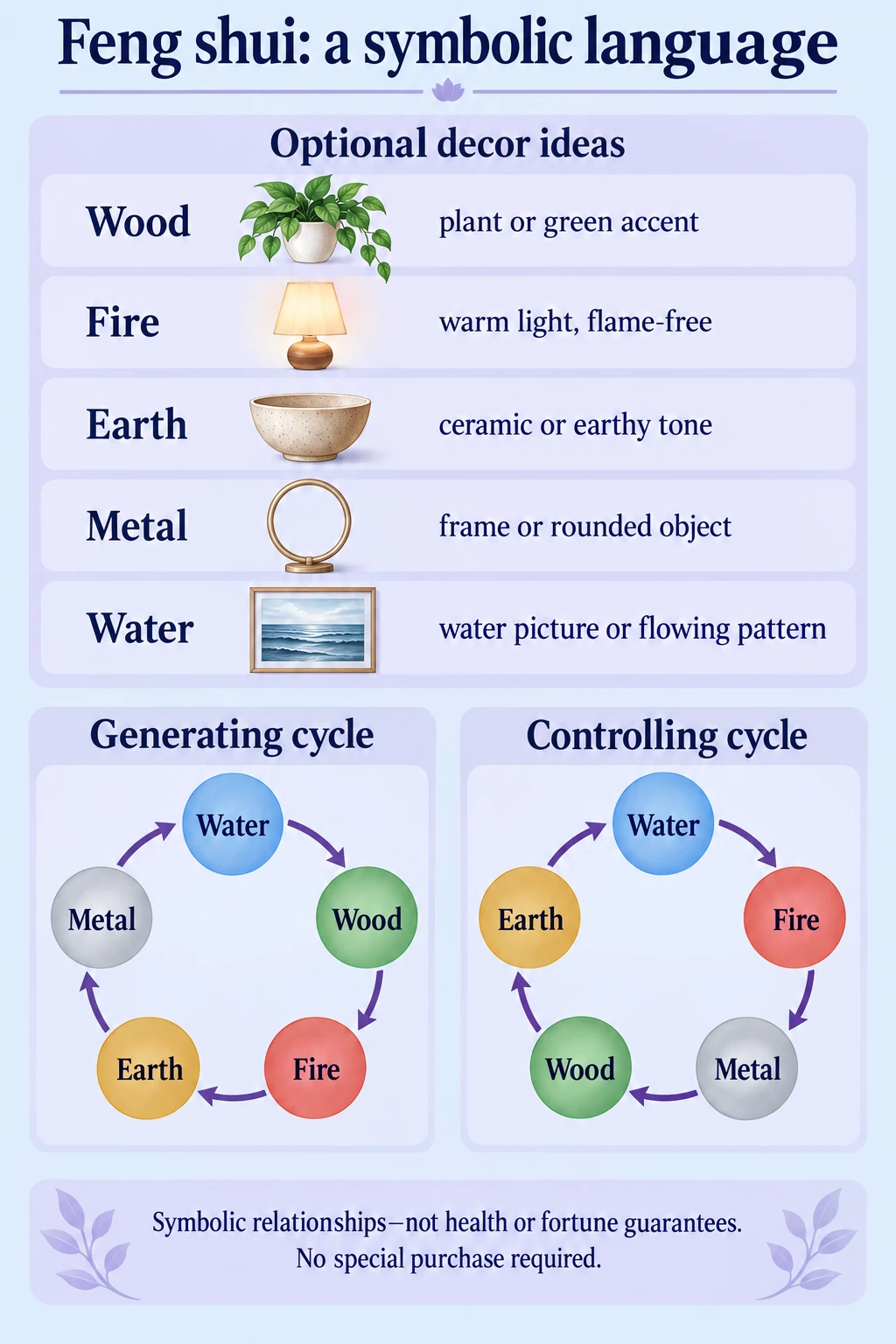
Read the five-element illustration as text
Optional decor ideas:
- Wood: Plant or green accent.
- Fire: Warm light, flame-free.
- Earth: Ceramic or earthy tone.
- Metal: Frame or rounded object.
- Water: Water picture or flowing pattern.
Generating cycle: Water → Wood → Fire → Earth → Metal → Water.
Controlling cycle: Water → Fire → Metal → Wood → Earth → Water.
The arrows show the next relationship in each separate cycle. These are symbolic relationships within feng shui—not health or fortune guarantees. No special purchase required.
Yin, yang and the feel of a space
Rather than assigning every object or person a rigid “feminine” or “masculine” energy, you can reflect on contrasts: quiet and activity, softer and brighter lighting, private rest and social time. This is a suggested way to explore balance, not a complete definition of the traditional concepts.
For example, a living room used for both conversation and reading might benefit from flexible lighting and a place to put away work materials. The useful question is how the space serves your life—not whether you have achieved a perfect energetic score.
Numbers, mirrors and sleeping directions
You may come across lucky-number interpretations, protective bagua mirrors or rules about which direction your head should face when you sleep. Treat these as beliefs or instructions from a particular approach, not universal guarantees.
An address number does not establish how long you will live, and a mirror cannot promise protection from harm. You do not need to fear your home because a number or layout is described as unlucky. If you display a meaningful symbol, place it securely and consider other people’s comfort.
For a bedroom, begin with a layout that is usable and comfortable. Do not rearrange it into an impractical position because an article says sleeping north is always wrong. If sleep problems persist, seek appropriate healthcare advice rather than relying on a directional remedy.
A small home project with a clear intention
- Choose one area. Try an entrance table, desk or reading corner.
- Name your intention. “I want arriving home to feel less rushed” is a workable starting point.
- Make one practical adjustment. Create a place for keys, clear the chair or improve the task lighting.
- Add one meaningful detail. Use an object, color or image you already enjoy.
- Notice the result. Is the space easier to use? Keep what helps and change what does not.
If you prepare a corner before a psychic reading, you might keep a notebook there for questions and reflections. The arrangement can express your intention without proving that it strengthens a psychic connection.
No smoke or expensive remedy is required
You can mark a fresh start with tidying, a spoken intention or quiet reflection. Our guide to smoke-cleansing rituals and a smoke-free alternative offers another symbolic option with safety boundaries.
There is no need to burn incense, hang crystals in a child’s window or install a water feature to make someone “whole.” Choose items with ordinary safety, maintenance and household needs in mind. Shared spaces work best when the people using them have a say.
A meaningful home does not have to be perfect
Feng shui can be a source of spiritual interest and an invitation to look more closely at your surroundings. Let it support intentional choices rather than become another reason to worry. A comfortable, usable home with room for what matters to you is a worthwhile goal—without a promise that the décor will decide your future.
Understanding the symbolic meaning of numbers in Feng Shui, such as the interpretation of addresses, adds an interesting layer to the practice.
The historical context of Feng Shui, particularly its origins with the Han dynasty, provides a rich backdrop to its application in modern environments.
The detailed explanation of the Bagua Map’s sections and their significance can help individuals tailor their living spaces to align with specific life areas.
The explanation of Feng Shui elements and their generative cycle provides practical knowledge on how to harmonize one’s environment using natural elements.
Learning about Feng Shui’s application in renowned institutions like Universal Studios and the Louvre Museum adds credibility to its principles.
The use of a Bagua Map and Compass in Feng Shui to determine the flow of energy is a fascinating method for creating balanced living and working spaces.
The concept of Chi moving through spaces and its impact on our mental state presents an intriguing intersection between spatial arrangement and psychological well-being.
The advice on the positioning of beds to ensure restful sleep underscores the practical aspects of Feng Shui in everyday life.