

The messages are shorter. Plans take longer to make. A goodbye that used to include a kiss feels rushed. When you care about someone, changes like these can leave you wondering: has he lost interest, or is something else going on?
If you trust your intuition, you may feel the distance before you can put it into words. That feeling is worth noticing, but it is a starting point for reflection—not proof of what your partner thinks. You can take your concern seriously without turning every missed message into a prediction of a breakup.
The useful question is not just “Does he still want me?” It is also “Can we talk honestly about what has changed, and does this relationship still meet both people’s needs?” This guide uses “he” to match the question, but communication and boundaries matter in relationships of any gender.
Look at patterns, not one moment
A change in attention can have more than one explanation. A demanding week, a change in routine, an unresolved disagreement or a change in feelings might be relevant. You cannot know which explanation fits by observing a single behavior or asking a reader to interpret it.
Instead of trying to score his interest, describe what you have actually noticed:
- Time together: Are plans repeatedly canceled without an alternative, or has there simply been a busy period?
- Conversation: Is there less curiosity or openness than before? What happens when you invite a conversation?
- Future plans: Have you stopped discussing plans you once shared, or never clarified them in the first place?
- Affection: Has your usual pattern changed? Have you asked how each of you feels about it?
- Effort: Are you doing all the initiating and adjusting, or is there a balance that works for both of you?
These observations can help you name a concern. They do not establish infidelity, a hidden motive or an inevitable ending.
Texting and intimacy are not simple tests of love
There is no universal rule that a strong relationship requires messages throughout the day. People differ in schedules and communication preferences. What matters is whether you can agree on a workable way to stay connected—not whether one person supplies constant updates to prove devotion.
Likewise, sex, hugging or kissing cannot certify the health of a relationship. Affection should be freely chosen, and either person can decline it. If a change matters to you, discuss it without treating physical intimacy as something you are owed.
The National Domestic Violence Hotline’s healthy-relationship guide emphasizes respect, honest communication, boundaries and consent. Those are more useful standards than a tally of kisses or messages.
Use intuition to identify a question, not deliver a verdict
You might describe your unease as a shift in energy or a feeling in your heart. If that language is meaningful to you, ask what it is helping you notice. Are you missing reassurance? Have you been avoiding a conversation? Does something observable make you uncomfortable?
A simple journal exercise can separate three things:
- What I observed: “We canceled two plans and haven’t arranged another.”
- What I am interpreting: “I’m afraid he no longer wants to see me.”
- What I want to ask: “Would you like to make another plan, and how are you feeling about us?”
The example is illustrative, not a diagnostic method. It helps you bring a clear concern to the conversation without pretending you already know the answer.
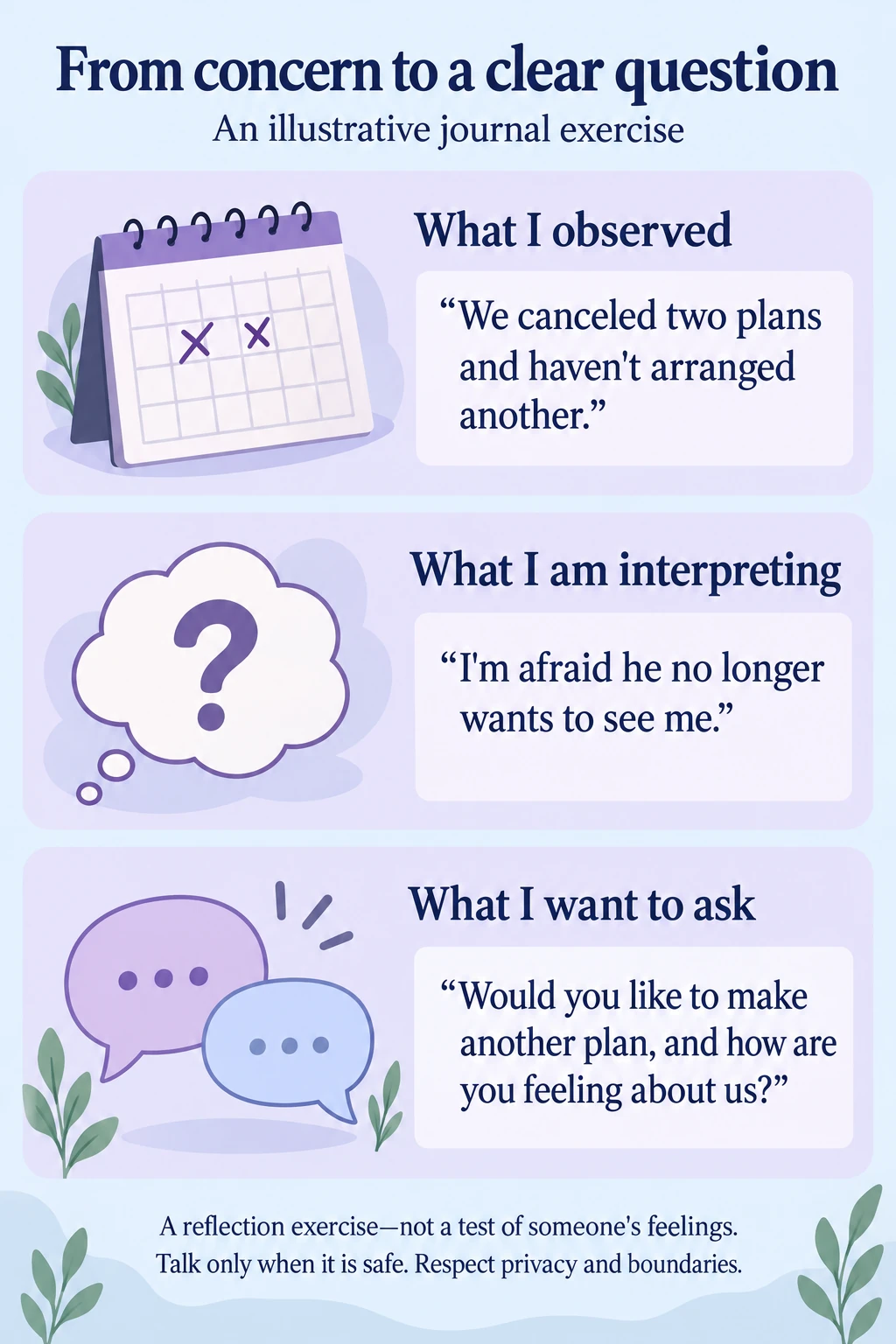
Read the journal illustration as text
- What I observed: “We canceled two plans and haven’t arranged another.”
- What I am interpreting: “I’m afraid he no longer wants to see me.”
- What I want to ask: “Would you like to make another plan, and how are you feeling about us?”
A reflection exercise—not a test of someone’s feelings. Talk only when it is safe. Respect privacy and boundaries.
Have a direct conversation, if it is safe
Choose a time when you are both able and willing to talk. You might say:
“I’ve noticed we haven’t been spending as much time together, and I miss feeling connected. How have you been feeling about our relationship? I’d like us to talk honestly, even if the answer is difficult.”
Then leave room for the response. Useful follow-up questions include:
- “Is something making it hard to connect right now?”
- “What kind of time or communication would feel realistic for both of us?”
- “Is there an unresolved issue we need to discuss?”
- “Do we both want to keep working on this relationship?”
You do not need to interrogate him, inspect private messages, set a jealousy trap or use a psychic prediction as evidence against him. Respect his privacy while being honest about your own needs.
Notice what happens after the conversation
Words matter, but so does follow-through. If you agree to make more time, does a workable plan emerge? Can you raise a concern without being mocked? Are both of you able to say what you want?
If he needs space, discuss what that means rather than assuming either constant contact or indefinite waiting. You can decide what arrangement is acceptable to you. If he does not want to continue the relationship, that decision should not be overridden by a soulmate label or a forecast that he will change his mind.
You are not solely responsible for noticing every warning early enough to stop someone leaving. A relationship requires two willing participants; you cannot maintain it through perfect vigilance.
Where a psychic reading can fit
A love reading may offer a space for spiritual reflection or symbolic questions. It cannot verify a partner’s private thoughts, establish why he is distant or guarantee that the relationship can be saved. An outside perspective is not automatically an accurate one.
If you choose a reading, consider questions centered on your choices:
- “What do I want to understand about my needs?”
- “What conversation am I afraid to have?”
- “What boundary would help me act with self-respect?”
- “What practical step makes sense even if the interpretation is wrong?”
Some readers use astrology, tarot, pendulums or crystals. Treat interpretations from those tools as part of their practice, not factual access to your partner’s mind. Ask what information is requested and why; do not assume you should share someone else’s private details.
Our guide to psychic love readings explores spiritual reflection alongside communication and boundaries. Repeatedly buying readings to obtain reassurance may leave the original conversation unresolved; you can pause rather than chase an answer.
Support, boundaries and safety
An appropriately qualified therapist may help you explore your feelings or communication choices, without promising to save the relationship. If you both want relationship support, consider what fits your circumstances. If there is abuse or fear, seek individualized safety support rather than treating it as an ordinary communication problem.
Threats, coercion, controlling behavior or punishment for setting boundaries are not simply signs of lost interest. In the U.S., the Hotline offers support at 800-799-SAFE (7233), by texting START to 88788, or through its website. Consider a safer device if your activity may be monitored. Contact emergency services if you are in immediate danger.
You deserve clarity, not constant decoding
There is room for hope and spiritual meaning, but you do not need to turn the relationship into a puzzle you must solve perfectly. Notice patterns, ask honestly when it is safe, and pay attention to how your needs and boundaries are treated. Whether you reconnect or move apart, your worth is not determined by another person’s level of interest.
I find it intriguing how the article emphasizes women’s intuition in deciphering relationship cues. Additionally, the mention of seeking therapy is a practical approach to salvaging partnerships in trouble.
The insights about men’s longing for freedom and how it impacts relationships provide a nuanced understanding of interpersonal dynamics. This information can be valuable for anyone trying to navigate a partnership.
While the article presents valid points about recognizing signs of a dwindling relationship, the suggestion to consult a psychic feels less grounded in empirical evidence. Nonetheless, different methods work for different people.
It is interesting to see the juxtaposition of Venus and Mars used as a metaphor for gender differences. The article effectively conveys the challenges faced in relationships and the signs of waning interest.
The utilization of astrology and psychics in understanding relationships introduces an alternative perspective. While some may find it helpful, others might prefer more conventional methods like counseling.
The advice regarding communication and intimacy as indicators of relationship health is sound. However, relying on psychics as a solution might not resonate with everyone, depending on their belief systems.
Acknowledging the intrinsic differences between men and women and the impact on relationships is crucial. The article’s recommendation to seek professional help when needed is particularly valuable.
The article touches on the complexities of relationships, highlighting the fundamental differences between men and women. It underscores the importance of communication and understanding, which are essential for a lasting bond.