

A familiar song, an old photograph or a dream can bring an ex back into your thoughts with surprising force. You may miss their humor, remember how understood you felt, or wonder whether the relationship ended before it had a fair chance. If you believe in soul connections, the question can feel even bigger: was this person meant to stay in your life?
You do not have to dismiss the connection to make a careful choice. But missing someone and being ready for a healthy relationship with them are different things. Before getting back with your ex, ask not only “Do I still love them?” but also “What would actually be different this time?”
The short answer: Consider reconnection only if you both freely want it, can discuss why the relationship ended, and have practical reasons to believe the old problems can be addressed. A reading, dream or feeling of destiny cannot establish your ex’s intentions or make an unsafe relationship safe.
Start with safety, not signs
Threats, coercion, controlling behavior, stalking or fear are not ordinary “small problems” to overlook for the sake of a soul connection. The National Domestic Violence Hotline’s relationship guide distinguishes respectful communication, boundaries and consent from unhealthy and abusive patterns.
If abuse was part of the relationship, seek individualized support rather than using this article as a reconciliation checklist. In the U.S., the Hotline offers help at 800-799-SAFE (7233), by texting START to 88788, or through its website. If someone may monitor your device, consider a safer way to access support. Contact emergency services if you are in immediate danger.
You do not need to return to prove forgiveness, finish a spiritual lesson or demonstrate compassion. Your safety and freedom to choose matter more than a label.
What does a soulmate feeling tell you?
“Soulmate,” “twin flame” and “karmic connection” are spiritual interpretations, not tests that determine whether two people should be partners. Beliefs about these terms differ; there is no reason to treat a claimed rule about having exactly one twin flame as an obligation.
Feeling deeply known can be meaningful. So can deciding that a meaningful relationship belongs in the past. If the word soulmate helps you describe what you valued, ask what that value would look like in daily life: respect, consistency, kindness, shared goals and space to be yourself.
Our guide to karmic connections and soul contracts explores spiritual meaning without making it a duty to remain in a relationship.
Separate affection from readiness
You still care, miss them or think about them often
Caring about an ex does not require hating them, and letting go does not require deciding they were entirely bad. You may still admire them, defend them from unfair criticism or feel sad about what you lost. None of that, by itself, answers whether you should reunite.
Try writing two lists: what I miss and what I would need in a relationship now. If the first list is about comfort and memories while the second includes needs that were repeatedly ignored, notice the difference. Forgiveness and a new relationship are separate choices.
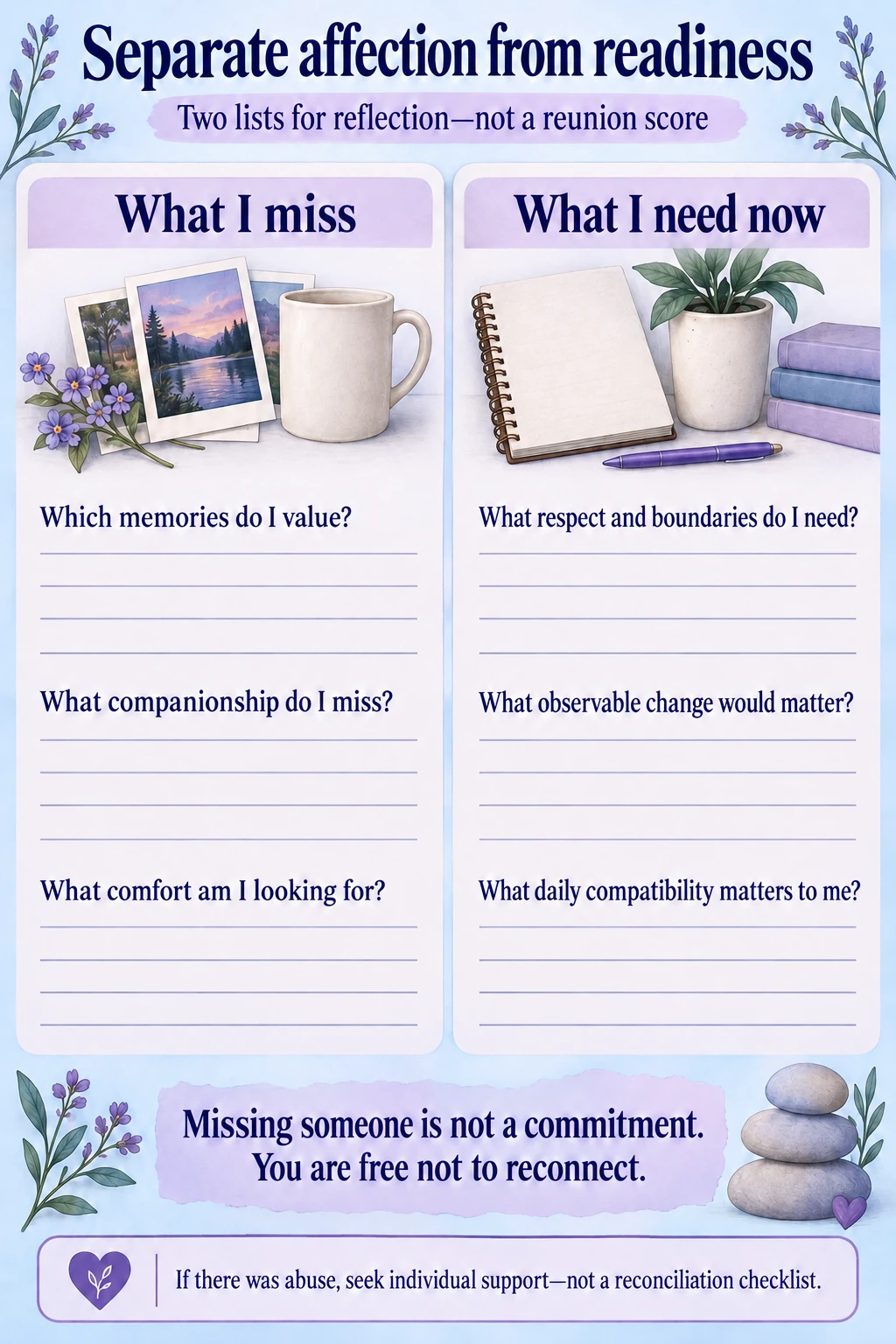
Read the two-list journal as text
What I miss:
- Which memories do I value?
- What companionship do I miss?
- What comfort am I looking for?
What I need now:
- What respect and boundaries do I need?
- What observable change would matter?
- What daily compatibility matters to me?
You can write your own responses beneath each prompt. Missing someone is not a commitment. You are free not to reconnect. If there was abuse, seek individual support—not a reconciliation checklist.
You still laugh and enjoy time together
Shared humor and easy conversation can be lovely parts of a connection. They do not replace the ability to handle disagreement, respect boundaries or follow through on commitments. Ask how you relate when things are inconvenient—not just when you are having fun.
You may also make good friends without making good romantic partners. If friendship keeps one of you hoping for more, discuss what contact means rather than leaving it ambiguous.
Dating others feels disappointing
Comparing every new person with your ex, disliking the dating scene or remaining single does not establish that your ex is your only match. You can take a break from dating without returning to a relationship that did not work.
Loneliness, housing worries or money concerns deserve support in their own right. They are not shameful, but it helps to distinguish those pressures from a freely chosen wish to rebuild this particular relationship.
Look for changes you can describe
Why did you break up?
Be specific. “Bad timing” might mean living far apart, incompatible work schedules or different plans for the future. Have those conditions actually changed? If the problem was how you handled conflict, moving closer together will not automatically resolve it.
A loving ending or a painful breakup can both leave unfinished feelings. Regret does not prove the breakup was a mistake. Ask what you knew then, what you know now and what still needs an honest conversation.
Are apologies supported by behavior?
Comforting words and an apology may open a conversation, but they are not guarantees. What responsibility is being taken? What has changed beyond the promise? Can you ask questions or decline reconciliation without being punished, pressured or blamed?
If there was abuse, an apology should not be treated as proof of safety. The Hotline’s guidance on change emphasizes accountability and the person’s own commitment to change. It is not your job to make them change, and you do not owe them renewed access to your life.
Have you grown without making yourself responsible for everything?
Time apart may help you clarify needs, practice communication or recognize patterns you want to change. You can work on your own behavior without “cleansing away” every difficult feeling or taking responsibility for another person’s harmful choices.
Describe growth in practical terms. “I now say when I need a pause and return to the conversation” is clearer than “my energy is completely healed.” Neither person’s self-improvement creates a right to reconciliation.
Contact is not the same as commitment
Texts, check-ins and mutual friends
Regular messages may mean affection, friendship, habit or a wish to reconnect. Asking friends about you is not a reliable way to determine what your ex wants. If contact is welcome and safe, a direct, low-pressure conversation is clearer than collecting clues.
Respect a request for space or no contact. Do not ask friends to pass on pressure, use a reading as an excuse to reach out, or interpret silence as a hidden invitation.
Drunk calls, belongings and casual time together
A late-night call after drinking is not a sign that you must be together. Wait until you are clear-headed before deciding what you want to say. If you keep contacting them impulsively, consider what boundary would help you pause.
Returning belongings is a practical matter, not a romantic promise. Arrange it in a way that respects both people’s preferences and safety; avoid an unannounced visit. Spending time together or having sex also does not automatically mean you have agreed to restart the relationship. Discuss expectations rather than assuming them.
Dreams, déjà vu and intuitive impressions
You may interpret a dream or a familiar feeling through your spiritual beliefs. You can explore its personal meaning without treating it as a message from your ex, evidence of mutual love or a prediction of reunion.
A useful journal prompt is: “What does this experience bring up in me?” Perhaps it points to tenderness, a need for closure or a wish to feel understood. That is different from claiming to know what another person feels.
If you choose a psychic love reading, keep the questions centered on your values and choices. Ask “What am I hoping to rebuild?” or “What boundary am I hesitant to name?” rather than expecting a reader to verify private thoughts. Our guide to psychic love readings explains reflection and relationship boundaries.
Listen to people you trust without handing them the decision
Your family may love your ex, and that can make separation harder. Their affection does not establish that the relationship meets your needs. Equally, criticism is not always jealousy or an attempt to keep soulmates apart.
Ask trusted people what they actually observed. “I saw you become afraid to disagree” is different from “I never liked their style.” Take concrete safety concerns seriously. You can make your own choice while staying connected to support.
Avoid diagnosing your ex from a personality label. Focus on conduct: honesty, respect, pressure, accountability and how they respond to a boundary.
A conversation to have before trying again
If there is no safety concern, contact is welcome and both of you want to explore reconnection, you do not need to decide everything at once. You might say:
“I still value what we had, and I’m open to talking. Before deciding anything, I’d like to understand what has changed and what each of us would need. It’s okay if we don’t want the same thing.”
Useful topics include:
- The old problem: What ended the relationship, in each person’s view?
- The actual change: What circumstances or behavior are different now?
- Present availability: Are you both free to make this choice, without secrecy or disregard for current partners?
- Boundaries: What contact, pace, privacy and intimacy feel comfortable?
- Daily compatibility: How do you approach time, money, distance and future plans?
- Disagreement: How will you respond when needs differ?
- Freedom to stop: Can either person decide not to continue without retaliation or pressure?
This is a discussion guide, not a score that proves a relationship will work. If one person does not want to reunite, that answer is enough. You do not need a second reading or another sign to override it.
You can honor the connection either way
Getting back with an ex is not automatically a mistake, and moving on is not a failure of faith. What matters is whether the relationship you can build now is freely chosen, respectful and workable—not whether the past felt magical.
Give yourself room to hope without promising a happily-ever-after. A soul connection, if that is how you understand it, can be part of your story without deciding the rest of it for you.
The notion that ex-partners can still be one’s soulmate is something to ponder. Relationships are complex, and getting back with an ex requires both parties to address past issues constructively.
The points about humor and shared values resonate with me. While these are important, they shouldn’t be the sole criteria for rekindling a relationship. Emotional maturity and growth are also essential.
The emphasis on not falling into manipulation is crucial. Emotional attachment can sometimes obscure red flags, so clarity and caution are paramount when considering a reunion with an ex.
Reconnecting with an ex is often a nuanced decision. The article rightly suggests that external opinions should not overly influence this personal choice, provided the relationship is healthy and mutually respectful.
I find the argument about soulmates compelling. However, the concept of ‘soulmates’ is quite subjective. It’s important to balance emotional inclinations with practical considerations when thinking about rekindling a past relationship.
Considering the familial approval of an ex is an insightful point. Family dynamics play a significant role, but it’s equally important to ensure the relationship is beneficial for both individuals involved.
The section about comparing new partners to an ex highlights an often-overlooked aspect of moving on. This tendency can cloud one’s judgment and impede forming new, healthy relationships.
Indeed, idealizing a past relationship can be a psychological barrier. Reflection and self-awareness are key in such situations.
The article provides an interesting perspective on relationships with ex-partners. While it highlights various emotional aspects, it is crucial for individuals to carefully evaluate their unique situation before making any decisions.