

A song plays, a familiar name appears, and suddenly you are thinking about someone you thought you had begun to release. If you understand that connection as a soulmate bond, the pull can feel especially personal: how do you honor what mattered without letting the relationship occupy your whole present?
In spiritual language, a soulmate cord is a way of picturing a meaningful connection. A cord-reset ritual can be an optional reflection on letting go, changing boundaries or reclaiming attention. It is not a demonstrated method of altering an invisible bond, reading another person’s feelings or bringing someone back. You can use the symbolism without treating it as a promise.
What a soulmate cord can mean
People use “soulmate” for romantic partners, close friends and relationships that changed how they saw themselves. Some also understand these bonds through past-life beliefs. Those interpretations may be meaningful to you, but a powerful feeling does not establish a shared past life or a permanent obligation to another person.
Think of the cord as a picture of what you carry: memories, affection, unanswered questions, disappointment or the future you imagined. Resetting it does not need to mean erasing the person. It can mean deciding which parts of that story you want to keep and which habits you no longer want to feed.
For example, you might keep gratitude for a friendship while giving up the nightly search for their social-media updates. You might acknowledge that a relationship felt sacred while accepting that the other person has chosen not to continue it. Meaning and access are different things.
Resetting, cutting or simply taking space?
Spiritual practitioners describe cord work differently. Some speak of cutting a connection; others prefer releasing, softening or resetting it. There is no need to settle those beliefs before choosing a useful personal practice.
- Resetting: picturing a connection taking up less of your attention.
- Releasing: setting down a hope, expectation or repeated habit that hurts.
- Taking space: making a practical change, such as limiting reminders or pausing contact.
You do not have to date someone new, stop caring immediately or decide that the relationship was meaningless. The next step may simply be a quieter evening in which your own needs have room.
You do not have to forgive before you begin
Forgiveness is a personal choice, not an entry requirement for a ritual or a boundary. You can still feel angry, hurt or confused and choose to protect your time. You can wish someone well without excusing their behavior, reconciling or telling them about your practice.
Likewise, feeling drawn to someone does not require you to contact them. Respect their boundaries as well as your own. A soulmate label never overrides consent or makes threats, manipulation or repeated harm something you must endure. The National Domestic Violence Hotline’s healthy-relationship guidance describes respect, communication and equality as important features of a healthy partnership.
A gentle seven-step soulmate-cord reflection
This is an optional symbolic exercise, not a treatment or a spiritual test. Change any part that does not suit you. If visualization makes you more distressed or preoccupied, stop and choose something ordinary and grounding instead.
1. Choose a comfortable, ordinary setting
Sit in a chair or rest somewhere you feel secure. A quiet corner and a few undisturbed minutes are enough. Candles, diffusers, smoke and special objects are not required. Keep your eyes open if that feels better, and breathe normally rather than forcing deep breaths.
2. Name what you are actually releasing
Be specific. “I am releasing the need to check for a message every hour” is easier to connect with everyday action than “I must stop all feelings.” Other intentions might be letting go of an imagined reunion, ending a repeated argument in your mind or making space for rest.
You could write: “This relationship mattered to me. Today I choose not to organize my whole day around it.”
3. Invite support in a way that fits your beliefs
If you work with spiritual guides, you may quietly ask for support. If you do not, think of a trusted person, a compassionate phrase or your own steadier perspective. Treat this as an expression of your beliefs and hopes, not proof that a message has arrived.
4. Picture the connection gently changing
If imagery comes easily, imagine a cord representing your memories and expectations. You might picture it loosening, resting on the ground or becoming a thread you no longer have to hold tightly. Avoid forcing a dramatic scene. If you do not visualize clearly, simply read your written intention.
The image concerns your relationship with the memory. It does not change the other person’s wishes or require their participation.
5. Make room for care
You might imagine soft pink light around you as a symbol of tenderness. In chakra-based practice, some people include crown imagery or a sense of spiritual protection. Keep those images symbolic; they do not guarantee protection from harm. You can also place your feet on the floor and notice the support of the chair.
Try a phrase such as: “I can remember love and still choose a boundary. I can feel sadness and still care for myself today.”
6. Finish without searching for a sign
Thank your guides if that is part of your practice, or acknowledge the time you gave yourself. Notice the room, stretch comfortably and return to your day. You do not need a dream, a sudden sensation or a message from the person to decide that the exercise is finished.
7. Follow the intention with one practical action
Put away a reminder for the evening, mute an account, plan time with a friend or decide how you will handle necessary contact. Choose something proportionate to your situation. No bath, smudging or swim is needed to remove “residual energy.” A symbolic practice can end with a cup of water and an ordinary next step.
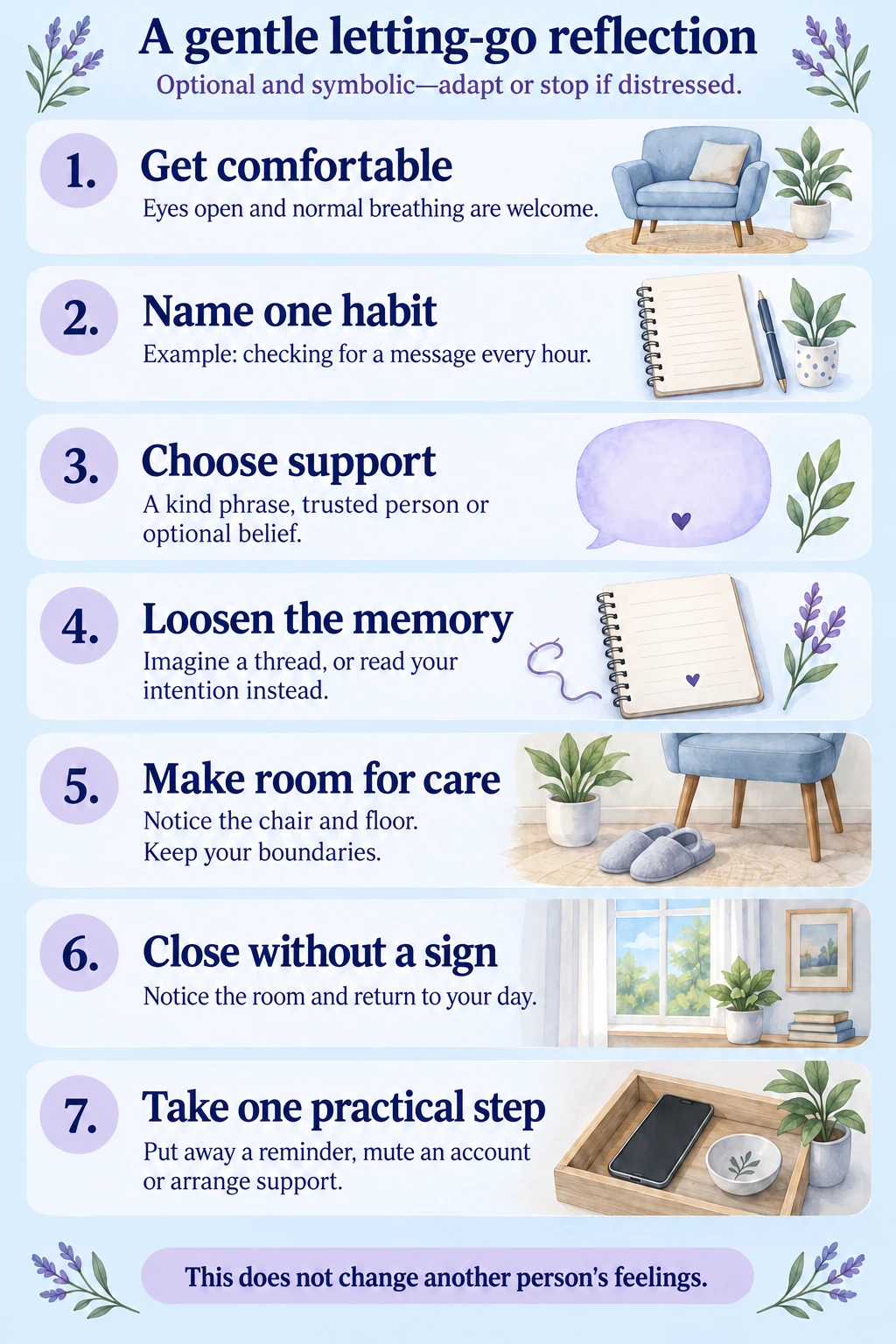
Read the letting-go reflection guide as text
Optional and symbolic—adapt or stop if distressed.
- Get comfortable: Eyes open and normal breathing are welcome.
- Name one habit: Example: checking for a message every hour.
- Choose support: A kind phrase, trusted person or optional belief.
- Loosen the memory: Imagine a thread, or read your intention instead.
- Make room for care: Notice the chair and floor. Keep your boundaries.
- Close without a sign: Notice the room and return to your day.
- Take one practical step: Put away a reminder, mute an account or arrange support.
This does not change another person’s feelings. These are optional reflection actions, not stages of grief or a requirement to forgive or reconnect.
What to do when the longing returns
A memory returning does not mean the ritual failed or that the person is sending energy toward you. Grief can include the loss of a relationship, not only bereavement, as the NHS explains in its guidance on grief and loss. Talking with someone supportive can be part of moving through it.
Instead of repeating the exercise until you feel perfectly clear, ask: “What triggered this, and what do I need now?” A reminder may call for a little space. An unanswered question may belong in a journal rather than another message to your ex. Persistent distress that disrupts sleep or daily life deserves support from a qualified mental-health professional, not only more spiritual work.
You might repeat the reflection occasionally if it feels helpful. If it becomes a compulsory ritual, a source of fear or a way of watching for their return, pause it. You do not need to complete cord work for every important person in your life.
If you want to discuss the connection in a psychic reading
Keep questions focused on your own choices: “What am I finding hard to release?” or “What boundary would support me now?” A reading can offer a spiritual perspective, but it cannot verify another person’s private thoughts, replace their direct communication or guarantee reconciliation.
Be wary of claims that a dangerous cord, curse or destined bond requires an urgent extra payment. You do not need a reader’s permission to end contact or decline further sessions. If abuse or intimidation is involved, seek practical support from the National Domestic Violence Hotline or an appropriate local service; prioritize safety over a ritual.
Frequently asked questions
Can I reset a soulmate cord without cutting off all contact?
Yes, as a personal symbolic practice. If contact is welcome and necessary, focus on realistic boundaries rather than imagining you must erase every feeling. Shared responsibilities may need practical arrangements, not a spiritual explanation.
Will resetting the cord make my soulmate return?
No ritual can guarantee another person’s return or willingness to reconnect. This practice is about your attention and choices, not influencing theirs.
Do I have to forgive someone who hurt me?
No. Forgiveness and reconciliation are separate choices, and neither is required before you set a boundary. Your safety and consent matter regardless of how you interpret the connection.
What if I still love them afterward?
You can still feel affection and choose to move forward. A useful intention is not “I will never think of them again,” but “When I do, I can respond with care for my present life.”
The discussion around the spiritual and emotional ramifications of soulmate connections provides a balanced view. The process for resetting these connections seems to offer a peaceful resolution for those in need.
The article offers a nuanced look at soulmate relationships and the potential need to reset those connections. The proposed techniques for doing so are intriguing and worth trying for those seeking closure.
The idea that soulmates can be a source of both joy and pain is well-articulated. The suggested practices for managing these connections seem considerate and well-thought-out.
It is intriguing how the article addresses the duality of soulmate connections. The concept of cutting or resetting soul cords as a form of healing is a novel idea that warrants further exploration.
The concept of soulmate connections impacting our daily lives is fascinating. The recommended process for resetting these bonds appears to be a practical tool for emotional healing.
The methodology for resetting soulmate connections, including the use of aromatherapy and visualization, is an interesting approach. This might be beneficial for those struggling with lingering emotional ties.
The approach to managing the complexities of soulmate relationships through spiritual practices is a novel idea. This could be quite helpful for individuals looking to move forward from past connections.
The article’s perspective on soulmates as both enriching and potentially challenging is quite insightful. The proposed method for resetting connections appears to be a thoughtful approach for those seeking emotional and spiritual clarity.