

Have you ever thought of someone just before they called, or felt a quiet nudge to pause before saying yes? Moments like these can make you curious about awakening your intuition. For someone who values psychic readings, they may also invite a deeper relationship with inner guidance.
You do not need to declare yourself psychic or turn every feeling into a message. A useful starting point is to notice your impressions, explore what they mean to you and check them against what actually happens. Spiritual curiosity and thoughtful judgment can sit side by side.
What does awakening your intuition mean?
Intuition is often described as a sense or impression that arrives before you can fully explain it. In psychic traditions, people may interpret this as guidance from spirit, an inner knowing or a connection with the universe. Those are spiritual interpretations, not proof that an impression reveals hidden facts or predicts the future.
“Awakening” can simply mean becoming more attentive to your inner life. You might notice your preferences, recognize when you need space or discover which questions keep returning in quiet moments. It does not have to involve dramatic sensations or a special identity, and intuition is not limited to one gender.
Six experiences that can spark intuitive curiosity
Rather than asking only “Was that a sign?”, try asking “What did I notice, what else might explain it, and what can I do with it?”
1. Thinking of someone before they call
A well-timed call can feel like a beautiful connection. Enjoy that meaning if it resonates with you. Familiar routines, frequent contact and coincidence can also play a part. If you keep a journal, include the times you thought of someone and no call arrived—not only the memorable matches.
2. Feeling that someone is not being honest
You may notice a mismatch between words and behavior. Treat that as a reason to ask a question or look for concrete information, not as certainty that someone is lying. “I’m confused because these details seem different” opens a conversation more fairly than “My intuition proves you’re hiding something.”
3. Sensing that someone feels upset
A change in tone or expression may catch your attention. Ask gently: “You seem quieter today. Would you like to talk?” Let the person describe their own feelings. Caring does not require reading a mind, diagnosing a problem or taking responsibility for someone else’s emotional life.
4. Having an impression about a future event
A dream or sudden thought may feel significant. Write down its specific details before the event, then review both matches and misses. Avoid reshaping a vague impression afterward to fit the outcome. A feeling can inspire reflection without becoming a reliable forecast.
5. Feeling uncomfortable around someone
You can decline an invitation, slow down or choose a setting that feels more comfortable without proving a person is “bad.” Consider their actual behavior: do they respect your limits, accept a no and communicate consistently? Personal boundaries are valid; claims about someone’s hidden energy are not necessary.
6. Feeling that something bad might happen
A worried impression is not a prediction. Check for an observable concern and take an ordinary precaution if appropriate. If there is immediate danger, act on the situation and seek help—not on a promise that spiritual guidance will keep you safe. Repeated fearful feelings deserve care, not constant searches for signs.
A simple practice for getting to know your intuition
Choose a small, low-stakes question, such as whether you would enjoy a quiet evening or a social plan. Save major health, financial and legal decisions for relevant information and qualified advice.
- Pause: Give yourself a brief, comfortable moment without trying to force an answer.
- Name the impression: Write “I feel drawn to…” or “I’m hesitant about…” rather than stating it as a fact.
- Separate the layers: Note what you know, what you feel and what you hope or fear.
- Choose a small action: Ask a question, gather information or try something reversible.
- Review kindly: What happened? What was useful? What did you overlook? An inaccurate impression is something to learn from, not evidence that you failed spiritually.
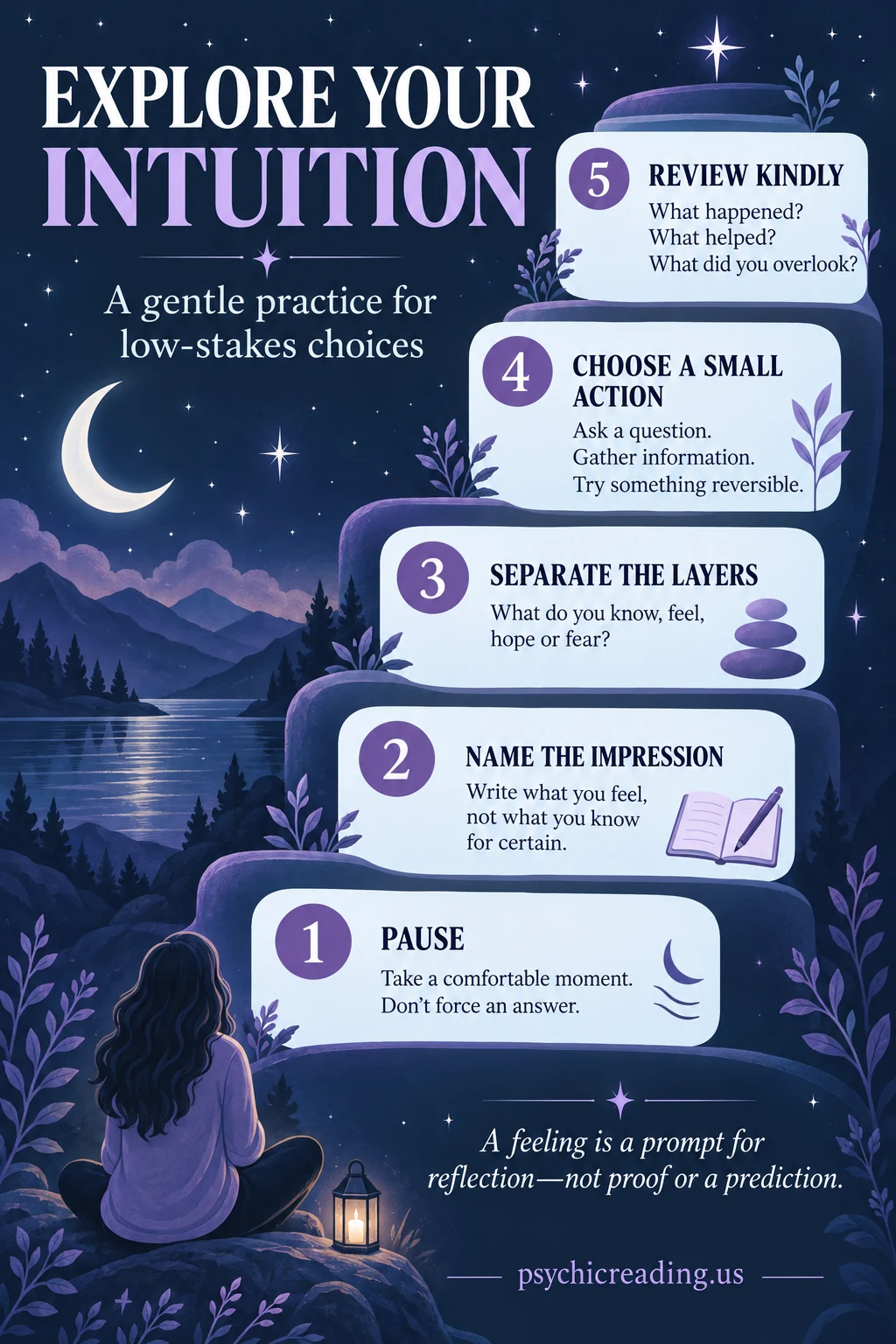
For example, you might feel drawn to a creative class. Check the schedule, cost and accessibility, then try one session if it suits you. You can honor the nudge while making the choice with your eyes open. Our guide to using your intuition explores this balance further.
If you feel blocked—or notice unusual sensations
You do not need a constant stream of impressions to have a meaningful spiritual practice. Tiredness, distraction or wanting an answer urgently can make reflection difficult. Take a break, return to ordinary routines and let “I don’t know yet” be an acceptable answer. You do not have to purchase another reading or a cleansing to become worthy of guidance.
Tingling is not a test of psychic ability. The NHS explains that pins and needles can have physical causes and advises seeing a GP when it is constant or keeps returning. Do not use a spiritual interpretation to dismiss a health concern.
If experiences leave you frightened, disrupt your sleep or make everyday tasks difficult, speak with a qualified health professional. The National Institute of Mental Health offers guidance on caring for your mental health and seeking support. Asking for help is compatible with keeping your spiritual beliefs.
Bringing intuitive curiosity into a psychic reading
A reading can be a space for reflection if that is what you want from it. Try questions that leave room for your judgment:
- “What themes could I reflect on as I learn to trust myself?”
- “How might I explore this feeling without rushing into a decision?”
- “What practical questions could help me understand this situation?”
A reader’s interpretation cannot verify another person’s private thoughts or guarantee your future. You remain free to disagree, stop a session or decline advice. When supporting a friend, ask permission before sharing an impression and let them make their own choices.
Frequently asked questions
Does everyone have psychic abilities?
Some spiritual traditions teach that everyone has intuitive potential. That belief does not establish that everyone has supernatural abilities. You can explore your feelings and inner guidance without needing to prove a psychic gift.
How do I know whether an impression is intuition or fear?
There is no simple feeling test that guarantees the difference. Describe the impression, consider your worries and wishes, check the available facts and give yourself time. Calmness alone does not prove an impression is correct.
Do I need to contact spirit guides?
No. If spirit guides are part of your beliefs, a private prayer or expression of gratitude may feel meaningful. Journaling and quiet reflection are also options. You do not need to force contact or obey a perceived message.
What if my intuition turns out to be wrong?
Revisit the impression honestly and adjust your decision if needed. Being wrong does not mean you are spiritually blocked or that you must spend money to fix yourself. A practice that allows uncertainty is more useful than one that demands certainty.
Make room for meaning, and keep room for choice
Awakening your intuition can be a gentle invitation to listen more closely—not a demand to interpret everything or follow every nudge. Notice what moves you, stay curious about other explanations and choose actions that respect your wellbeing and other people’s boundaries. You can value spiritual guidance while keeping the final decision in your own hands.
I’m curious about the distinction between general intuition and psychic abilities. Are they considered the same, or does one encompass the other?
The idea that intuition can be guided by spirit guides to make better life decisions is an interesting perspective. It adds a spiritual dimension to intuitive experiences.
The concept of intuition and developing psychic abilities seems intriguing. It might be beneficial to explore this further to understand its implications better.
The notion of intuition warning you about future events seems quite abstract. Perhaps a more logical explanation could help in understanding this phenomenon.
Understanding intuition as a gift from the universe is a fascinating approach. It raises questions about how different individuals perceive and harness their intuitive capabilities.
The suggestion that everyone has latent psychic abilities is an appealing thought. It would be interesting to see if there are any structured methods for unlocking these abilities.
The article provides a general overview of intuition and psychic abilities. It might be beneficial to include real-life examples of people who have successfully developed these skills.
The article touches on an interesting topic about intuition and psychic abilities. More scientific evidence and examples could be useful to substantiate these claims.