

A meeting feels meant to happen. An unexpected turn changes your plans. A psychic reading describes a possible future, and you wonder: if this is destiny, what part is mine to choose?
The tension between destiny and free will can be an absorbing spiritual question. You do not have to solve it completely to make a thoughtful decision today. You can find meaning in what happens while recognizing that your choices, other people’s choices and circumstances all matter.
Destiny and free will: two different questions
In everyday spiritual language, destiny often refers to a path or event someone believes is meant to unfold. Free will refers to the possibility of choosing how to act. People use these terms differently, so it helps to ask what you mean before deciding they must conflict.
The Stanford Encyclopedia of Philosophy’s entry on free will describes a continuing debate about control over actions, the ability to do otherwise and responsibility. It includes views that regard freedom as compatible with determinism and views that do not. This article is a spiritual reflection, not a resolution of that philosophical debate.
For practical purposes, a useful question is: “Given what I know and the options available to me, what can I do next?” That question leaves room for belief without assuming that every outcome is either fully controlled or completely inevitable.
Where karma enters the conversation
People may bring karma, reincarnation or soul lessons into their understanding of destiny. Interpretations differ; there is no single account that this article can establish as a universal law.
If karma is part of your beliefs, you might use it to reflect on how you treat others and the patterns you want to change. That is different from claiming you can calculate someone’s spiritual debt or identify a past-life cause for their circumstances. Nor does a metaphor about actions and consequences establish a measurable energy mechanism.
A grounded reflection might be: “When I make a promise, what follows from keeping or breaking it?” That question concerns something you can examine. “This person is suffering because of past-life karma” makes a claim you cannot verify and risks replacing care with blame.
Your circumstances are not a verdict on your worth
Illness, poverty, loss, disability or harm from another person should not be treated as proof of spiritual failure. You do not need to believe you chose suffering before birth in order to find meaning afterward. You may also decide that an experience has no lesson you want to assign to it.
Recognizing limits is important. Resources, health, responsibilities and other people’s decisions can restrict the options available to you. Encouraging agency should not become “You could change everything if you tried harder.” Seeking support, asking for an accommodation or needing time can be part of a thoughtful response.
What can you choose, influence or not control?
Try separating a situation into three parts:
- Your next action: A question you ask, a boundary you state, information you seek or a commitment you make.
- What you may influence: A conversation, a plan or a shared decision where others also have a say.
- What you cannot decide alone: Another person’s feelings, consent, response or an outcome affected by circumstances beyond you.
This is a reflection tool, not a demand to be calm or in control at all times. Sometimes the next action is simply to get help or postpone a decision.
For example, you might feel that a job opening is a sign of destiny. You can prepare an application and ask about the role. You cannot guarantee the employer’s decision. If you are not selected, that does not prove you missed your soul’s purpose or created bad karma.
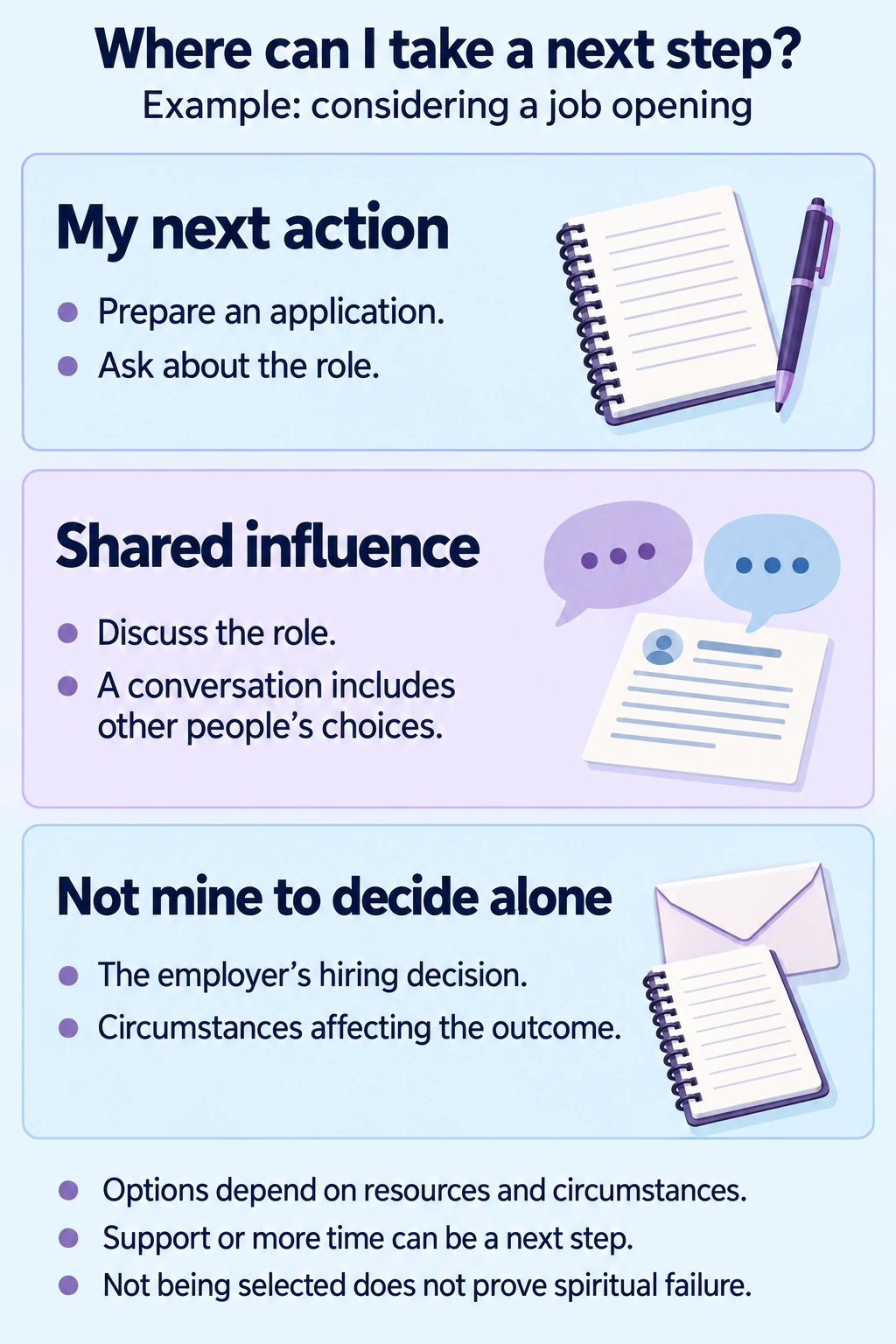
Read the job-opening reflection comparison as text
Where can I take a next step? Example: considering a job opening.
- My next action: Prepare an application. Ask about the role.
- Shared influence: Discuss the role. A conversation includes other people’s choices.
- Not mine to decide alone: The employer’s hiring decision. Circumstances affecting the outcome.
Options depend on resources and circumstances. Support or more time can be a next step. Not being selected does not prove spiritual failure.
Does a psychic prediction make the future fixed?
A reader may describe possibilities, timing or spiritual themes. Their interpretation does not establish a fixed future, and you are not obligated to arrange your life around it.
If a prediction does not happen, free will should not become an automatic explanation that makes the prediction impossible to question. It may simply have been inaccurate. You do not need to blame your thoughts, openness or choices for that result. Our article on why psychic predictions do not come true explores reviewing an interpretation without blame.
A useful reading question might be “What priorities could I reflect on as I consider this path?” rather than “Tell me the only future I am allowed to choose.” Keep medical, legal and financial decisions grounded in relevant information and qualified advice.
Meaning does not create an obligation to stay
A relationship may feel karmic or destined without requiring permanent commitment. You do not owe someone access to your body, time, money or private life because of a spiritual label. Their consent and choices matter too.
If a situation involves threats, control or harm, do not interpret the urge to leave or seek help as a failure to finish a soul lesson. The National Domestic Violence Hotline’s relationship guide distinguishes healthy respect and boundaries from controlling and abusive behavior. Seek appropriate support for safety concerns; contact emergency services if there is immediate danger.
Our guide to karmic connections and soul contracts offers reflection without treating spiritual meaning as an obligation.
Five questions for a crossroads
- What is happening? Describe the facts separately from a prediction, sign or interpretation.
- What matters to me? Name values such as care, honesty, stability or independence.
- What options are actually available? Include support, a smaller step and more time where possible.
- What can I check before acting? Look for practical information and the consent of anyone involved.
- When will I review the choice? Allow yourself to adjust when circumstances or information change.
You could use these questions in a journal, during a quiet prayer or before a reading. They do not need to reveal one cosmic answer to be useful. A reversible step can help you learn more without declaring the rest of your life decided.
Changing a pattern without rewriting your whole past
If you notice a habit you want to change, start with a specific action. You might clarify an expectation instead of assuming it is understood, apologize for a mistake or ask for support before you become overwhelmed.
Repair does not guarantee forgiveness, and a good decision does not guarantee an easy outcome. It can still be worth making. You can take responsibility for your own behavior without assuming responsibility for everything that happens to you.
Frequently asked questions
Can I believe in destiny and still make choices?
Yes. Many people hold spiritual beliefs while taking everyday decisions seriously. You can reflect on meaning without treating a belief as proof of a fixed outcome.
Does karma explain why something bad happened to me?
A spiritual interpretation cannot verify that cause. You do not need to accept blame or a past-life explanation to deserve care and support.
Should I follow a reading even if it conflicts with my judgment?
No. You may disagree, seek information and choose differently. A reading does not remove your boundaries or obligations to consider other people’s consent.
Does changing my mind mean I failed my destiny?
No interpretation can establish that verdict. New information may justify a new choice. You can revisit a decision without treating uncertainty as spiritual failure.
Make room for mystery—and your next step
You can remain curious about destiny, karma and the larger meaning of your life without assigning a supernatural cause to every event. Honor what you believe, be honest about what you do not know and consider the choices within reach. Meaning and agency need not compete for a place in your story.
The idea that old behavior patterns can be broken through conscious decision-making is empowering. It supports the belief that we can change our destinies.
This article provides a clear distinction between destiny and free will. Understanding how they interact can help us better navigate our lives.
The interplay of free will and destiny suggests that while we may not have total control, our actions still hold significant weight in shaping our lives.
The relationship between karma and destiny is indeed a profound one. The notion that our actions can influence our future aligns with many philosophical and spiritual teachings.
This perspective on free will versus predestination is well-balanced. It acknowledges the complexity of life while offering a hopeful outlook on personal agency.
The concept of karma shaping our destiny is intriguing. It emphasizes personal responsibility and the potential for growth and change.
The explanation of karma as a spiritual law that involves energy and actions is quite enlightening. It sheds light on how our choices influence our future.
The article’s view that destiny is not set in stone and can be influenced by our actions is a refreshing take. It underscores the importance of making thoughtful choices.