

A fresh start can feel exciting and unsettling at the same time. After a breakup, a job change or a difficult year, you may know that something needs to change without knowing where to begin. You do not need a perfect plan—or a permanently positive mood—to take one useful step.

If spiritual reflection matters to you, journaling, prayer or a psychic reading may offer a way to explore what this new chapter means. Treat any reading as an interpretation to consider, not a guaranteed forecast or an instruction you must follow. Your choices, circumstances and support still matter.
These five barriers are starting points for reflection, not a diagnosis or a reason to blame yourself. Some call for a smaller plan; others call for help, resources or time.
1. Accountability that feels like pressure instead of support
“Change my whole life” is a difficult goal to check. “Spend fifteen minutes listing the roles I want to explore” gives you something specific to try. Accountability works best here as a way to notice what happened, not as a test of your worth.
Choose one action within your control and a realistic time to review it. If you want company, ask a trusted person for a simple check-in: “Can I tell you on Friday what I tried?” They do not need to monitor you or decide whether your progress is good enough.
Try this: Write three lines: what I will try, when I will try it, and what support I need. Include rest or a revised deadline if your week requires it.
Reflection prompt: What would supportive accountability look like, without shame or comparison?
2. Self-doubt that turns uncertainty into a verdict
“What if this does not work?” is a reasonable question. “It will never work because I am incapable” is a much broader conclusion. You do not have to silence every worry. Separate a practical concern from a harsh judgment, then ask whether there is a low-risk way to learn more.
For example, someone considering a career change might worry about training costs. That concern deserves information and a budget—not an affirmation that money will somehow appear. Reading a course outline or asking about requirements can be a first step without committing to enrollment.
Try this: Put your worry beside one thing you can check. Leave unanswered questions marked as unknown rather than treating hope or fear as evidence.
Reflection prompt: What can I explore before making a larger commitment?
3. Physical reminders and real-life obstacles
A photograph, an old message or a familiar room may bring up feelings after loss. That does not mean you must throw everything away to move forward. You can keep meaningful reminders, put something out of sight temporarily, or wait before deciding. A new chapter does not require erasing the previous one.
Grief can follow bereavement, the end of a relationship or losing a job. The NHS guidance on grief and loss emphasizes that people respond differently and suggests small targets and support. If coping feels difficult, consider talking with a healthcare professional or counselor; spiritual support does not replace that care.
Other obstacles are practical: limited money, housing, health needs, accessibility or caregiving responsibilities. These are not failures of mindset. You may need assistance, an adapted plan or a longer timeline.
Try this: Divide your list into “I can change this,” “I need help with this” and “This needs time.” Pick one manageable item, not the entire list.
Reflection prompt: What can I carry forward with care, and what support would make the next step possible?
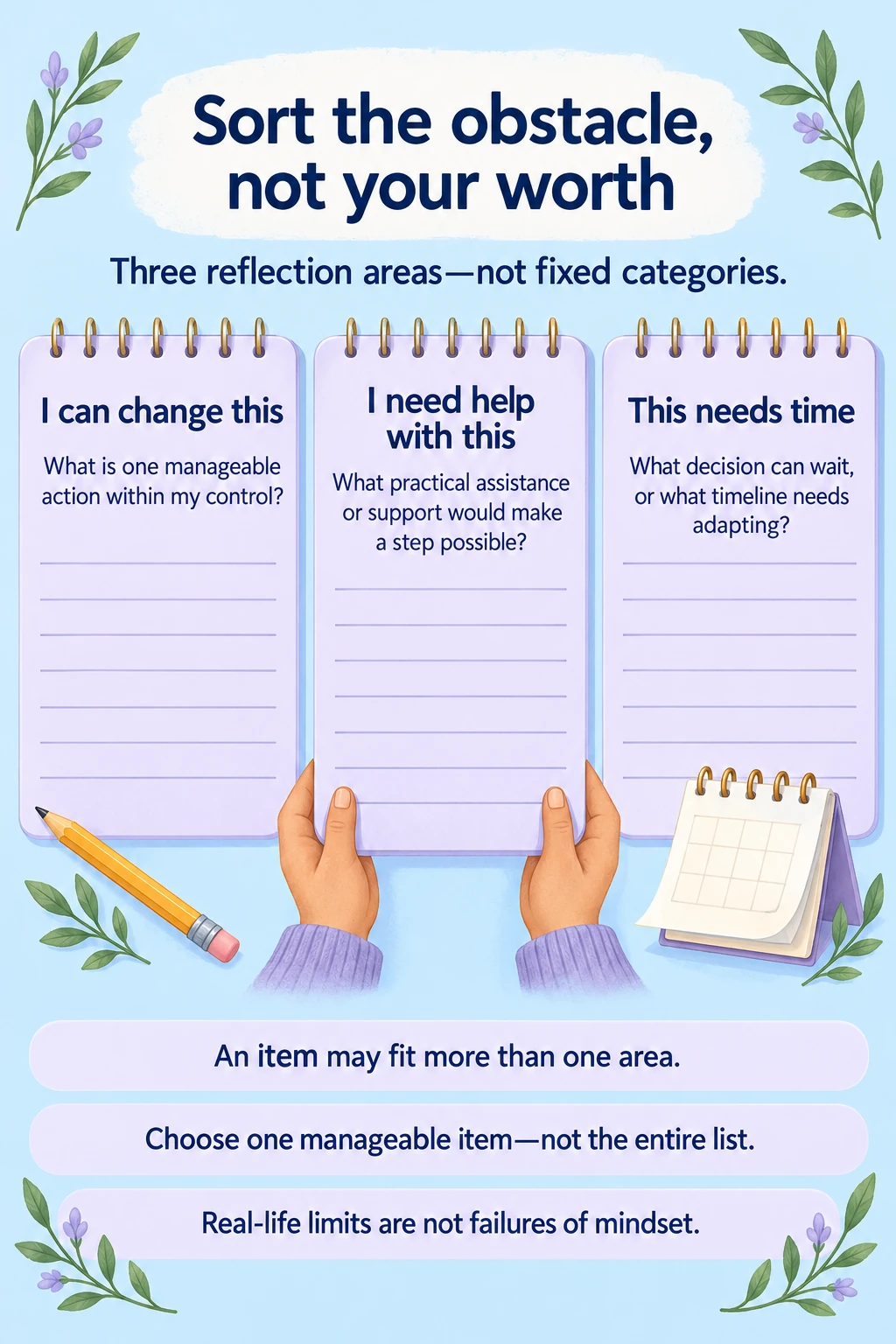
Read the obstacle reflection areas as text
Sort the obstacle, not your worth. Three reflection areas—not fixed categories.
- I can change this: What is one manageable action within my control?
- I need help with this: What practical assistance or support would make a step possible?
- This needs time: What decision can wait, or what timeline needs adapting?
An item may fit more than one area. Choose one manageable item—not the entire list. Real-life limits are not failures of mindset.
4. A plan too large to turn into action
Sometimes the gap between intention and action is the size of the task. “Build a new social life” can feel enormous. Sending one message to a friend, looking up one local activity or making space for a quiet evening is more concrete.
A first step should fit your actual energy and resources. It can be gathering information, asking for help or deciding what you are not ready to do. You do not need to make an irreversible decision to prove that you are serious.
Try this: Choose an action that takes about ten minutes, or a shorter version if needed. Decide what “done” means before starting. Stop there if that is enough for today.
Reflection prompt: What is the smallest useful version of this change?
5. Patterns you call “self-sabotage” without understanding them
Repeatedly avoiding a task can be frustrating, but labeling yourself lazy rarely explains what is happening. The task may be unclear, the goal may no longer fit, you may fear disappointment, or you may simply be exhausted. Rather than assuming a hidden motive, look at a specific occasion.
Suppose you keep postponing a difficult conversation. What happens just before you avoid it? Could you prepare two sentences, choose a safer setting, or seek support first? If the situation involves threats or control, prioritize safety and appropriate help instead of pressuring yourself to confront someone.
Try this: Describe the pattern neutrally: “I postponed this three times.” Then identify one change to the task, timing or support. A setback is information, not proof that you cannot change.
Reflection prompt: What makes this step difficult, and what adjustment would respect my needs?
A simple fresh-start check-in
- Name the change: What would you like more or less of in daily life?
- Name the limit: What time, money, health or relationship constraint needs consideration?
- Choose one step: Make it specific, modest and within your control.
- Arrange support: Ask for practical assistance or a kind check-in if useful.
- Review without judgment: What did you learn, and what needs adjusting?
If you choose a psychic reading, an open question such as “What possibilities could I reflect on during this transition?” leaves room for your judgment. Avoid treating a prediction as a deadline, proof of another person’s intentions or a reason to spend beyond your budget. You can reflect without booking a reading at all.
Questions about starting over
Do I need to feel confident before I begin?
No. You can feel uncertain and still try a small, reversible step. Confidence is not a requirement, and taking action does not guarantee a particular outcome.
Does a fresh start mean letting go of every reminder?
No. Keep what is meaningful or useful. You can change how you relate to an object or memory without discarding it, and you can delay decisions while grieving.
Can a psychic tell me exactly when my new life will begin?
A reader may offer a spiritual interpretation, but a timing prediction is not a verified schedule. Make practical decisions using information, your circumstances and appropriate advice.
What if my first plan does not work?
Review what was difficult: the goal, the task size, the timing or the available support. Adjusting a plan, resting or choosing a different direction can be reasonable. Starting over is not a promise that every obstacle will disappear.
You do not have to reinvent yourself overnight. A fresh start can be one honest decision, one request for help or one small change that makes tomorrow feel more workable.
While the advice is sound, some strategies for maintaining long-term motivation would have been a valuable addition.
The discussion on self-doubt is insightful. It’s a common issue that many struggle with when contemplating a fresh start.
The section on self-sabotage is particularly striking. It’s important to recognize when we are our own worst enemies.
I appreciate the emphasis on accountability and taking action. These points are often overlooked but are crucial for achieving any new goal.
The idea of letting go of physical obstacles is akin to many philosophical teachings about detachment and moving forward.
I find the overall structure of the article beneficial. Breaking down barriers into categories makes it easier to address them individually.
The notion of rewarding oneself to maintain accountability is an interesting method. It seems practical and achievable.
The article provides a clear and systematic approach to overcoming common barriers when starting over. It’s a concise guide that could be useful for many.