

“What am I meant to do with my life?” can sound like a question about destiny. Often, it also contains more everyday questions: What matters to me now? Where do I want to give my time? Which part of my life needs more room?
If you value psychic readings, a conversation about life purpose may offer a spiritual perspective on those questions. It cannot verify a fixed mission, guarantee a career outcome or identify the people you must keep in your life. You can welcome reflection while keeping the decisions yours.
Purpose does not have to be one extraordinary calling. It may show up in work, relationships, creativity, learning, community or the care you offer. What feels meaningful can change as your circumstances and priorities change.
What a life-purpose reading can—and cannot—offer
A reader may use cards, intuitive impressions or spiritual imagery to discuss themes such as expression, service or change. Treat those themes as invitations to think, not instructions you must obey. “You seem drawn to teaching” can become a question about your interests; it is not proof that you should resign and become a teacher.
You also do not need a reading to earn permission to explore a new direction. A thoughtful conversation with a friend, mentor or career adviser may be useful alongside private reflection. If you choose a psychic session, decide what you want to discuss and what you are comfortable spending before it begins.
Career: Separate the calling from the decision
A career question may have a spiritual side: you want work that feels aligned with your values. It also has practical parts: skills, opportunities, income, location and working conditions. A reading cannot objectively see where your career is headed or determine whether an employer is right for you.
Start with what you can describe. Are you bored by the tasks, frustrated by a specific arrangement or interested in a different field? Those are different problems and may need different next steps. A new role within the same field might suit you better than a complete career change.
For factual exploration, the U.S. Bureau of Labor Statistics’ Occupational Outlook Handbook offers occupation profiles and information such as education, pay and outlook. Use relevant information alongside conversations with people who understand the work; broad occupation data is not a promise about an individual vacancy.
Question for reflection: “Which parts of my work feel meaningful, and which parts am I ready to investigate changing?”
Small next step: Compare two possible roles, identify a skill you would need or ask someone about their typical working day. Check practical options before making a major commitment.
Jobs and careers: A paycheck is not a failure
A job can be one role you hold, while a career describes a longer work path. Neither has to carry your entire sense of purpose. Work that pays the bills may support a meaningful life even when the tasks themselves are not your passion.
There is no need to shame yourself for needing stability. You may be caring for someone, managing a health condition, rebuilding finances or simply choosing a reliable arrangement. A reader should not turn those circumstances into evidence that you are spiritually blocked.
If a workplace is difficult, name the actual concern rather than relying on a label such as “toxic energy.” Is there a workload problem, unclear expectations or harmful treatment? Seek appropriate practical support for the issue. A psychic interpretation does not establish what happened or replace qualified employment advice where needed.
Question for reflection: “What does this job make possible, and what would make it more workable while I consider my options?”
Small next step: Update a résumé, clarify a responsibility or identify a realistic transition plan. You do not have to quit to demonstrate trust in the universe.
Your life path: Look beyond one defining role
You may have been taught to introduce yourself through a job title or achievement. Try making a wider map: relationships, creativity, learning, spiritual practice, community and ordinary care. Which areas are receiving attention? Which do you miss?
A life-path reading may help you consider a theme in that map, but no reader can ensure you are exactly where you “need” to be. Other people may offer perspectives without owning your direction. You can also disagree with an interpretation that does not fit your experience.
Purpose may be less about finding a hidden answer than choosing how you want to participate in life. You might value bringing people together, making useful things or supporting someone through a difficult season. These are possible meanings, not assignments you must fulfill.
Question for reflection: “What would I still care about if nobody praised me for it?”
Small next step: Give one neglected value a modest place in your week, without turning it into another demand to perform.
Pursuing passions: Make room without pretending time is unlimited
A passion does not need to become a business or a career. Gardening, music, study, writing or a spiritual interest can matter because you enjoy it. You are allowed to explore something without proving that it belongs to your destiny.
Time and energy vary. A long commute, caregiving, disability, illness or financial pressure can leave little spare capacity. Do not assume that everyone has plenty of hours waiting to be used, or take needed rest away to satisfy a reading’s advice.
Look for a version that fits your actual life. Reading a few pages may be more realistic than enrolling in an intensive course. Borrowing equipment may make more sense than an expensive purchase. Some seasons call for keeping an interest gently alive rather than expanding it.
Question for reflection: “What do I enjoy when it is not measured by productivity?”
Small next step: Choose one low-pressure opportunity and decide in advance how much time, money and effort you can give it.
The people around you: Use behavior, not predictions
Relationships can contribute to meaning, and support need not come from only one person. Notice where you can speak honestly, have boundaries and receive care. A difficult interaction does not automatically mean someone is wrong for your life path.
A reader cannot verify another person’s motives or decide who must stay or go. Instead of asking, “Is this person blocking my purpose?” consider, “What happens between us, what do I need, and is a conversation safe and useful?”
Responsibility for mistreatment belongs to the person doing it. It is not proof that you created the problem or failed to follow your intuition. If you are worried about controlling or harmful behavior, our guide to relationship concerns and safety distinguishes ordinary differences from situations needing support.
Question for reflection: “Which relationships allow both people to have needs and choices?”
Small next step: Ask for a specific kind of support, reconnect with a trusted friend or reconsider an arrangement that repeatedly ignores your boundaries.
Setting goals: Turn inspiration into an experiment
Not every interest needs to become a lifelong plan. Trying something and deciding it is not for you can provide useful information. A psychic cannot determine that a dream is “not yours to pursue,” and you do not need certainty about success to explore responsibly.
Define a goal you can act on. “Find my calling” is broad; “learn what this course involves and try an introductory session” gives you something concrete to review. Consider obstacles and support as well as enthusiasm.
Question for reflection: “What would I like to learn from trying this, even if I do not continue?”
Small next step: Choose a manageable test, a spending limit if needed and a date to reflect on the experience. Make adjustments based on what happens, not only on whether the idea still feels exciting.
Five questions to bring to a life-purpose reading
- What area of my life would be useful to reflect on more closely?
- What am I hoping a change will give me?
- Which value do I want to express more clearly?
- What assumption could I question without rushing a decision?
- How might I translate this interpretation into a small, practical step?
You can tell the reader you do not want fixed predictions or decisions made for you. If a message feels meaningful, write down what it brings up; if it does not fit, you can leave it. Agreement is not a test of your openness or spiritual worth.
After the reading: A simple meaning-to-action worksheet
- Record the theme. What idea stayed with you?
- Separate interpretation from fact. What was suggested, and what do you actually know?
- Name your value. Why does this possibility matter to you?
- Check the practical details. What information, resources or qualified advice do you need?
- Choose one modest step. What can you try without making an unnecessarily costly or irreversible commitment?
- Review your experience. What did the step teach you, and what would you change?
For example, a reading about “creative expression” might prompt you to join a beginner writing group. You can investigate the cost and schedule, try it and decide whether it suits you. The reading can be a starting point for curiosity without becoming proof that you must publish a book.
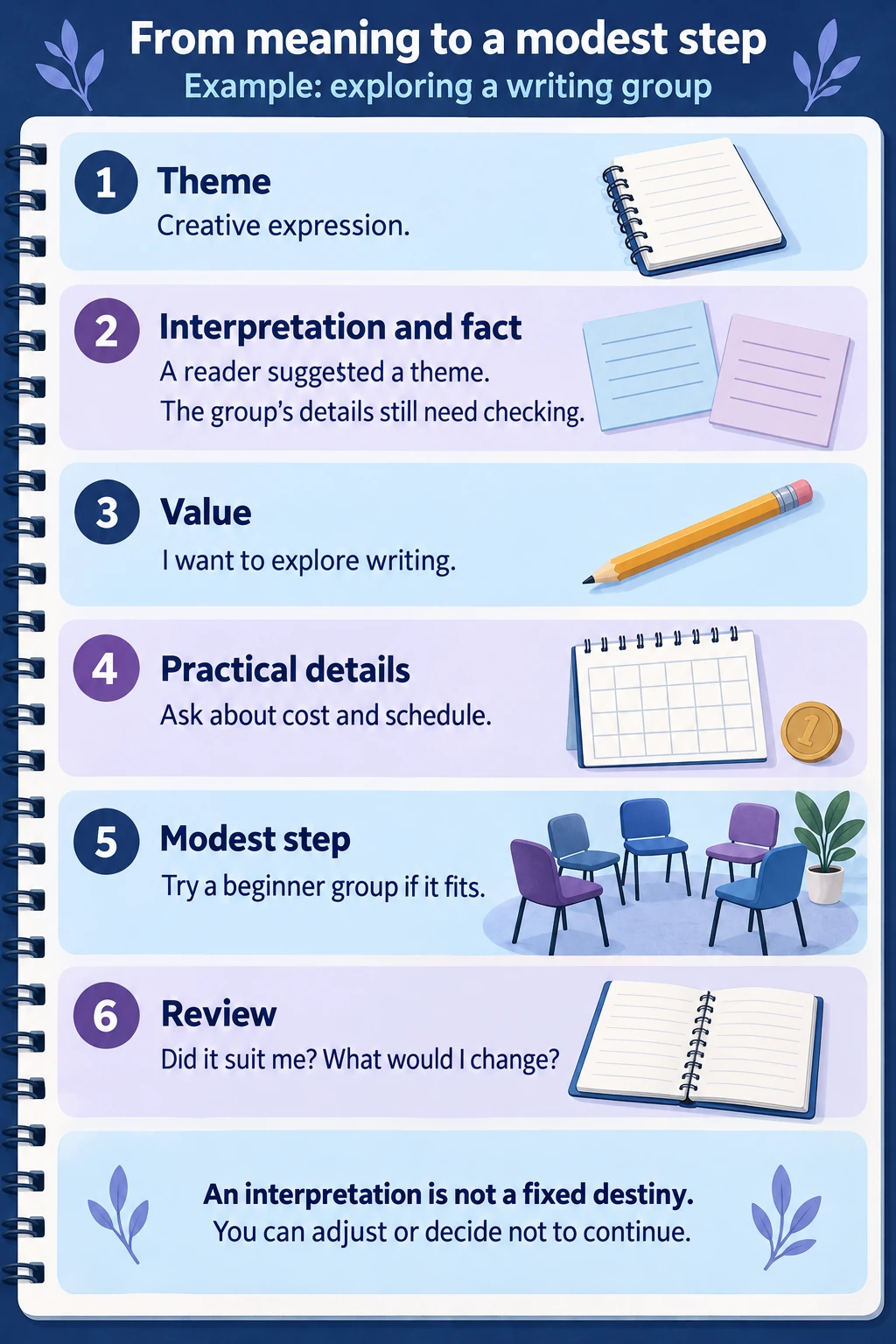
Read the writing-group worksheet example as text
From meaning to a modest step. Example: exploring a writing group.
- Theme: Creative expression.
- Interpretation and fact: A reader suggested a theme. The group’s details still need checking.
- Value: I want to explore writing.
- Practical details: Ask about cost and schedule.
- Modest step: Try a beginner group if it fits.
- Review: Did it suit me? What would I change?
An interpretation is not a fixed destiny. You can adjust or decide not to continue.
Keep room for uncertainty and your own judgment
Be cautious if someone says you will waste your life unless you follow their instructions, need repeated paid sessions to discover your mission or must leave a relationship or job immediately. You can decline, pause and seek another perspective.
For medical, mental-health, legal or financial concerns, use appropriate qualified support. Spiritual guidance can sit alongside that care, but it should not replace it. Not knowing your next direction does not make you a failed person.
Frequently asked questions
Can a psychic tell me my exact life purpose?
A reading may offer spiritual themes, but it cannot verify one fixed purpose as a fact. You decide what feels meaningful and examine how an idea fits your circumstances.
Does my job have to be my calling?
No. Work can provide stability while purpose comes from relationships, creativity, community or other parts of life. You do not have to turn every meaningful interest into paid work.
What if the reading tells me to make a major change?
Do not treat it as an instruction. Check the facts, costs, responsibilities and consequences, and seek relevant advice. You can explore a possibility gradually or decide not to follow it.
Can my sense of purpose change?
Yes. You can revisit priorities as your life changes. A new direction does not mean earlier choices were wasted, and you do not need to settle every question before taking a useful small step.
Your life does not have to look extraordinary to carry meaning. Begin with something you genuinely value, give it attention you can afford and let experience help shape what comes next.
I appreciate the holistic approach suggested here, integrating career, relationships, and passions. Whether one believes in psychics or not, it’s crucial to consider all these aspects for a fulfilling life.
The idea of consulting a psychic for career advice is novel, but I wonder if traditional career counseling could offer similar insights without the metaphysical aspect.
I’m not entirely convinced that psychics can offer the unique insights claimed here. Relying on evidence-based methods for personal development seems more reliable.
It’s interesting to see how psychics are being touted as career and life coaches here. I’m curious about the empirical evidence supporting their effectiveness.
The notion that a psychic can help identify toxic relationships is intriguing. It’s generally good to seek multiple opinions when it comes to personal matters.
Agree. It might also be beneficial to consult psychological experts or trusted friends for a more balanced perspective.
This article suggests that psychics can provide clarity and direction, but I’d like to know how they compare to other self-discovery tools like personality tests or therapy.
While the article makes some good points about finding purpose, I’m skeptical about relying on a psychic for such significant life decisions. More tangible methods might be more effective.
The emphasis on setting goals and pursuing passions is strong advice. However, attributing that guidance solely to a psychic seems limiting. Self-reflection and practical planning can also be very effective.