
An email goes unanswered, a journey needs rearranging and an old relationship comes back to mind. If you follow astrology, you may wonder whether a retrograde is part of the story. That question can be a useful invitation to pause—as long as it does not turn an ordinary setback into a prediction of disaster.
Planetary retrograde has two different meanings in this conversation: an observable pattern of apparent motion in the sky and the symbolic interpretations astrologers give it. Understanding the distinction lets you enjoy the reflection without assuming a planet caused a broken device, argument or breakup.
What retrograde actually means in astronomy
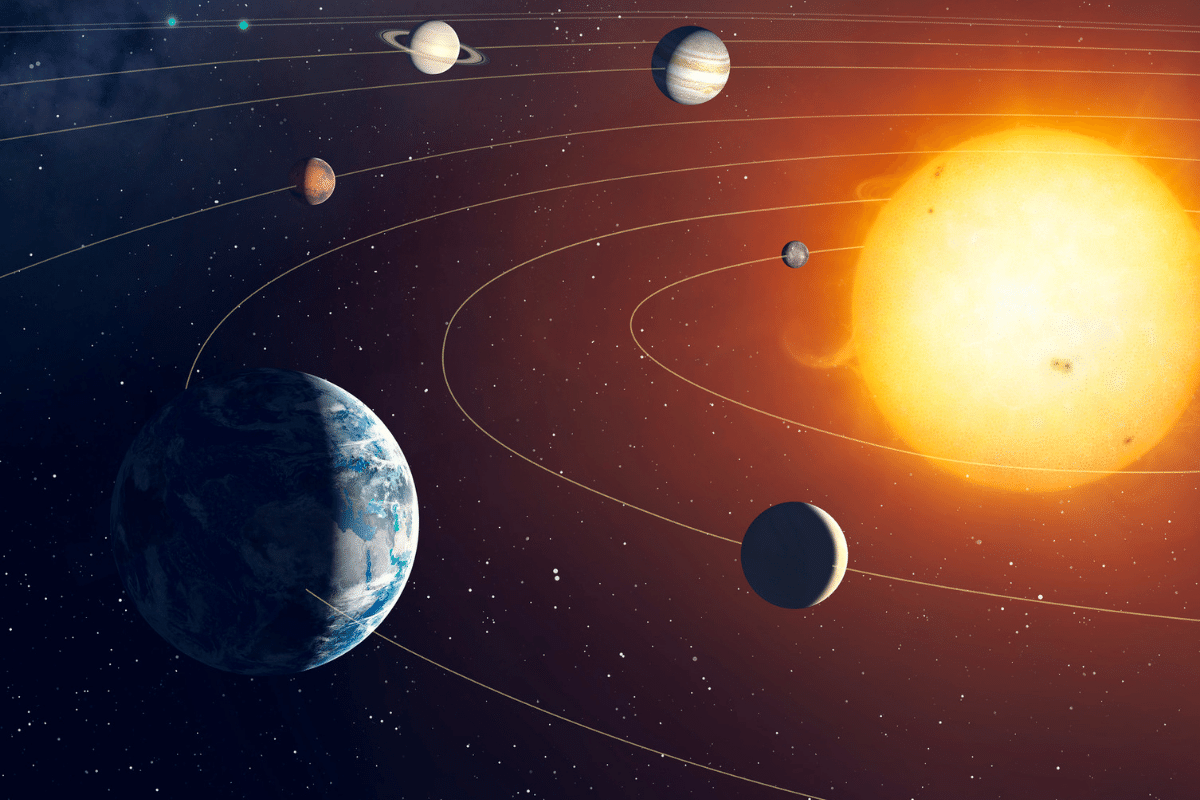
In apparent retrograde motion, a planet seems to reverse its usual direction against the background stars when observed from Earth. It does not suddenly reverse its orbit or start spinning backward. The changing view comes from the relative positions and motion of Earth and the other planet, as NASA’s explanation of retrograde motion describes.
For an outer planet such as Mars, Earth overtaking it in orbit helps explain the apparent reversal. Mercury and Venus orbit closer to the Sun than Earth, so “Earth passes every slower planet” is not an explanation that fits all cases. The common principle is our changing viewpoint as the bodies orbit the Sun.
When the apparent movement resumes its usual direction, astrologers call the planet direct. Apparent motion across the sky is distinct from a body’s physical rotation or orbital direction; the word “retrograde” can be used in those other astronomical contexts too.
What astrologers mean by a retrograde period
Astrologers often use retrograde symbolism to explore review, repetition and inward attention. They may connect those themes with the meanings assigned to a particular planet. These are interpretive beliefs, not an established explanation for events in your life.
For example, Astrology.com’s Mercury retrograde guide associates Mercury with communication and describes a cycle of reconsideration. That is an example of astrological interpretation, not evidence that the planet disrupts technology or makes a contract unsafe.
You may also encounter the term “shadow period” for time surrounding a retrograde, especially Mercury’s. Astrologers use it to extend their discussion of a cycle beyond its start and end. It does not establish an extra period of danger or an invisible force affecting you.
Retrogrades differ in frequency and duration by celestial body. If you want dates for a particular cycle, check a dated ephemeris or calendar and its time zone rather than treating a general guide as a current schedule. This article is a meaning-and-reflection guide, not a live retrograde calendar.
Eight retrograde themes you can use for reflection
The prompts below adapt familiar astrological themes into everyday questions. They are optional; you can use them at any time, whether or not the relevant body is currently retrograde. They do not predict what will happen.
Mercury: Communication, information and unfinished details
Instead of expecting misunderstandings, ask where clearer communication would help. Is an instruction ambiguous? Have you checked the date on a booking? Is there an unfinished draft you want to revisit?
Reflection: “What am I assuming another person understands?”
Practical step: Confirm an important detail in plain language. Maintain sensible backups and check travel arrangements as ordinary habits, not only during retrograde. If a device fails, investigate the actual fault rather than using astrology as the diagnosis.
Venus: Relationships, values and what you enjoy
Venus symbolism can invite reflection on affection, preferences and reciprocity. An old partner coming to mind does not mean they will return or that you should contact them. Consider what you value now rather than what a reunion would seem to prove.
Reflection: “Where do my choices reflect my values, and where am I accepting something that does not fit?”
Practical step: Discuss a relationship expectation if it is safe and welcome, or review a purchase against your budget. There is no need to postpone a wedding or proposal solely because of a retrograde label. Consent, readiness and practical circumstances matter more.
Mars: Action, frustration and the pace you set
Mars themes can provide a language for exploring effort and conflict. They do not mean that fighting is inevitable or that hurtful behavior is caused by a planet.
Reflection: “Am I acting toward something important, or reacting because I feel rushed?”
Practical step: Break a task into a manageable next step. In a disagreement, pause when possible and return to a specific issue. Patience does not require accepting intimidation or giving up a boundary.
Jupiter: Learning, possibility and realistic growth
Use Jupiter as a symbol for examining what you hope to expand: knowledge, experience or an idea you once set aside. Enthusiasm can be valuable without making every opportunity a wise commitment.
Reflection: “Which possibility still interests me after I consider the time, cost and work?”
Practical step: Research a course or revisit a project plan. Check resources and responsibilities before committing. A retrograde is not a financial risk assessment or a reason to restart a business that no longer makes sense.
Saturn: Structure, responsibilities and boundaries
Saturn’s reflective theme can be the scaffolding of everyday life: what supports you, what is overdue and what needs a more realistic limit. This need not be framed around a father figure or a duty to resolve family pain.
Reflection: “Which responsibility is mine, and which have I taken on without agreement?”
Practical step: Review a deadline, routine or commitment. Make a plan that allows for rest as well as effort. Self-discipline is not a reason to ignore your needs.
Uranus: Change, independence and useful experimentation
Uranus symbolism can invite questions about habits and change. You do not have to reject everyone who disagrees with you or make a dramatic break to feel independent.
Reflection: “What change am I seeking, and what problem would it actually solve?”
Practical step: Try a small, reversible experiment. Learn about an issue that interests you, or test a different routine before making a major decision. Curiosity can be more useful than rebellion for its own sake.
Neptune: Imagination, inspiration and clarity
Neptune themes may appeal when you want to return to music, art or spiritual reflection. Keep imagination and factual claims distinct: a meaningful image is not proof of another person’s intentions or a medical explanation.
Reflection: “What inspires me, and what information am I missing?”
Practical step: Revisit a creative project or make time for a gentle practice you enjoy. Name specific draining interactions rather than labeling people “energy vampires.” If you need healthcare, seek it rather than treating retrograde as a healing prescription.
Pluto: Patterns, letting go and making room
Pluto is included in many astrological systems even though astronomy classifies it as a dwarf planet; NASA’s solar-system overview distinguishes the eight planets from dwarf planets. Its reflective use here concerns what you want to examine or change.
Reflection: “Which recurring pattern can I approach with honesty rather than shame?”
Practical step: Clear one manageable space, reconsider a habit or seek appropriate support for a difficult issue. You do not need to force buried memories, undertake hypnotherapy or explore traumatic experiences because of an astrological cycle.
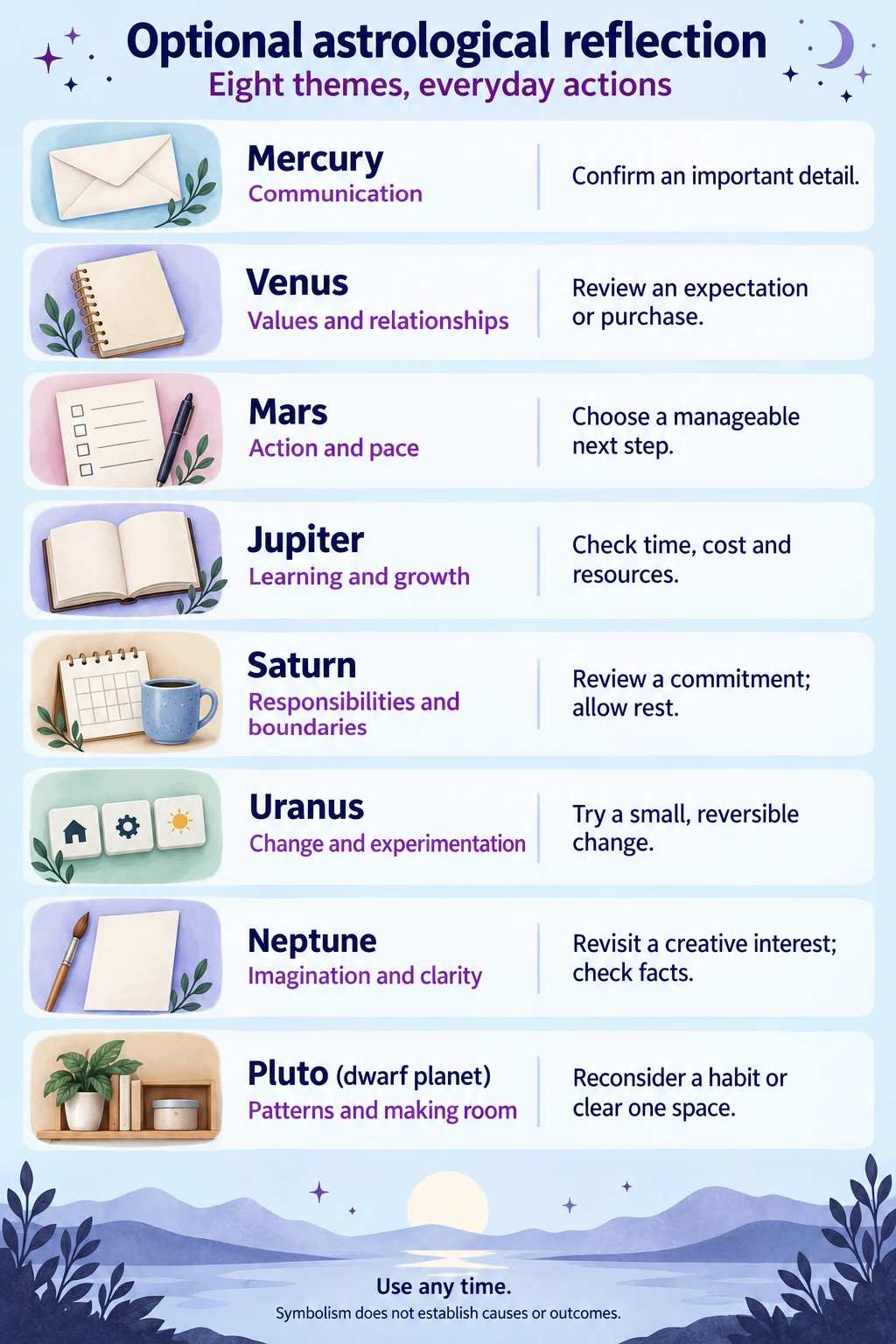
Read the eight reflection themes as text
Optional astrological reflection: Eight themes, everyday actions.
- Mercury — Communication: Confirm an important detail.
- Venus — Values and relationships: Review an expectation or purchase.
- Mars — Action and pace: Choose a manageable next step.
- Jupiter — Learning and growth: Check time, cost and resources.
- Saturn — Responsibilities and boundaries: Review a commitment; allow rest.
- Uranus — Change and experimentation: Try a small, reversible change.
- Neptune — Imagination and clarity: Revisit a creative interest; check facts.
- Pluto (dwarf planet) — Patterns and making room: Reconsider a habit or clear one space.
Use any time. Symbolism does not establish causes or outcomes.
A simple review-and-revise practice
Choose one theme that feels relevant. Then keep the reflection connected to an actual situation:
- Name it: What happened, without a planetary explanation?
- Reflect: What feeling, value or concern does it bring up?
- Check: What facts, direct questions or professional advice would help?
- Revise: What small, realistic change can you make?
- Review: Did the action help, and what still needs attention?
Suppose a meeting was missed. You might use Mercury symbolism as a reminder to review communication, then discover the invitations used different time zones. Confirming the time solves a real problem. You do not have to establish a cosmic cause to make that adjustment worthwhile.
Likewise, a Venus-themed reflection might reveal that you miss companionship rather than a particular ex. Your next step could be spending time with friends instead of contacting someone who has asked for space.
What not to put on hold because of retrograde
Do not postpone urgent care, safety measures or essential responsibilities while waiting for a planet to go direct. For major legal, financial or medical decisions, use relevant facts and qualified advice. Astrology cannot determine whether a treatment, contract or investment is safe.
Nor does retrograde excuse another person’s behavior. You do not owe reconciliation to a former partner or peace with every man or woman in your life. Any contact should respect consent and your boundaries. If relationship patterns concern you, explore our guide to relationship concerns, practical boundaries and safety.
If you discuss retrograde in a reading
Ask for a perspective you can reflect on: “What could I review in this area of life?” is different from “What disaster will this planet cause?” You can listen without surrendering your judgment or treating an interpretation as certainty.
Be cautious if a reader claims a retrograde guarantees loss, requires an urgent paid remedy or prevents you from making your own choices. You can decline additional services. A useful spiritual conversation should leave room for questions and real-world context.
Frequently asked questions
Do planets really move backward during retrograde?
Not in the sense described by an astrological retrograde cycle. Their apparent motion against the background stars reverses from our Earth-based viewpoint; they do not suddenly reverse their orbits or spin.
Does Mercury retrograde cause technology problems?
Communication and technology are astrological associations, not an established diagnosis for a failure. Check the device, service or instructions and use ordinary troubleshooting.
Should I avoid important decisions during retrograde?
Do not use the calendar label as your only reason to delay. Consider your readiness, available information, deadlines and relevant professional advice. Urgent needs should not wait for an astrological cycle.
Can retrograde be a positive reflection tool?
Yes, if the symbolism helps you pause and review without creating fear or replacing practical judgment. Reconnecting with an interest, revising a plan or clarifying a conversation can be useful at any time.
Retrograde can be a reminder to look again, not an instruction to stop living. Let the sky inspire a question, then meet the answer with attention to the life in front of you.
Even if retrogrades are just an illusion, using these periods for practical purposes like finishing projects or resolving conflicts is undeniably useful advice.
As someone who follows astrology, I find this article very informative. It consolidates various retrograde periods and their influences in a concise manner.
While I appreciate the detailed information about each planet’s retrograde, I am skeptical about attributing specific life events to planetary movements. Correlation does not imply causation.
True, but for some, these cycles offer a structured way to deal with life’s complexities.
Skepticism is healthy, but sometimes psychological and cultural contexts play a role in how we interpret these events.
The suggested actions for each planet’s retrograde period seem practical. Even if one doesn’t believe in astrology, these tips could be useful for personal growth.
The explanation of retrograde motion as an optical illusion is well-presented. It’s fascinating how a phenomenon based on planetary orbits can have such significant cultural impact.
It’s important to approach topics like these with both an open mind and a critical eye. The article provides useful advice that can be applied irrespective of one’s belief in astrology.
The notion that retrogrades can be used to reevaluate and renew aspects of our lives aligns well with philosophical ideas of periodic self-reflection and improvement.
The article offers an interesting perspective on retrograde planets. While I am skeptical about the direct impact of these astrological events on our lives, the idea of using this time for reflection and growth is compelling.
I agree. Regardless of the scientific validity, the proactive advice given could be beneficial.