

A vivid dream can stay with you long after waking. A frightening scene, an unfamiliar place or a person you have not seen for years may leave you wondering: was this a warning?
If you value psychic readings, you may enjoy exploring a dream’s spiritual meaning. You can do that without assuming it predicts danger, diagnoses a health problem or reveals someone else’s intentions. A strong feeling after a dream is not proof that the dream will happen.
Are dreams trying to warn you?
There is no verified universal dream code that tells you what a symbol means or what will happen next. A dream can invite personal reflection without functioning as a forecast.
Separate three things: what you remember, what you think it means, and what you can actually check. A remembered image is not the same as evidence of an event. You do not need to take urgent action solely because a dream felt convincing.
Seven dream themes to reflect on
1. Health: attend to real symptoms, not dream diagnoses
A dream about illness may prompt you to think about care, fear or an upcoming appointment. It does not establish that your body is warning you of a hidden condition.
If you have symptoms or a health concern while awake, seek appropriate medical advice. Do not use a dream interpretation or psychic reading to diagnose yourself, stop treatment or postpone care.
Ask: Is there an actual concern I can address, or am I treating the dream itself as a symptom?
2. Habits: let animals be associations, not verdicts
You might dream of flying like a bird or moving as an animal. Some spiritual interpretations attach qualities to those images. Your own associations may be different.
An animal does not automatically expose your “base desires,” a hidden identity or a habit you must change. If the image interests you, ask what it evokes: freedom, caution, playfulness or something else.
Ask: What does this image mean to me—not what must it mean for everyone?
3. State of mind: name a feeling without diagnosing yourself
Notice whether the dream left you sad, relieved, frightened or curious. You can explore that response without assuming every character is a concealed part of your mind.
Try a simple sentence: “This dream brought up…” You do not need to solve it before moving on with the day. A distressing image is not proof that you want it to happen.
4. Growth: death dreams are not lifespan predictions
A dream about death can be upsetting. It does not predict someone’s death, promise longevity or prove that a cycle is ending.
You may choose to reflect on change or loss if that association fits your life, but it is optional. Do not tell another person they are in danger because of your dream, and do not treat a frightening interpretation as a fact.
5. Future possibilities: imagine without forecasting
A dream about a future job, a reunion or a new place may reveal a hope worth exploring. It does not establish that the event will occur.
If something later feels familiar, record the actual similarities and differences. A déjà vu feeling or a partial match does not by itself verify a prediction. Keep room for uncertainty rather than rewriting an unclear dream into an exact forecast.
6. Creativity: borrow the image, not the claim
You can turn a memorable dream into a sketch, a story prompt or a question for a journal. You do not need to prove where the idea came from to enjoy creating with it.
For example, a dream about a house with many doors might inspire a drawing or a reflection about choices. It does not identify a hidden opportunity or require you to choose one path.
7. Details and decisions: notice without forcing a code
A color, an item of clothing or a small background detail may catch your attention. Consider it alongside the wider scene, but avoid treating every detail as an instruction.
Ask: Would this decision still make sense if I had not had the dream? Practical facts, consent and your needs should remain part of the answer.
A five-step dream journal
- Record: Write what you remember, including gaps, before interpreting it.
- Name: Note the feeling you woke with.
- Associate: List personal meanings as possibilities, not conclusions.
- Check: Identify what is known while awake and what is only part of the dream.
- Choose: If helpful, take a small, respectful step—or leave the dream alone.
You might dream that a friend is far away and decide to send a kind greeting if contact is welcome. That is different from claiming the friend is in trouble or pursuing them after they have requested no contact.
You can include prayer or spiritual reflection if it comforts you. You do not need to find a message, keep checking for signs or buy an interpretation.
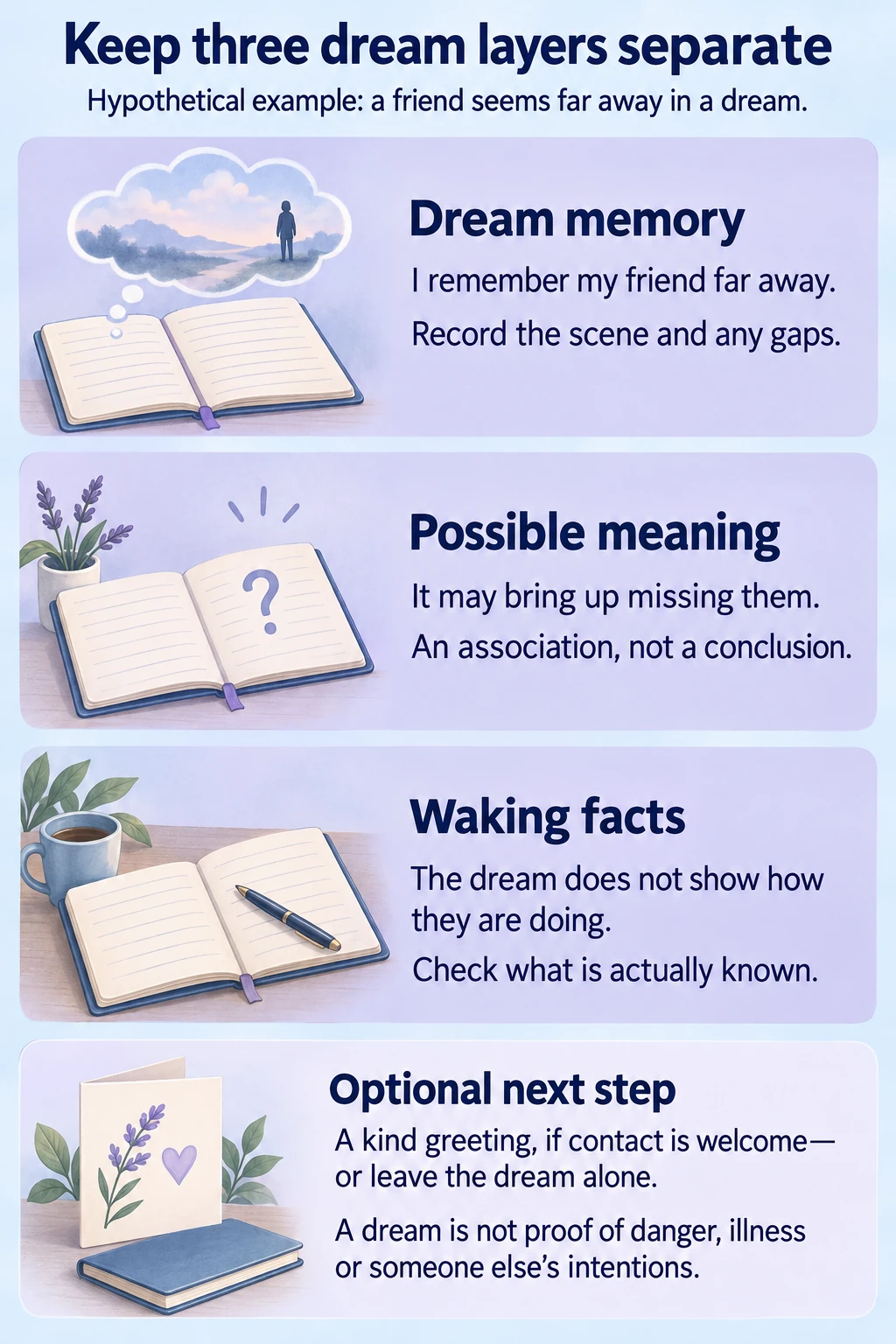
Read the three dream layers as text
Keep three dream layers separate. Hypothetical example: a friend seems far away in a dream.
- Dream memory: “I remember my friend far away.” Record the scene and any gaps.
- Possible meaning: “It may bring up missing them.” An association, not a conclusion.
- Waking facts: The dream does not show how they are doing. Check what is actually known.
Optional next step: A kind greeting, if contact is welcome—or leave the dream alone.
A dream is not proof of danger, illness or someone else’s intentions.
When nightmares need practical support
The NHS guidance on nightmares and night terrors explains that nightmares can be associated with stress, frightening experiences, medicines or sleep-related conditions. A nightmare is not evidence of a psychic attack.
The NHS suggests a relaxing bedtime routine and a sleep diary, and recommends medical advice when regular nightmares affect sleep and everyday life. Do not stop prescribed medicine because you suspect a dream-related effect; discuss concerns with the prescriber.
Take a break from interpretation if it increases fear. Qualified support and your spiritual beliefs can coexist.
Discussing a dream in a psychic reading
Ask for possibilities rather than certainty: “What associations could I reflect on?” or “What questions does this bring up for me?” A reader cannot verify that a dream predicts danger, establishes an illness or reveals another person’s private life.
Decline paid protection, cleansing or repeated bookings framed as necessary to prevent the dream coming true. You may disagree, keep details private or stop the session. Meaningful reflection should not become an obligation to buy reassurance.
Frequently asked questions
Does a vivid dream mean it is prophetic?
No. Vividness and emotional intensity do not establish that a dream predicts an event.
Does dreaming of death mean a death will happen?
No. It is not a reliable death or longevity prediction. A personal interpretation about change is optional, not a rule.
Do repeating nightmares prove a warning?
No. If they affect sleep or daily life, seek qualified advice rather than assuming a supernatural cause.
Must I interpret every dream?
No. You can record one, explore it gently or let it go. There is no message you are required to uncover.
Keep the mystery without carrying the fear
A dream can be a story, a creative prompt or a moment of spiritual curiosity. You can appreciate its meaning while leaving uncertain claims uncertain—and making waking-life choices with care.
Interpreting dreams as a form of health check while we are asleep is an intriguing concept. It might be worth paying more attention to what our dreams are trying to tell us.
Understanding dreams as metaphors for our state of mind makes sense. They might reveal what we are subconsciously experiencing.
Agreed. Dreams often reflect what’s going on in our lives, even if we don’t realize it while awake. It’s a different way to process emotions.
Indeed. The metaphorical representation in dreams can provide insights into our mental and emotional state, which is something we might overlook in our waking life.
The idea that dreams can symbolize aspects of our subconscious mind is quite fascinating. It offers a unique way to understand ourselves.
It’s interesting that dreams can sometimes predict future events or scenarios, leading to déjà vu experiences. This connection to future possibilities adds another layer to dream interpretation.
The article provides a balanced view of the potential meanings behind dreams. The connection to health, creativity, and future possibilities offers a well-rounded perspective on the topic.
Dreams as representations of our habits and inner desires through animal symbols is a compelling idea. It might reflect our deeper instincts and motivations.
The notion that dreams can signify the end of a life cycle rather than an actual death is a comforting interpretation. It emphasizes personal growth and transformation.
The link between creativity and dreams is well-documented. Many artists claim their best ideas come during sleep, which aligns with the article’s points.